Let’s be real for a second on AI and how to use it for your scholarship research.
Everyone is talking about AI right now. People use it for schoolwork, for writing, for planning, for almost everything. So it makes sense that students are also trying to use AI for scholarship research.
If you’ve been searching for scholarships recently, you’ve probably seen people say things like, “Just use AI, it makes everything easier.” And yes, AI can help. It can save time. It can explain confusing things. It can help you organise your thoughts.
But here’s the part nobody says clearly enough: AI can also mislead you if you don’t use it wisely. It does not replace real research. It does not replace official scholarship websites. And it definitely does not replace your own thinking.
So in this article, let’s talk about the honest way to use AI for scholarship research. What it’s good for. What it’s bad at. And how to use it without wasting time or making costly mistakes.
Scholarship Categories to Explore on ScholarWaka— Here are some key scholarship opportunities you should check out on ScholarWaka:



- Study Abroad: Study in USA | Study in Canada | Study in UK | Study in Europe | Study in Asia | Study in Australia | Study in Africa
- Scholarship Category: Undergraduate Scholarships | Postgraduate Scholarships | Masters Scholarships | PhD Scholarships | Diploma Scholarships | Competitions | High School Scholarships | Internships Scholarships | Training | Fellowships
What AI Is Actually Good At
AI works best as a support tool, not as your main source of information.
Here’s what it can help you with:
- Explaining confusing terms in simple language
(For example: “eligibility criteria,” “statement of purpose,” “transcript,” “referee”) - Summarising long scholarship descriptions so you can see the main points faster
- Helping you organise your research and create simple checklists
- Brainstorming better search ideas and keywords for Google
- Comparing two scholarships using the information you already have
- Breaking down complex requirements into clearer, simpler points
Used this way, AI saves time and reduces confusion.
What AI Is Not Good At
This is where many students make mistakes.
AI is not good at:
- Giving you accurate, up-to-date scholarship lists
- Replacing official scholarship websites
- Guaranteeing that information is correct
- Making decisions for you
- Understanding your full background, goals, or chances
Sometimes, AI can sound very confident and still be wrong. That’s why you should always treat it as a helper, not as the final authority.
Tips and Guide on Where to Get Fully Funded Scholarships in 2026. All on our YouTube Channel:
Smart Ways to Use AI for Scholarship Research
When used properly, AI can make your research easier and clearer.
One good way to use AI is to understand requirements. If you find a scholarship and the requirements look confusing, you can paste them into AI and ask for a simple explanation. This helps you understand what the scholarship is really asking for.
You can also use AI to break down eligibility criteria. For example, if a scholarship says applicants must show “leadership potential” or “academic excellence,” you can ask AI what these usually mean in practice and what kind of examples people often use.
AI is also useful for organising your research. You can ask it to help you create a simple checklist of what to check before applying for any scholarship. This helps you stay structured instead of feeling lost.
Another good use is comparing opportunities. If you already found two scholarships, you can ask AI to help you summarise the main differences between them based on the information you provide.
And of course, you can use AI to explain things you don’t understand. Terms like “referee,” “motivation letter,” or “transcript” can be confusing at first. AI can help explain them in simple words.
Common Mistakes Students Make When Using AI
Many students misuse AI without realising it. Here are some common mistakes:
- Copy-pasting AI answers without checking the original source
- Trusting AI more than the official scholarship website
- Using AI instead of thinking and understanding
- Using AI to write applications blindly
- Forgetting to verify deadlines, requirements, and eligibility details
These mistakes can cost you opportunities, even if your profile is good.
We get it, scholarship applications can feel overwhelming. That’s why we break them down clearly on YouTube, just for you.
A Simple and Safe Way to Combine AI and Real Research
The best approach is to use AI and real research together.
You can follow this simple flow:
- Start with AI to get clarity and understand what you’re looking for
- Go to Google and official scholarship websites to find real information
- Read the scholarship pages yourself
- Cross-check deadlines, requirements, and documents
- Save links and notes
- Use AI again to help summarise and organise what you found
This way, AI supports your work instead of replacing it.
Confused About Where and How to Start Securing Scholarships Abroad:
- Top 10 LinkedIn Accounts to Follow for Scholarship Opportunities
- Step-by-Step Guide to Securing Scholarships Abroad for Beginners
Here is an easy-to-follow guide for starting your scholarship application and crafting a compelling personal statement:
- How to Prepare A Scholarship Application – 5 Tips to Succeed
- How to Write a Personal Statement for Scholarship | Tips and Free Template
- Tips on How to Win a Scholarship
The Honest Truth About AI and Scholarships
Let’s be very clear:
- AI will not win you a scholarship
- AI will not fix a weak profile
- AI will not do the hard work for you
- AI will not guarantee success
What really matters is:
- Your preparation
- Your understanding of what you’re applying for
- Your documents
- Your story
- Your consistency
AI is just a tool. A useful one, yes. But still just a tool.
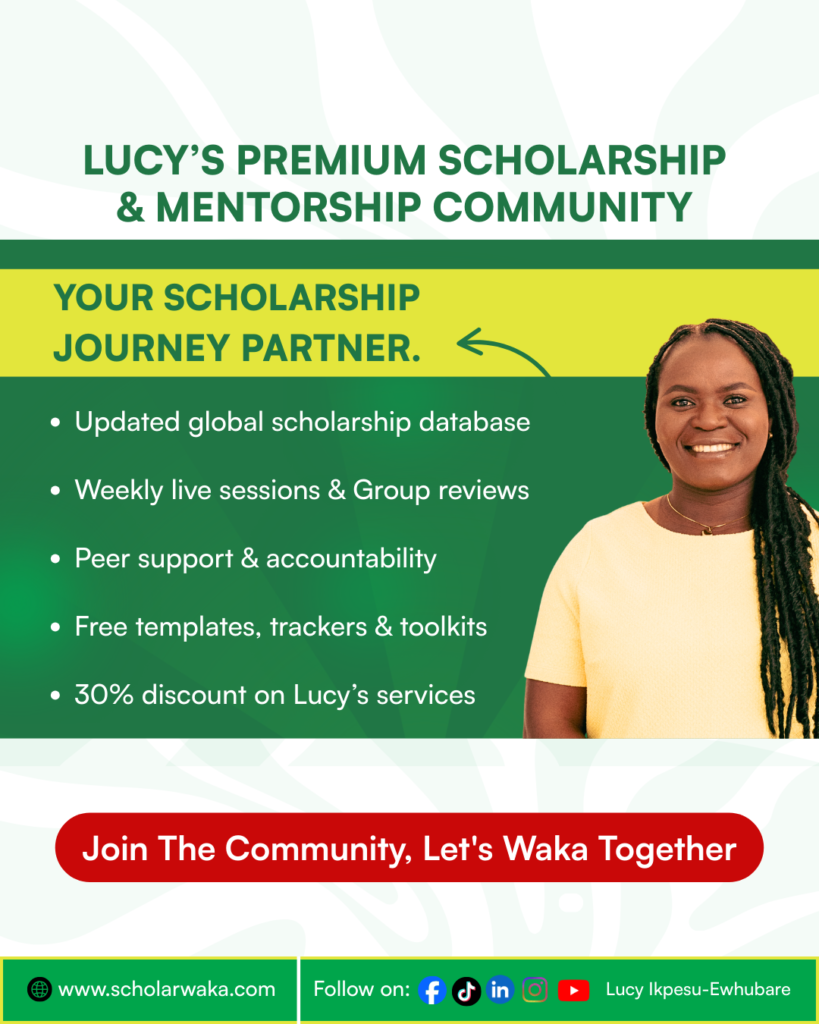
Join our Premium Scholarship & Mentorship Community
Receive the Latest Scholarship Updates through our Social Media Channels:
- Twitter: @ScholarWaka
- Instagram: @ScholarWaka
- LinkedIn: @ScholarWaka
- Facebook: @ScholarWaka
- YouTube: @Lucy Ikpesu-Ewhubare