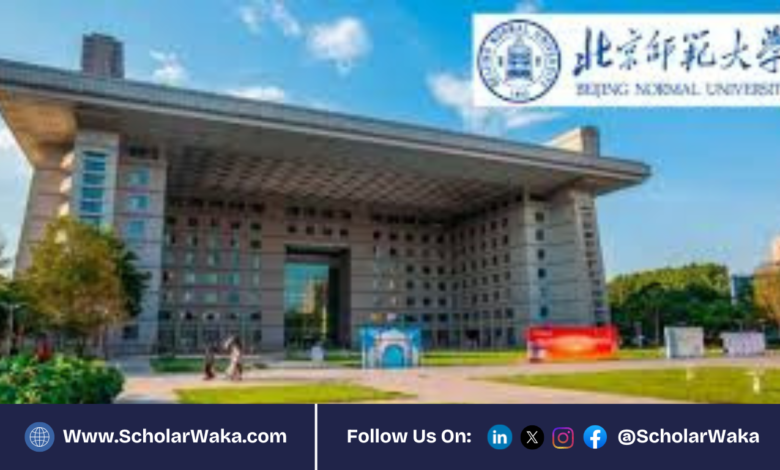
Chinese Government Scholarship at Beijing Normal University 2026

Somewhere between December and April each year, more than sixty thousand international students compete for one of China’s most consistently generous scholarship schemes — full tuition, a monthly stipend, and comprehensive medical insurance, funded directly by the Chinese Ministry of Education.
Also, Check Out: Top Fully Funded Master’s Scholarships in Europe
The 2026 cycle at Beijing Normal University closed its application window on March 15, 2026, and successful candidates from that round are now settling into their first academic year in Beijing. If you missed that window, the good news is that Beijing Normal University runs this scholarship on a predictable annual rhythm, and understanding exactly how BNU’s route compares to the scholarship’s other application channels will put you in a stronger position for the 2027 cycle than most applicants who apply cold.
Don’t Miss: Top Fully Funded Scholarships for International Students
Chinese Government Scholarship at Beijing Normal University Summary
| Scholarship Name ⇒ | Chinese Government Scholarship at Beijing Normal University |
| Host Country ⇒ | China |
| Study Level ⇒ | Undergraduate, Masters and PhD |
| Benefits ⇒ | Full tuition, free or subsidised accommodation, monthly stipend, comprehensive medical insurance |
| Funded by ⇒ | China Scholarship Council, hosted and recommended through Beijing Normal University |
| Eligible Countries ⇒ | All countries (non-Chinese citizens) |
| Application Deadline ⇒ | 2026 cycle closed March 15, 2026. The 2027 cycle is expected to open around December 2026, with BNU’s deadline historically falling in early-to-mid March |
Why Beijing Normal University’s Route Is Worth Understanding
The Chinese Government Scholarship, often shortened to CSC, is not a single application process — it runs through three distinct channels, and which one you use significantly changes your odds and your workload. Type A is the Embassy or Bilateral Programme, where you apply through the Chinese embassy in your home country and compete against a small, fixed quota allocated to that country. Type C runs through provincial governments in places like Beijing, Shanghai, Jiangsu, and Zhejiang. Type B, the route Beijing Normal University uses, is the University Programme — you apply directly to BNU, which reviews your academic profile and recommends a shortlist of candidates to the China Scholarship Council for final approval.
Also Read: How to Write a Personal Statement for Scholarship | Tips and Free Template
For most international applicants, Type B is the more accessible of the three. You’re not competing within a narrow national quota set by your embassy; you’re being evaluated on your fit for BNU’s specific programmes, with the university itself acting as your advocate in the CSC’s final review. BNU holds agency number 10027 within the CSC system, a detail you’ll need at the exact point of registration, and it’s worth having it ready before you start your application rather than hunting for it mid-form.
Eligibility Requirements
Beijing Normal University applied a tiered set of criteria depending on the degree level you’re applying for, alongside conditions that applied across all applicants:
- You must meet BNU’s own admission requirements for your chosen programme, separate from the CSC’s baseline scholarship criteria
- You must not be currently holding any other scholarship at the time of application — CSC scholarships cannot be combined with other funding from the Chinese government or elsewhere
- Undergraduate applicants must be high school graduates and must not be older than 25 years of age
- Master’s applicants must hold a bachelor’s degree and must not be older than 35 years of age
- Doctoral applicants must hold a master’s degree and must not be older than 40 years of age
- You must meet whatever language requirement applies to your chosen programme — some BNU programmes are taught in Chinese, others in English, and the required proficiency certificate depends entirely on which track you’re admitted into
One detail worth being precise about: BNU does not offer preparatory Chinese language courses ahead of enrolment, which means if your target programme is Chinese-taught and your Chinese isn’t yet at the required level, you’ll need to close that gap independently before applying rather than counting on the university to bridge it for you.

What the Scholarship Covers
The Chinese Government Scholarship is one of the more comprehensively funded international scholarships available anywhere, and the coverage breaks down as follows:
- Full tuition fees for the complete duration of your programme, matched to the standard length of your specific degree
- Accommodation, either through a free university dormitory placement or an accommodation subsidy, depending on availability and your specific programme
- A monthly living stipend, which under the broader CSC scheme has historically ranged between roughly 2,500 and 3,500 RMB depending on your degree level, with doctoral candidates typically receiving the higher end of that range
- Comprehensive medical insurance for the duration of your studies in China, covering standard healthcare needs while you’re enrolled
Because BNU’s coverage sits within Type B of the broader CSC scheme, the exact stipend figure for your specific admission year should be confirmed directly with BNU’s International Students Office once you’re shortlisted, since amounts are periodically adjusted by the China Scholarship Council.
Required Documents
BNU’s documentation list is one of the more extensive among Chinese university scholarship applications, and several items — particularly the physical examination form and the non-criminal record certificate — take longer to obtain than applicants typically expect:
- Completed Chinese Government Scholarship application form
- Valid passport copy
- Highest academic diploma or degree certificate already earned
- Official academic transcripts
- Language proficiency certificate matching your programme — HSK for Chinese-taught programmes, or IELTS/TOEFL for English-taught programmes
- CSCA score report, required specifically for undergraduate applicants
- A study plan or research proposal outlining your intended focus at BNU
- One or more recommendation letters
- A portfolio, for applicants to arts or design programmes only
- Guardian documentation, required only for applicants under 18
- Foreigner Physical Examination Form, completed through an approved medical facility
- Certificate of Non-Criminal Record
Start the physical examination and non-criminal record certificate early. Both typically require scheduling through specific approved providers in your home country, and delays with either of these two documents have historically cost otherwise-qualified applicants their place in the review timeline.
How to Apply for the Next BNU Cycle
The process BNU uses has stayed consistent across recent cycles, which makes it worth committing to memory ahead of the 2027 window:
- Apply for admission through Beijing Normal University’s International Student Application System, since BNU’s own admission and the CSC scholarship application are handled as two connected but distinct steps.
- Register separately on the China Scholarship Council’s online system and select the Type B, University Programme application category.
- Enter Beijing Normal University’s agency number, 10027, at the point of registration — using the wrong agency number is a common and entirely avoidable mistake.
- Complete, print, and physically sign the Chinese Government Scholarship application form, since a signed copy is a formal requirement of the process.
- Assemble every required document listed above, with certified translations where your originals aren’t in Chinese or English.
- Submit the complete application package to Beijing Normal University ahead of the announced deadline, since BNU has previously stated that late paper documentation is treated as an abandoned application rather than reviewed with an extension.
Application Deadline
The 2026 cycle at Beijing Normal University closed on March 15, 2026. Looking at BNU’s recent history, the university’s deadline fell around March 10 for the 2025 cycle and March 15 for 2026, which is earlier than the broader CSC window of December through April that applies across all 290-plus participating Chinese universities.
Based on that pattern, applicants should expect the 2027 cycle to open around December 2026, with BNU’s specific deadline likely landing in early-to-mid March 2027 rather than at the later end of the CSC’s general window. Confirm the exact date directly through BNU’s International Students Office once the 2027 cycle is officially announced, since university-specific deadlines are set independently of the CSC’s general timeline.
Frequently Asked Questions
Is the Chinese Government Scholarship at Beijing Normal University still open for 2026?
No. The 2026 cycle closed on March 15, 2026. Based on BNU’s recent application history, the 2027 cycle is expected to open around December 2026.
What’s the difference between applying through BNU and applying through my country’s embassy?
Applying through BNU uses the Type B, University Programme route, where the university reviews and recommends your application directly to the China Scholarship Council. Applying through your embassy uses Type A, the Bilateral Programme, which competes within a fixed quota allocated to your specific country. For most applicants, the university route offers a more direct and often more accessible path.
Can Nigerian and other African students apply for this scholarship?
Yes. The scholarship is open to all countries, and CSC scholarships are among the most widely accessed fully funded opportunities by African students applying to study in China.
Do I need to speak Chinese to study at Beijing Normal University under this scholarship?
Not necessarily. BNU offers both Chinese-taught and English-taught programmes. Your language requirement depends entirely on which programme you’re admitted into, though BNU does not provide preparatory Chinese language courses, so any language gap for Chinese-taught programmes needs to be closed independently beforehand.
How much is the monthly stipend under this scholarship?
Under the broader CSC scheme, monthly stipends have generally ranged between approximately 2,500 and 3,500 RMB depending on degree level, with the exact figure for your admission year confirmed directly by BNU once you’re shortlisted.
Can I hold this scholarship alongside another one?
No. Applicants must not be holding any other scholarship at the time of application, and CSC scholarships cannot be combined with other Chinese government or university funding.
Disclaimer: All programme details, deadlines, and eligibility criteria in this post were verified from official sources as of August 2026. Information is subject to change without notice. Always confirm the latest details directly with Beijing Normal University’s International Students Office or the China Scholarship Council before submitting your application. ScholarWaka is not affiliated with Beijing Normal University or the China Scholarship Council.
Official Application Portal
Join ScholarWaka Community
Get the latest scholarship updates and study abroad opportunities before anyone else.