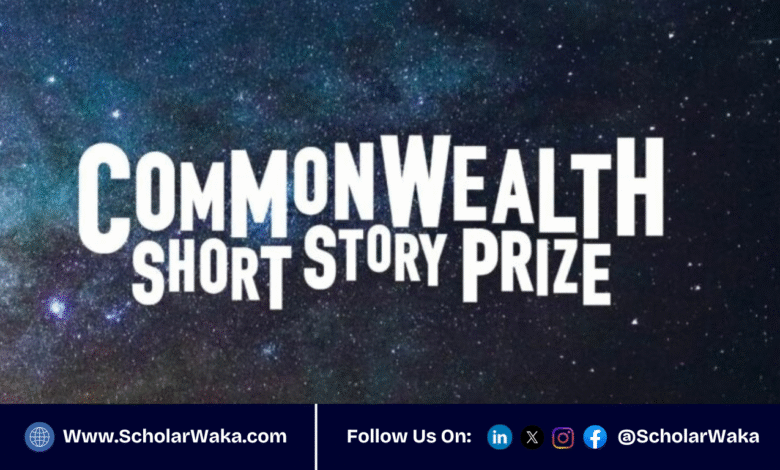
Nearly 7,806 stories. Fifty-four countries. Twenty-five names on the shortlist. And in the end, one winner: “The Serpent in the Grove” by Jamir Nazir of Trinidad and Tobago, representing the Caribbean region, took the overall 2026 prize following an announcement in late June.
Also, Check Out: Top Fully Funded Master’s Scholarships in Europe
The application window for this cycle closed back on November 1, 2025, and the entire competition — shortlisting in April, regional winners in May, the overall winner in June — has now fully played out. If you’re a writer weighing whether to submit to the 2027 cycle, here’s a genuinely detailed look at how this competition actually works, drawn directly from what just happened.
Don’t Miss: Top Fully Funded Scholarships for International Students
The World’s Most Linguistically Open Literary Prize
The Commonwealth Short Story Prize, run by the Commonwealth Foundation, has built a reputation over more than a decade as arguably the most linguistically accessible major literary competition in the world. Beyond English, the prize accepts entries written in Bengali, Chinese, Creole, French, Greek, Malay, Maltese, Portuguese, Samoan, Swahili, Tamil, and Turkish — a genuinely unusual level of multilingual openness for an international literary award of this scale. The 2026 cycle put that openness on full display: two of the 25 shortlisted stories were originally written in Bengali and Malay, and the shortlist itself included John Edward DeMicoli, the first Maltese writer ever shortlisted in the prize’s history.
Also Read: How to Write a Personal Statement for Scholarship | Tips and Free Template
The judging structure reflects that same regional and cultural breadth. Each year, five judges — one representing each of the prize’s five regions: Africa, Asia, Canada and Europe, the Caribbean, and the Pacific — sit under an overall Chair of Judges, a role held for 2026 by award-winning British novelist and dramatist Louise Doughty. Judges assess entries within their own region first, but then read and discuss stories from every region together before finalizing decisions, ensuring the eventual overall winner is chosen through genuine cross-regional comparison, not simply the strongest of five separately-judged pools.
Commonwealth Short Story Prize Summary
| Scholarship Name ⇒ | Commonwealth Short Story Prize |
| Host Country ⇒ | UK |
| Study Level ⇒ | Competitions |
| Benefits ⇒ | Up to £5,000 |
| Funded by ⇒ | Commonwealth Foundation |
| Eligible Countries ⇒ | All Commonwealth countries |
| Application Deadline ⇒ | 2026 cycle closed November 1, 2025. Full results were announced through 2026: shortlist in April, regional winners May 13, overall winner late June. The 2027 cycle is expected to open with a similar autumn deadline |
Eligibility Requirements
To be eligible for the Commonwealth Short Story Prize, applicants generally need to meet the following:
- You must be a citizen of a Commonwealth country, or a stateless person currently residing in a Commonwealth nation
- You must be 18 years or older as of the entry deadline
- Your entry must be original and genuinely unpublished, in any language, before the prize’s stated publication cutoff for that cycle
- The prize is open to short fiction in any genre — literary, speculative, historical, or otherwise — provided it’s genuinely fiction rather than nonfiction or memoir
- Your story must fall between 2,000 and 5,000 words
- Entries can be submitted in English or in any of the prize’s approved Commonwealth languages, provided an English translation accompanies non-English submissions
- Co-authored or jointly written stories are not accepted — this is a prize for individual authorship only
- Your name must not appear anywhere on the story document itself, since judging is conducted anonymously to ensure fairness
For the 2026 cycle specifically, shortlisted writers ranged in age from 25 to 68, and the final shortlist included 11 men and 14 women — reflecting the prize’s genuinely broad reach across both age and gender rather than skewing toward any particular demographic of writer.
What the Prize Provides
- £5,000 for the overall winner, selected from among the five regional winners
- £2,500 for each of the four remaining regional winners — Africa, Asia, Canada and Europe, the Caribbean, and the Pacific each produce one regional winner, with the strongest of the five going on to become the overall winner
- Additional prize money for the translator, in the specific case where the winning story was originally written in a language other than English and later translated
- Genuine international recognition, as part of what the Commonwealth Foundation describes as the largest and most globally representative prize of its kind, with the 2026 cycle alone drawing entries from 54 of the Commonwealth’s 56 member countries

Required Documents
The Commonwealth Short Story Prize—administered annually by the Commonwealth Foundation—is a free-to-enter global award for unpublished short fiction (2,000 to 5,000 words). Because entries are processed through a competitive, multi-regional screening panel, strict submission guidelines and technical formatting rules are enforced.
Completed Online Entry Form:
- Submission Portal: Submissions are accepted exclusively via the Commonwealth Foundation online entry portal during the open window.
- Author Data: Captures your legal name, contact details, Commonwealth country of citizenship or permanent residence, and year of birth (entrants must be $\ge 18$ years old).
2. Short Story Manuscript File:
- Format & Naming: Uploaded as a PDF or Microsoft Word document (
.docor.docx). The file must be saved using the exact title of the story as the file name (e.g.,The_Harvest_Moon.pdf), avoiding generic names like “Short Story” or “Commonwealth Entry”. - Word Count Limits: Must strictly be between 2,000 and 5,000 words (excluding the title).
- Header/First Page: The first page of the document must display the story title and exact word count.
3. Approved Language & Translation Documents:
- English Entries & Approved Languages: Submissions are accepted in English or in select approved languages (e.g., Bengali, Chinese, Creole, French, Greek, Malay, Maltese, Portuguese, Samoan, Swahili, Tamil, and Turkish).
- Translated Entries: If submitting an English translation of a story written in another language, the translation must be submitted by the original writer (not the translator), and the translator must also hold citizenship in a Commonwealth country.
4. Anonymity & Blind Judging Rules (Strict Disqualification Risk):
Zero Personal Markers: To preserve anonymous judging, your name, email address, biographical details, or identifying markers must not appear anywhere inside the manuscript file or headers/footers. All personal details are stored separately via the online portal form.
5. Proof of Commonwealth Citizenship / Residency (Upon Selection):
Verification: Entrants are not required to upload passport scans at the initial submission step, but proof of citizenship or legal residence (e.g., valid passport or national ID) is formally requested by the Foundation if your entry is shortlisted or selected for a regional award.
6. Optional Author Biography:
Format: A short 50-to-100-word biographical statement submitted directly into the designated text field on the online portal form (never included within the uploaded story document).
How to Apply for the Next Cycle
The 2026 cycle has fully concluded, but the Commonwealth Foundation runs this prize on a consistent annual calendar:
- Watch the Commonwealth Foundation’s official prize website for the opening of the 2027 entry window, historically opening in the latter half of the year.
- Read the full rules and guidelines carefully before drafting your entry, paying particular attention to the anonymity requirements, since a name accidentally left in your document can disqualify an otherwise strong entry.
- Write and refine your story within the strict 2,000-to-5,000-word range, in any fiction genre.
- If writing in a language other than English, prepare a complete, accurate English translation alongside your original.
- Format your document precisely according to the prize’s specifications — Arial 12-point font, double line spacing, numbered pages, and no identifying information anywhere in the text.
- Submit your entry through the official online entry form before the stated deadline, historically falling around November 1.
- Watch for an email confirmation acknowledging receipt of your entry, and retain your entry submission number for any future correspondence with the Foundation.
Application Deadline
The 2026 cycle’s entry deadline was November 1, 2025. The full competition timeline that followed ran: shortlist announcement on April 14, 2026 (25 writers from 14 countries, selected from 7,806 entries); regional winners announced May 13, 2026; and the overall winner announced in late June 2026. Based on this consistent annual structure, the 2027 cycle is expected to open with a similar entry window later in 2026, closing again around November 1.
Frequently Asked Questions
Is the Commonwealth Short Story Prize still accepting entries for 2026?
No. The 2026 cycle’s deadline was November 1, 2025, and the entire competition has concluded, with the overall winner announced in late June 2026.
Who won the 2026 Commonwealth Short Story Prize?
Jamir Nazir of Trinidad and Tobago won the overall prize with “The Serpent in the Grove,” representing the Caribbean region. The other 2026 regional winners were Lisa-Anne Julien (South Africa, Africa), Sharon Aruparayil (India, Asia), John Edward DeMicoli (Malta, Canada and Europe), and Holly Ann Miller (New Zealand, Pacific).
Is there an entry fee?
No. The prize is free to enter.
Can I submit a story I co-wrote with someone else?
No. Co-authored or jointly written stories are not accepted — entries must represent individual authorship.
Does my story need to be written in English?
No. Entries can be submitted in any of the prize’s approved Commonwealth languages — including Bengali, Chinese, Creole, French, Greek, Malay, Maltese, Portuguese, Samoan, Swahili, Tamil, and Turkish — provided an English translation accompanies the submission.
How competitive is this prize really?
Very. The 2026 cycle drew 7,806 entries from 54 Commonwealth countries, narrowed to a shortlist of just 25 writers, and ultimately five regional winners and one overall winner.
Disclaimer: All programme details and results in this post were verified from official and independent sources as of August 2026. Information is subject to change without notice. Always confirm the latest details directly on the Commonwealth Foundation’s official prize website before applying. ScholarWaka is not affiliated with the Commonwealth Foundation.
Official Application Portal
Join ScholarWaka Community
Get the latest scholarship updates and study abroad opportunities before anyone else.