Danish Government Scholarship 2026 | How to Apply

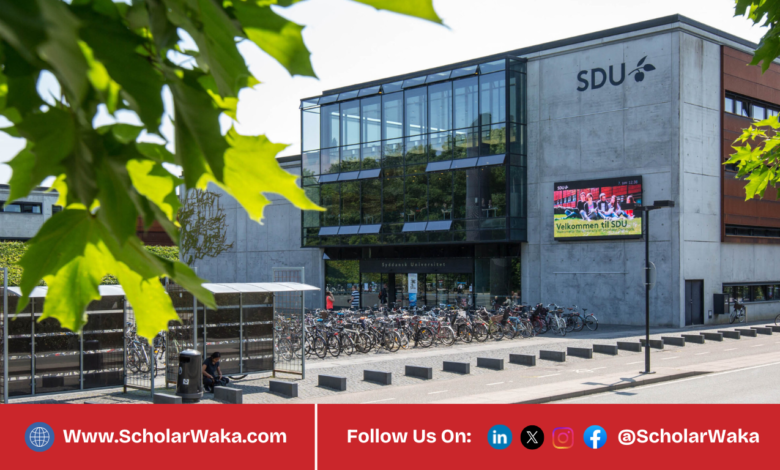
The Danish Government Scholarship at the University of Southern Denmark (SDU)—funded by the Danish Ministry of Higher Education and Science—is a highly competitive, merit-based award targeted at high-achieving non-EU/EEA international students. A major operational detail frequently overlooked in standard university summaries is the dual-layer nature of the Master’s level funding package: beyond a 100% full tuition fee waiver, Master’s recipients are awarded a direct monthly living grant of DKK 3,000 (before taxes) throughout the academic term to help offset Denmark’s high cost of living.
Also, Check Out: Top Fully Funded Master’s Scholarships in Europe
Applications for the recent 2026 intake cycle officially closed following the February 1 deadline for Master’s applicants and the March 15 deadline for Bachelor’s applicants. Looking ahead, SDU operates on fixed, predictable admissions schedules: the next intake deadlines are confirmed for February 1, 2027 (Master’s level) and March 15, 2027 (Bachelor’s level). Because scholarship consideration is entirely integrated into the standard university admissions process, no separate scholarship application form is required—candidates are automatically evaluated based on academic merit upon applying for an eligible degree program.
Don’t Miss: Top Fully Funded Scholarships for International Students
A Merger University With Real International Ambition
The University of Southern Denmark was established in 1998 through the merger of Odense University, the Southern Denmark School of Business and Engineering, and the South Jutland University Centre, and has since grown into a broad research university with campuses spanning Odense, Sønderborg, Esbjerg, Kolding, and Vejle. SDU currently ranks among the world’s top 50 universities on several major international rankings, and this scholarship reflects a deliberate strategy to draw strong non-EU/EEA students specifically into its engineering and technology programmes at two smaller regional campuses — Sønderborg and Vejle — rather than its larger Odense hub.
Also Read: How to Write a Personal Statement for Scholarship | Tips and Free Template
The scholarship is administered by SDU directly rather than through a separate national body, and it’s explicitly restricted to a narrow, specific list of programmes rather than open across the university broadly — a structure worth understanding before you invest time researching SDU generally, since only a handful of specific degrees actually carry this funding.
Danish Government Scholarship Summary
| Scholarship Name ⇒ | Danish Government |
| Host Country ⇒ | Denmark |
| Study Level ⇒ | Undergraduate and Masters |
| Benefits ⇒ | Full or partial tuition fee waiver, plus a DKK 3,000/month living grant for Master’s recipients |
| Funded by ⇒ | University of Southern Denmark (SDU) |
| Eligible Countries ⇒ | All non-EU/EEA countries |
| Application Deadline ⇒ | 2026 cycle closed — Master’s: February 1, 2026; Bachelor’s: March 15, 2026. Confirmed 2027 deadlines: Master’s: February 1, 2027; Bachelor’s: March 15, 2027 |
What the Danish Government Scholarship Covers
The Danish Government Scholarship at the University of Southern Denmark (SDU) provides targeted tuition relief and living support for non-EU/EEA international students. However, the award is subject to strict academic performance thresholds, credit caps, and tiered allocation structures that dictate how funds are maintained across your degree tenure.
1. Financial Tiers & Full vs. Partial Waivers
The scope of financial support varies depending on whether you are admitted to a Bachelor’s or Master’s program and the specific funding tier allocated to your application:
- Full Tuition Fee Waiver (100% Coverage): Covers the complete international tuition fees across the standard nominal duration of the program—3 years (180 ECTS) for Bachelor’s degrees and 2 years (120 ECTS) for Master’s degrees.
- Master’s Monthly Living Grant: Master’s-level recipients awarded a full waiver also receive a direct monthly stipend of DKK 3,000 (before tax). Distributed across the academic year, this grant helps offset housing and living expenses in Denmark.
- Partial Tuition Waiver Alternative: Depending on faculty quotas and ranking, SDU may grant a partial tuition waiver. Under this structure, the scholarship specifically covers tuition fees for the 2nd and 4th semesters (30 ECTS each). The student remains personally responsible for paying the full international tuition fees for the 1st and 3rd semesters.
2. Strict 30 ECTS Semester Credit Cap
Scholarship waivers are strictly calibrated to the standard full-time academic workload:
- Standard Coverage: The waiver pays for up to 30 ECTS credits per semester.
- Out-of-Pocket Excess Credits: If you choose to register for additional electives, retake courses, or take extra modules exceeding 30 ECTS in a single semester, the scholarship will not cover those additional credits. You will be billed per credit hour for any ECTS taken above the 30-credit limit based on SDU’s standard per-credit international tuition rates.
3. Ongoing Academic Performance Thresholds
Continued funding is not guaranteed upon admission; it is contingent on maintaining satisfactory academic progress throughout every term:
- The 20 ECTS Progress Requirement: To retain your tuition waiver and monthly grant, you must successfully pass a minimum of 20 out of your 30 ECTS credits every semester.
- Consequences of Academic Deficit: If your passed credits fall below this threshold, your scholarship is subject to immediate review and potential cancellation for subsequent semesters. Losing the scholarship converts your enrollment status to self-funded, requiring you to pay standard international tuition rates out of pocket to continue studying.
Eligible Programmes
This scholarship is restricted specifically to the following degrees:
Master’s programmes, Sønderborg campus:
- MSc in Engineering – Electronics/Electrical Engineering
- MSc in Engineering – Mechanical Engineering
- MSc in Engineering – Mechatronics
Bachelor’s programmes, Vejle campus:
- BSc in Artificial Intelligence
- BSc in Computer Science
- BSc in Interactive Technology Engineering
- BSc in Software Engineering

Eligibility Requirements
To qualify for the SDU Danish Government Scholarship, applicants generally need to meet the following:
- You must be a non-EU/EEA citizen
- You must apply for admission to one of the specific approved programmes listed above
- You must not be eligible for the Danish State Grant (SU) — this scholarship exists specifically for students who wouldn’t otherwise qualify for Danish state support
For Bachelor’s applicants specifically:
- You must apply for admission by March 15
- You must take SDU’s online admission test, uniTEST
- You must be ready to attend an online interview if shortlisted, historically held in early June
For Master’s applicants specifically:
- You must submit your admission application by February 1 — this deadline applies even if you already hold a Danish residence permit
- Your application must be genuinely complete at the time of submission, with no documents outstanding that SDU would need to request afterwards
- Your chosen SDU Master’s programme must be your first-choice preference, if you’ve applied to more than one programme elsewhere
- If shortlisted, interviews are historically held online from February 19 onward
Priority consideration is given to applicants from: the USA, Great Britain, Japan, Singapore, Australia, Canada, India, Brazil, Malaysia, Montenegro, Serbia, North Macedonia, Albania, Ukraine, and Moldova — though applicants from other non-EU/EEA countries remain eligible to apply.
Required Documents
Because scholarship consideration for the Danish Government Scholarship at SDU is automatically integrated into the general degree admission process, candidate portfolios are audited directly by faculty admission boards. Applications are evaluated based on academic GPA, course alignment, and verified language abilities.
All materials must be uploaded directly to Denmark’s digital portals for Bachelor’s applicants and SDU’s DANS (Digital Application System) portal for Master’s applicants. Documents submitted via email or physical post are immediately discarded without processing.
1. Bachelor’s Level Application Dossier
- Upper Secondary / High School Credentials: Official high school diploma and complete final transcripts equivalent to the Danish upper secondary school leaving certificate. Must prove specific course-level completion in key subjects (e.g., Mathematics, Physics, or English) mapped to Danish Levels A, B, or C.
- Valid Foreign Passport: High-resolution color scan of your valid passport bio-page used for fee status assessment, identity verification, and generation of the ST1 Danish residence permit application.
- Proof of Application Fee Payment (€200): Non-EU/EEA applicants must pay a non-refundable EUR 200 application fee via SDU’s payment gateway and upload the NETS transaction receipt directly to Optagelse.dk. (Note: If offered admission, this fee is deducted from your first tuition installment).
- Statement of Hours / Course Syllabus (If Requested): A breakdown of total contact hours per subject during secondary school to confirm fulfillment of minimum subject hour requirements.
2. Master’s Level Application Dossier
- Application Deposit Fee Receipt (€200): Official email transaction receipt for the mandatory EUR 200 fee. Applications missing this receipt at the time of the February 1 deadline are rejected automatically.
- Official Bachelor’s Transcripts & Diploma:
- Certified degree certificate and full academic transcripts issued in English, Danish, Swedish, or Norwegian. Documents in any other language require official, certified translations alongside the original language documents.
- Graduating Applicants: If you have not yet completed your Bachelor’s degree, you must submit an official temporary transcript showing all passed courses to date, alongside an official statement from your home university confirming your expected graduation date.
- Detailed Course Descriptions / Syllabi:
- An official, detailed syllabus catalog covering every course listed on your Bachelor’s transcript.
- Must explicitly detail course topics, learning objectives, textbooks used, and ECTS (or local credit/contact hour) allocations to verify prerequisite coverage.
- SDU Pre-Assessment / Self-Assessment Form:
- Mandatory for technical programs like MSc in Mechatronics and MSc in Electronics.
- Applicants must download SDU’s official mapping template and manually match their previous university coursework against required foundational ECTS categories: Mechanical Design/3D CAD (10 ECTS), Mathematics (15 ECTS), Embedded Programming (5 ECTS), Control Theory (5 ECTS), Analog/Digital Electronics (5 ECTS), and Machine Learning/Statistics (5 ECTS).
- Proof of English Language Proficiency:
- SDU requires verification of English proficiency equivalent to Danish English B2/C1 levels.
- Accepted Standards: IELTS Academic (minimum overall score 6.5) or TOEFL iBT (minimum score 88–90). Test scores must be sent digitally by the testing provider directly to SDU or uploaded before the document deadline.
How to Apply for the Next Cycle
The 2026 window is closed, but SDU has already confirmed exact 2027 dates:
- Choose one of the specific eligible programmes — three Master’s options in Sønderborg, or four Bachelor’s options in Vejle.
- Apply for admission through SDU’s official online application portal well ahead of your track’s confirmed deadline — February 1, 2027, for Master’s, or March 15, 2027, for Bachelor’s.
- Upload every required document at the time of submission — for Master’s applicants especially, an incomplete application at submission is a disqualifying issue, not something correctable afterwards.
- Bachelor’s applicants should prepare for and complete the uniTEST admission test as part of the process.
- If shortlisted, prepare for an online interview — historically early June for Bachelor’s applicants, or from February 19 onward for Master’s applicants.
- Wait for SDU’s final scholarship decision — there’s no separate scholarship application required, since admission and scholarship consideration happen together automatically.
- If awarded, track your ECTS credit progress carefully each semester, since maintaining a pass rate of at least 20 out of 30 ECTS is required to keep the scholarship active.
Application Deadline
For the 2026 intake, the Master’s deadline was February 1, 2026, and the Bachelor’s deadline was March 15, 2026 — both now closed. SDU has already confirmed the following cycle’s dates precisely: February 1, 2027, for Master’s applicants, and March 15, 2027, for Bachelor’s applicants, both for September 2027 entry. This level of advance confirmation is genuinely useful, giving prospective applicants a firm target to plan their document preparation around well in advance.
Frequently Asked Questions
Is the SDU Danish Government Scholarship still accepting applications for 2026?
No. Both the Master’s deadline (February 1, 2026) and the Bachelor’s deadline (March 15, 2026) have passed. The confirmed 2027 deadlines are February 1, 2027, and March 15, 2027, respectively.
Do Master’s recipients get a living stipend, or just a tuition waiver?
Both. Master’s-level recipients receive a full tuition fee waiver plus a monthly living grant of DKK 3,000 before tax — a detail often left out of shorter summaries of this scholarship.
Is this scholarship available for any SDU programme?
No. It’s restricted to three specific Master’s engineering programmes in Sønderborg and four specific Bachelor’s technology programmes in Vejle — not SDU’s broader course catalogue.
Do I need to submit a separate scholarship application?
No. Applying for admission to one of the eligible programmes automatically enters you into scholarship consideration — there’s no standalone scholarship form.
What happens if I fail too many credits during my degree?
You risk losing the scholarship. You must pass at least 20 out of 30 ECTS credits each semester to retain your funding — this is an ongoing requirement throughout your studies, not just an admission criterion.
Can I receive this scholarship if I’m eligible for Danish state financial aid (SU)?
No. Applicants who qualify for the Danish State Grant are explicitly excluded from receiving this scholarship instead.
Disclaimer: All programme details, deadlines, and eligibility criteria in this post were verified from official sources as of August 2026. Information is subject to change without notice. Always confirm the latest details directly on the University of Southern Denmark’s official scholarships page before applying. ScholarWaka is not affiliated with the University of Southern Denmark.
Official Application Portal
Join ScholarWaka Community
Get the latest scholarship updates and study abroad opportunities before anyone else.