Erasmus Mundus Excellence in Analytical Chemistry (EACH) Scholarship 2026

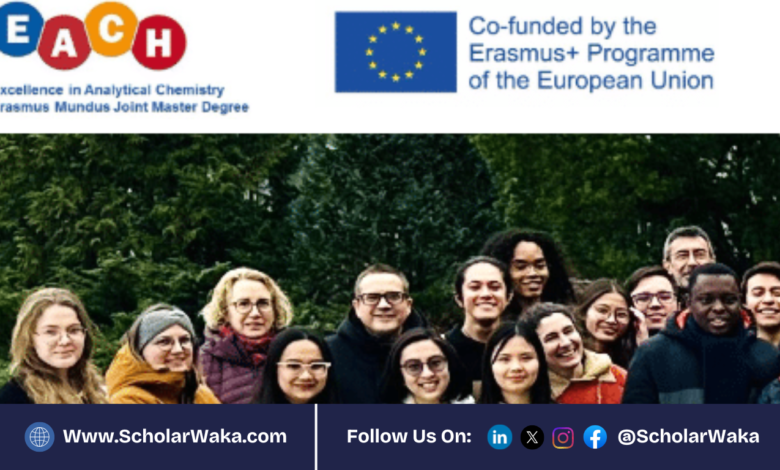
A common point of confusion among applicants involves the two distinct intake periods for the Erasmus Mundus Joint Master’s Degree in Excellence in Analytical Chemistry (EACH). ONLINE scholarship boards frequently treat Admission Period 1 and Admission Period 2 as interchangeable application attempts, but they operate under vastly different funding frameworks.
Also, Check Out: Top Fully Funded Master’s Scholarships in Europe
Only Admission Period 1 (which ran from November 5, 2025, through January 5, 2026) considers candidates for the fully funded Erasmus Mundus scholarship. Admission Period 2 (which closed on February 5, 2026) was established strictly for candidates seeking a partial tuition waiver or a self-funded, fee-based study place. Selection outcomes were formally released on March 6, 2026 for Period 1 and April 7, 2026 for Period 2. Prospective scholars targeting the upcoming 2027–2029 intake must target the first deadline exclusively if they require complete financial coverage.
Coordinated by the University of Tartu (Estonia) alongside a consortium of top European institutions—Uppsala University (Sweden), University Claude Bernard Lyon 1 (France), and Åbo Akademi University (Finland)—EACH is a two-year, 120 ECTS Joint Master’s program designed to train world-class specialists in modern analytical techniques, sensors, microfluidics, and industrial quality management.
Don’t Miss: Top Fully Funded Scholarships for International Students
Erasmus Mundus EACH Scholarship Summary
| Scholarship Name ⇒ | Erasmus Mundus Excellence in Analytical Chemistry (EACH) |
| Host Country ⇒ | Multiple Countries |
| Study Level ⇒ | Masters |
| Benefits ⇒ | Erasmus Mundus scholarship (tuition, ~€1,400/month, travel, insurance) — Admission Period 1 only |
| Funded by ⇒ | University of Tartu (coordinator), Uppsala University, Université Claude Bernard Lyon 1, Åbo Akademi University |
| Eligible Countries ⇒ | All countries |
| Application Deadline ⇒ | Admission Period 1 (Erasmus Mundus scholarship): closed January 5, 2026, results by March 6, 2026. Admission Period 2 (tuition waiver/fee-based only): closed February 5, 2026, results by April 7, 2026 |
A Genuinely Multi-Country Degree, Not Just a Multi-Country Application
EACH is coordinated by the University of Tartu in Estonia, in partnership with Uppsala University in Sweden, Université Claude Bernard Lyon 1 in France, and Åbo Akademi University in Finland. Every student spends their first year at Tartu, building foundational expertise in analytical chemistry, metrology, and laboratory technique, before moving to one of the three partner universities for a specialized second year. Tartu itself is a genuinely strong host institution, ranking among the top 350 universities worldwide according to recent Times Higher Education rankings.
Also Read: How to Write a Personal Statement for Scholarship | Tips and Free Template
What’s worth understanding clearly is that your second-year location isn’t simply your own choice — it’s determined through a competitive process weighing both your stated preference and your academic performance during your first semester at Tartu. This means your actual specialization track (Sweden’s electroanalytical and materials focus, France’s industrial process control focus, or Finland’s sensor and nanotechnology focus) is earned partly through performance after you’ve already started the programme, not locked in at the point of admission. Graduates leave with a genuine double degree — one from Tartu, and a second from whichever partner university hosted their second year.
What Selection Actually Weighs Most Heavily
This is worth knowing clearly: EACH’s admissions team has stated that, beyond the baseline academic and credit requirements, the motivation letter is the document examined most closely. It should specifically address two things — your previous study and work experience (including your actual responsibilities if you worked as part of a team, described honestly rather than inflated), and a genuinely self-critical account of your current limits in analytical knowledge and skills relative to your intended future job. Applicants with relevant lab experience, publications, or industry work are encouraged to make that explicit here rather than assuming it speaks for itself elsewhere in the application.

What the Erasmus Mundus Scholarship Provides
For applicants accepted through Admission Period 1 and awarded the full Erasmus Mundus scholarship:
- Full tuition fee coverage, avoiding the standard programme fees, which for non-scholarship students run €4,500 per year for students from programme countries, or €9,000 per year for students from partner countries
- A monthly allowance of approximately €1,400, for up to 24 months
- Travel support, covering relocation between your first and second-year host countries
- Full insurance coverage for the duration of the programme
Applicants who aren’t selected for the Erasmus Mundus scholarship, or who apply through the second admission window, may still be offered a tuition waiver or fee-based study place — meaningfully cheaper than the full self-funded rate, but without the monthly living allowance or full scholarship benefits.
Eligibility Requirements
Academic Entry Criteria
- Primary Degree Level: You must hold a Bachelor’s degree (minimum 180 ECTS equivalent) in chemistry, chemical engineering, materials science, or a closely related field from an accredited higher education institution.
- Quantitative Coursework Minimums:
- Chemistry Core: At least 60 ECTS credits explicitly completed in fundamental or applied chemistry / chemical engineering.
- Math & Physics Core: At least 20 ECTS credits explicitly completed in higher mathematics, physics, or quantitative data analysis.
- Grade Point Average Threshold: A cumulative academic average of at least 66% (or equivalent on the degree-granting institution’s grading scale) across all courses listed on your official transcripts.
Language Proficiency Standards
Unless exempt by citizenship from an officially recognized majority English-speaking nation, candidates must submit valid standardized test results meeting the following hard cutoffs:
- IELTS Academic: Minimum overall score of 6.5, with no individual band below 5.5 (or 6.0 depending on institutional sub-requirements).
- TOEFL iBT: Minimum overall score of 90 (sent directly via ETS).
- Cambridge English: C1 Advanced or C2 Proficiency with a score of at least 173.
- PTE Academic: Minimum overall score of 62.
Specialization & Second-Year Track Requirements
During the application process, you must select and rank your preferred second-year specialization track. Each partner university enforces track-specific focus areas and requirements:
- Uppsala University (Sweden): Focuses on Organic and Bioanalytical Chemistry, Mass Spectrometry, and Separation Methods. Requires a strong background in organic synthesis and structural analysis.
- University Claude Bernard Lyon 1 (France): Focuses on Industrial Analytical Chemistry and Process Analysis. Requires coursework or demonstrated knowledge in industrial quality control and physical chemistry.
- Åbo Akademi University (Finland): Focuses on Sensors, Electrochemistry, and Advanced Material Analysis. Requires prior foundational exposure to physical chemistry and instrumentation.
Required Documents
Applications for the Erasmus Mundus Joint Master Degree in Excellence in Analytical Chemistry (EACH) are submitted digitally through the Study in Estonia DreamApply online platform. Because application files are evaluated strictly on the materials uploaded prior to the deadline—with no opportunity to edit submitted text or replace files once locked—assembling a fully compliant document dossier is critical.
1. Official Academic & Personal Credentials
- Completed DreamApply Online Application Form: Generates a unique tracking code for monitoring file progress and receiving consortium decisions.
- Bachelor’s Diploma / Degree Certificate: Official copy of your Bachelor’s degree (180 ECTS equivalent) in chemistry, chemical engineering, or closely related materials science disciplines. Candidates graduating in the year of application may upload a temporary Pre-Graduation Certificate / Proof of Enrollment stating their expected graduation date, with final degree certificates due by late July.
- Official Academic Transcripts & Diploma Supplement: Year-by-year transcript detailing completed coursework, grades, credit allocations (ECTS), and the institution’s official grading scale. Transcripts must explicitly demonstrate compliance with the quantitative credit minimums: at least 60 ECTS in chemistry and at least 20 ECTS in mathematics and/or physics.
- Certified English Translations: Required for any diplomas, transcripts, or institutional certificates issued in languages other than English. Translations must be produced by a sworn/certified translator or authenticated by a notary public.
- Passport Bio-Data Page: Clear, color copy of the personal particulars page of your valid foreign passport.
2. Specific Program & Institutional Requirements
- Proof of English Language Proficiency: Official score reports from accredited test providers. Accepted tests and minimum scores include:
- IELTS Academic: Overall band score of 6.5 (with no section score below 5.5).
- TOEFL iBT: Overall score of 90 (must be sent directly via ETS using University of Tartu Institutional Code
0133). - Cambridge English / PTE Academic: Cambridge C1 Advanced/C2 Proficiency (minimum 173) or Pearson PTE Academic (minimum 62).
- Structured Self-Critical Motivation Letter (Max 5,000 Characters): The single most important written document in your file, carrying 40% of your total admission ranking score. It must be written directly in the DreamApply text field (up to 5,000 characters including spaces) and specifically answer three mandatory prompts:
- Previous Academic/Work Experience & Personality: Summary of relevant studies, team research roles, and future career expectations. (Note: The selection committee does not evaluate standalone CVs; all professional achievements, publications, and projects must be explained here).
- Self-Assessment of Limitations: A candid, self-critical analysis explaining the specific boundaries of your current analytical chemistry knowledge and practical laboratory skills relative to your career ambitions.
- Program Alignment & Study Track Ranking: Concrete explanation of how the EACH curriculum addresses your identified skill gaps, along with your ranked preferences for second-year specializations (Uppsala, Lyon, or Åbo).
- Official Proof of Residence: An official certificate issued within 12 months prior to the application deadline verifying your place of residence (e.g., a residence certificate issued by your local municipality or a formal confirmation letter from your current university or employer). This document is used by the European Commission to calculate travel allowances and enforce the Erasmus Mundus 12-Month Residency Rule
Application Deadline
Admission Period 1, which included Erasmus Mundus scholarship consideration, ran November 5, 2025, to January 5, 2026, with results announced by March 6, 2026. Admission Period 2, open only to tuition waiver and fee-based applicants, ran January 7 to February 5, 2026, with results by April 7, 2026. Both have closed. Based on this consistent structure, the next Admission Period 1 is likely to open around early November 2026, closing in early January 2027 — that window is the one to target if scholarship funding is your goal.
How to Apply for the Next Cycle
Both 2026 windows are closed, but EACH runs on a consistent annual schedule:
- Confirm you meet the ECTS credit requirements in chemistry/chemical engineering and mathematics/physics, along with the minimum grade threshold.
- Watch the official EACH website (each.ut.ee) for the opening of Admission Period 1, which has run from early November to early January in recent cycles.
- If you want to be considered for the full Erasmus Mundus scholarship specifically, apply within Admission Period 1 — Period 2 does not offer scholarship consideration.
- Prepare your motivation letter carefully, addressing your background and honestly assessing your current analytical knowledge gaps relative to your career goals, since this is the document examined most closely.
- Complete your application through the DreamApply system, uploading all required documents before the deadline.
- Take the online problem-solving test after the application deadline, as instructed.
- If offered admission, send printed and signed physical documents by post to the University of Tartu as instructed.
Frequently Asked Questions
Is the EACH programme still accepting applications for 2026 entry?
No. Both admission windows have closed: Period 1 on January 5, 2026, and Period 2 on February 5, 2026, with results already announced for both.
Do both admission periods offer the Erasmus Mundus scholarship?
No, and this is a common point of confusion. Only Admission Period 1 considers applicants for the actual Erasmus Mundus scholarship. Admission Period 2 is limited to tuition waiver and fee-based study places.
How is my second-year host university decided?
Through a competitive process based on both your stated preference and your academic performance during your first semester at the University of Tartu — it isn’t simply your free choice at the point of admission.
What if I haven’t graduated yet when I apply?
You can still apply. EACH offers conditional admission for students graduating in 2026, with final degree documents required by July 31, 2026.
What does the programme cost without the scholarship?
€4,500 per year for students from Erasmus+ programme countries, or €9,000 per year for students from partner countries, under the tuition waiver or fee-based routes.
What’s the single most important part of the application?
The motivation letter. EACH’s admissions team has stated it’s examined closely, and should honestly address your prior experience and your specific, self-assessed gaps in analytical knowledge relative to your career goals.
Disclaimer: All programme details, deadlines, and eligibility criteria in this post were verified from official sources as of August 2026. Information is subject to change without notice. Always confirm the latest details directly on the official EACH programme website before applying. ScholarWaka is not affiliated with the University of Tartu or the EACH consortium.
Official Application Portal
Join ScholarWaka Community
Get the latest scholarship updates and study abroad opportunities before anyone else.