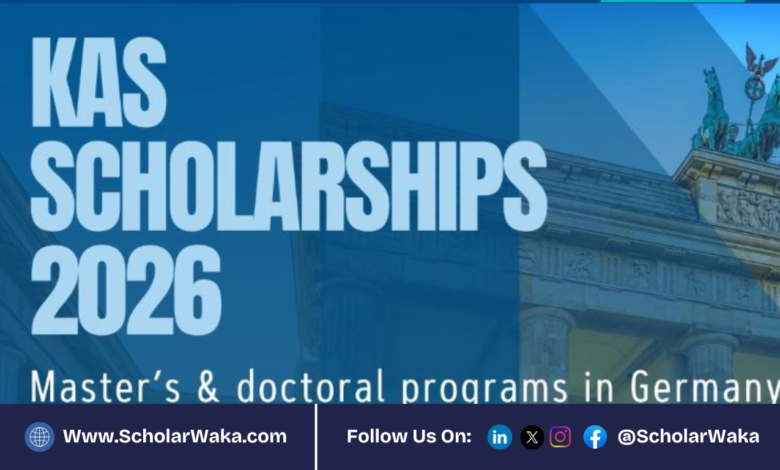
Konrad-Adenauer-Stiftung (KAS) Scholarships 2026 in Germany

There’s a specific philosophy behind this scholarship that shapes everything about how it selects candidates, and it’s worth understanding in full before diving into eligibility checklists: the Konrad-Adenauer-Stiftung isn’t simply looking for the strongest exam results in a given applicant pool.
Don’t Miss: Top Fully Funded Scholarships for International Students
It’s a German political foundation, closely tied to the country’s Christian-democratic tradition, and it’s explicit that it’s searching for young people who are already demonstrably committed to democracy, pluralism, and human rights — people who see their eventual Master’s or PhD not as a personal career milestone alone, but as a tool they intend to bring back into public life, civic engagement, or political and social leadership in their home country.
That distinction matters enormously for how you should approach an application, since it means your academic transcript, however strong, is only ever half the story the selection committee is reading. This scholarship funds the full cost of German postgraduate study for applicants from Kenya, Uganda, South Sudan, Tanzania, and Ethiopia specifically, through the KAS regional office in Nairobi.
Also, Check Out: Top Fully Funded Master’s Scholarships in Europe
The application deadline for this cycle, 1 March 2026, has now passed, and the regional selection interviews conducted through KAS Nairobi were scheduled for May 2026 — meaning outcomes for this round should already be known to applicants. Below is a genuinely comprehensive breakdown of everything involved: who this scholarship is really built for, what the German B2 language requirement actually means in practice, every document you’d need to prepare, and exactly how the multi-stage application and selection process runs from first submission through to final decision.
About the Scholarship
The Konrad-Adenauer-Stiftung, named after Germany’s first post-war Chancellor, operates worldwide with a stated mission of promoting democracy through political education, civic training, and international scholarship support. Since 1999, the foundation has run a structured scholarship programme through its Foreign Student Support division, funded ultimately by the Federal Republic of Germany, supporting international students and doctoral candidates who want to pursue advanced study at a German university.
Also Read: How to Write a Personal Statement for Scholarship | Tips and Free Template
While KAS runs versions of this scholarship for applicants from multiple regions around the world — including a parallel track through its Buenos Aires office covering several South American countries — the specific track covered in this guide runs through the foundation’s Nairobi office, and is reserved exclusively for young academics from five East African nations: Kenya, Uganda, South Sudan, Tanzania, and Ethiopia.
What makes KAS distinctive among the many government and foundation scholarships funding study in Germany is how deliberately it blends financial support with a genuine, structured programme of political and civic development running alongside your academic studies — you’re not simply handed tuition money and left to your own devices for the duration of your degree, you become part of an active, engaged scholarship community with over 15,000 current and former scholars globally.
Konrad-Adenauer-Stiftung (KAS) Scholarships Summary
| Scholarship Name ⇒ | Konrad-Adenauer-Stiftung (KAS) |
| Host Country ⇒ | Gremany |
| Study Level ⇒ | Master’s and PhD |
| Benefits ⇒ | Full financial support, plus a comprehensive seminar, mentoring, and networking programme |
| Funded by ⇒ | Konrad-Adenauer-Stiftung e.V., funded by the Federal Republic of Germany |
| Eligible Countries ⇒ | Kenya, Uganda, South Sudan, Tanzania, Ethiopia |
| Application Deadline ⇒ | 1 March 2026, now closed. Regional selection interviews took place in Nairobi in May 2026 |
What This Scholarship Actually Covers
- Full financial support for your studies — covering the core costs of your German university education for the duration of your programme, structured to remove the financial barrier to postgraduate study in Germany entirely for successful scholars
- Access to an international network of more than 15,000 current and former KAS scholarship recipients — this is a genuinely substantial, active alumni and current-scholar community spanning countries worldwide, not a symbolic mailing list. Scholars connect through this network throughout their studies and often for years afterwards, building professional and personal relationships that extend well beyond the funded study period itself
- A comprehensive seminar programme accompanying your studies — these seminars explore major political, economic, and cultural developments, conducted in German, and structured to actively develop your understanding of these areas alongside your formal degree coursework
- The opportunity to organise your own seminars and events — rather than being a purely passive participant, KAS scholars are actively encouraged and supported to design and lead their own programming within the scholarship community, building genuine event-organising and leadership experience
- Personal guidance for your studies and career planning — provided both by dedicated academic advisors and by KAS’s own Foreign Student Support team, offering structured support for navigating German university life, academic challenges, and your longer-term career direction, tailored specifically to your circumstances as an international scholar
- Active local university group life — including activities such as theatre visits, group discussions, and social events, designed to build genuine community and friendship among scholars studying at the same or nearby German institutions
Eligibility Requirements
Every single one of the following criteria is assessed together by the selection committee, and no single strength — however impressive — compensates for a clear gap in another area:
1. Country of origin
You need to be a young academic from Kenya, Uganda, South Sudan, Tanzania, or Ethiopia specifically — this is a fixed, narrow eligibility base tied directly to KAS’s Nairobi regional office, and applicants from outside these five countries would need to apply through a different, appropriate regional KAS office covering their own country, where one exists
2. Intended programme:
You need to be applying for a Master’s degree, or a doctoral (PhD) programme, at a recognised German university — either a traditional university (Universität) or a university of applied sciences (Fachhochschule) qualifies, and KAS is explicit that funding is open across essentially all academic disciplines, without restricting applicants to a narrow set of politically or socially adjacent subjects
3. Academic performance:
You need to demonstrate genuinely excellent academic achievement throughout your prior studies — this is a real, substantive bar, not a token minimum
4. Social or political engagement
This is where KAS diverges sharply from most academic scholarships. You need concrete, demonstrable evidence of social or political engagement — real involvement in civic life, community organising, advocacy, youth leadership, or comparable activity, not simply an interest in these areas stated on paper. A strong transcript paired with no evidence of civic engagement is treated as an incomplete application in spirit, even if every document is technically present
5. Values alignment
You need a genuinely positive, demonstrable attitude toward democracy, pluralism, and human rights — again, this is something the selection process actively probes, particularly during interview, rather than something you simply affirm in a motivation letter
6. German language proficiency
You need proficiency at level B2 of the Common European Framework of Reference by the time your studies begin, though only B1 proficiency is required at the point you actually submit your application. This staged requirement gives genuine breathing room for applicants who are still actively improving their German at application stage, provided you can credibly demonstrate a clear path to B2 by your intended start date. This requirement exists for a very practical reason: KAS’s seminars, mentoring sessions, and much of its scholar community life are conducted in German, not English, so genuine language capability is essential to actually participating in the fuller KAS experience, not just attending your German degree programme itself
7. Discipline eligibility
Your intended field of study needs to be one KAS actually funds — while the programme is broadly open across academic disciplines, it explicitly does not fund second degree programmes (meaning a further Master’s or Bachelor’s on top of one you already hold at the same level), second doctorates, or postgraduate programmes in human medicine specifically

What Documents You Need to Prepare
1. A completed and signed application form
Obtained through official KAS channels, and completed accurately and in full
2. A letter of motivation, capped at a maximum of 1.5 pages
Given this tight length constraint, every sentence needs to work hard. This is your primary opportunity to demonstrate, in your own words, how your academic goals, civic engagement, and values genuinely align with what KAS is looking for — a letter that reads as generic, or that focuses purely on academic ambition without addressing social or political engagement, is unlikely to succeed regardless of how strong your transcript is
3. A tabular CV, written in German
This is a specific, structured CV format common in the German professional and academic context, and it needs to be genuinely written in German, not simply translated loosely from an English original. If your German isn’t yet strong enough to produce this confidently and accurately yourself, it’s worth seeking careful review from a fluent speaker before submission
4. Copies of university certificates and transcripts, accompanied by German translations
Worth noting precisely: if your original documents are in English, no translation is required, since English is accepted alongside German for this specific document category. Documents in any other original language do need accompanying German translations
5. A reference letter from a university lecturer
Ideally someone who taught or supervised you directly and can speak with genuine specificity to both your academic capability and, where possible, your character and civic engagement
6. Proof of voluntary engagement
Concrete documentation of your social or political activity, whether that’s a letter from an organisation you’ve volunteered with, evidence of a leadership role you’ve held, or comparable proof of genuine civic involvement
7. Proof of German language proficiency
Showing at least B1 level at the time of application, with a credible path toward B2 by the time your studies begin
8. For doctoral applicants specifically, three additional documents:
A description of your dissertation project, setting out your intended research question and approach; a reference letter from your doctoral supervisor specifically, rather than simply any academic reference; and confirmation of your admission to your doctoral programme, where this is already available at the time you apply
How to Apply
- Begin gathering your documents well ahead of the deadline, given how many of them — particularly the German-language tabular CV, the translated transcripts, and your proof of voluntary engagement — genuinely take real time and, in some cases, external support to prepare properly
- Ensure every document meets the specific language and format requirements laid out above, since KAS’s application process is precise about these details, and a document submitted in the wrong format or language can weaken an otherwise strong application
- Complete the official application form in full, ensuring every section is accurately and thoroughly filled in
- Assemble your complete application package, including every required document for your specific applicant category (Master’s or Doctoral)
- Send your full application by email to the KAS Nairobi office at [email protected]
- Submit before the stated deadline — for this cycle, that was 1 March 2026
- Check the official KAS information page directly for any additional process details specific to the current cycle, since exact requirements and formats can be updated between application rounds
- If shortlisted, prepare for the regional selection interview stage, conducted through KAS’s Nairobi office — for the 2026 cycle, these interviews were scheduled for May 2026, giving shortlisted candidates a window of several weeks after the application deadline to prepare
- For specific questions about the process, KAS names a direct contact for this regional programme: Ms. Eva-Maria Okot, Programme Manager Kenya, reachable at [email protected]
What the Deadline and Selection Timeline Look Like
- Application deadline: 1 March 2026 — now closed
- Regional selection interviews: Conducted through KAS’s Nairobi office in May 2026, covering applicants from Kenya, Uganda/South Sudan, Tanzania, and Ethiopia together
- Results: Following the May interview stage — if you applied and interviewed, your outcome for this cycle should already be known
- Next expected cycle: Based on KAS’s consistent annual pattern for this regional track, expect the following year’s application deadline to fall again around early March, with regional interviews again following in May
What to Do Before the Next Cycle Opens
- Start building, or continuing to build, a genuine, documented record of social or political engagement now, well before you begin drafting an application — this cannot be manufactured convincingly in the weeks before a deadline, and the selection committee is specifically trained to distinguish authentic, sustained civic involvement from engagement invented purely for the application
- Begin or continue your German language study seriously, aiming for genuine B1 proficiency well ahead of any future application, with a realistic, credible plan to reach B2 by your intended study start date
- Draft your 1.5-page motivation letter early, and revise it multiple times, since fitting a compelling case for both your academic ambition and your civic commitment into such a tight length genuinely requires careful, deliberate editing rather than a first draft
- Identify a university lecturer who knows your work well enough to write a genuinely specific, strong reference letter, rather than approaching someone at the last minute who can only offer generic praise
- If you’re aiming for the doctoral track specifically, begin developing your dissertation project description and building a relationship with a prospective doctoral supervisor well in advance, since these documents need real depth and specificity to stand out
Frequently Asked Questions
Is the KAS Scholarship for East African applicants still accepting 2026 applications?
No. The deadline was 1 March 2026, and regional selection interviews through KAS Nairobi took place in May 2026. Results for this cycle should already be known.
Do I need to already speak German fluently to apply?
No. You need at least B1-level German proficiency at the point you apply, with B2 proficiency required only by the time your studies actually begin, giving genuine time to continue improving your German between application and enrolment.
Can I apply if I already hold a Master’s degree and want to pursue a second Master’s?
No. KAS explicitly excludes funding for second degree programmes, second doctorates, and postgraduate programmes in human medicine.
Does this scholarship only fund politics or social science degrees?
No. The programme is open across all academic disciplines, though your civic engagement and values alignment are assessed regardless of your chosen field of study.
Is this the only KAS scholarship track available to African applicants?
No. KAS runs scholarship programmes for students from several other African countries, including a distinct track for South Africa, Zimbabwe, and others through different regional offices, alongside a separate KAS-SAIIA scholarship specifically for Master’s study at political science departments in Cape Town, Stellenbosch, or the University of the Western Cape — worth checking if your country falls outside the Nairobi office’s specific five-country list.
Disclaimer: All scholarship details and figures in this post are verified from official Konrad-Adenauer-Stiftung sources as of July 2026. Information is subject to change without notice. Always confirm the latest details directly through the KAS Nairobi office at [email protected], or on the official KAS scholarship webpage. ScholarWaka is not affiliated with the Konrad-Adenauer-Stiftung.
Official Application Portal
Join ScholarWaka Community
Get the latest scholarship updates and study abroad opportunities before anyone else.