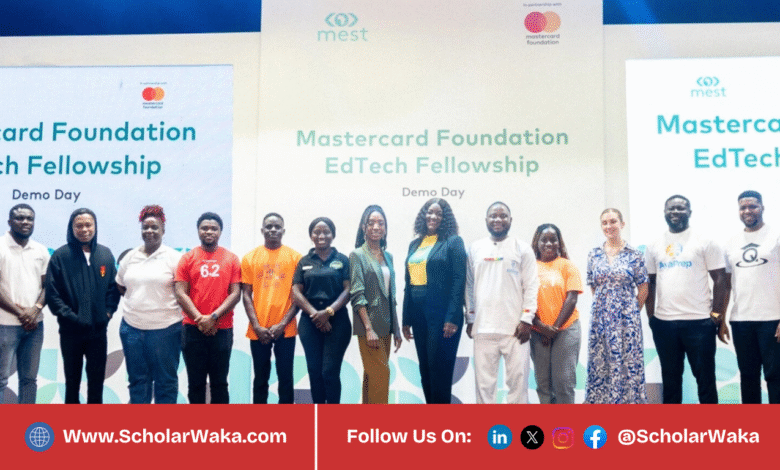
MEST Africa closed applications for its Ghana cohort of the Mastercard Foundation EdTech Fellowship on 30 January 2026 and announced the 12 selected companies in April 2026. This brings the total number of Ghanaian EdTech ventures supported through the hub to 36 since its launch in 2024. Importantly, multiple local implementing partners deliver the programme as a pan-African initiative, with each partner running an independent cohort across different countries, not just Ghana.
Don’t Miss: Top Fully Funded Scholarships for International Students
MEST Africa runs the Ghana cohort specifically, while iHUB runs a separate cohort in Kenya, Sahara Consult runs one in Tanzania, Injini runs one in South Africa, and EtriLabs runs programming across the Francophone WAEMU region — each with its own eligibility specifics, timeline, and application portal. If you’re not building a business registered in Ghana, this specific application isn’t for you, but a parallel version very likely is. This guide covers exactly how the Ghana cohort worked, points you toward the right hub if you’re elsewhere in Africa, and explains what to prepare for the next round.
Also, Check Out: Top Fully Funded Master’s Scholarships in Europe
Understanding Why This Fellowship Runs Differently by Country
The Mastercard Foundation’s underlying strategy here is genuinely deliberate: rather than running one centralised programme, it partners with established local innovation hubs and accelerators in each country, letting organisations who already understand that specific market’s EdTech landscape run the actual selection and support process.
Also Read: How to Write a Personal Statement for Scholarship | Tips and Free Template
That’s why eligibility criteria differ meaningfully by country — the South African cohort run by Injini, for instance, places a strategic emphasis on ventures serving young women, people with disabilities, refugees and displaced persons, and rural youth specifically, while the Ghana cohort run by MEST Africa focuses more broadly on K-12, tertiary, and vocational EdTech solutions with a minimum 8,000-learner reach requirement. Before applying, confirm which country hub matches where your business is registered and operates. Applying to the wrong country’s cohort will not result in consideration.
Mastercard Foundation EdTech Fellowship Summary
| Scholarship Name ⇒ | Mastercard Foundation EdTech Fellowship |
| Host Country ⇒ | Ghana |
| Study Level ⇒ | Fellowships |
| Benefits ⇒ | $60,000 equity-free funding plus business support |
| Funded by ⇒ | Mastercard Foundation, implemented locally by MEST Africa (Ghana) |
| Eligible Countries ⇒ | Ghana |
| Application Deadline ⇒ | Ghana Cohort 4 closed by 30 January 2026, with selected ventures announced in April 2026. Based on the annual pattern, the next Ghana cohort is expected to open around November 2026 |
What Selected Ventures Actually Receive
- Equity-free funding: $60,000, with no ownership stake taken by the Foundation or implementing partner
- Mentorship network: guidance from people who genuinely understand the realities of building EdTech specifically in African markets, not generic startup advisors
- Structured accelerated growth: a defined learning programme helping refine your product, scale operations, and demonstrate real impact
- Market access: direct opportunities to showcase your solution to investors, partners, and education-sector stakeholders
- Continued post-programme support: monthly office-hour consultations, guidance on impact reporting and investment readiness, and ongoing quarterly workshops and networking events even after the formal fellowship concludes
- Commitment structure: a hybrid model combining virtual sessions with mandatory monthly in-person workshops for team leads, requiring roughly 20 to 25 hours of engagement per month
Who Could Apply
- Legal Incorporation & Jurisdiction: Your organization must be legally registered and incorporated in Ghana.
- Organizational Structure: Startups, SMEs, and Non-Governmental Organizations (NGOs) are all fully eligible. The program is open to both for-profit and non-profit models provided they meet the operational baseline.
- Operational History: You must have been actively operating for at least three (3) years prior to applying.
- Growth Stage & Live Product: Must be a growth-stage venture with a functional, live tech or tech-enabled product and active users/paying customers. Pre-launch products, prototypes, or purely conceptual ideas are excluded.
- Scope & Educational Focus: The solution must specifically target improved learning outcomes in Ghana across K-12, tertiary education, or vocational/skills training.
- Learner Reach & Scale: Must demonstrate a proven, verifiable capacity to reach and scale to at least 8,000 learners.
- Team Composition: Must feature an inclusive, diverse team with demonstrated commitment to the education sector. Participating ventures must commit at least two core management team members to the hybrid programme activities, averaging 20–25 hours per month.

Documents Required
The application process is structured in progressive stages. Because the initial form serves strictly as a first-round filter, applicants must prepare both immediate submission assets and secondary evaluation deliverables required during subsequent rounds.
1. Phase 1: Initial Application Portal Submission
To submit the official online application form, you must assemble and upload the following baseline materials:
- Official Application Form Entry: Direct submission of core business details via the MEST Africa portal.
- Proof of Legal Business Registration: Copy of official incorporation documents (e.g., Registrar General’s Department certificate verifying Ghana incorporation and at least 3 years of operation).
- Company Pitch Deck: Slide deck detailing the core problem, tech/tech-enabled solution, business/revenue model, target educational outcome (K-12, tertiary, or TVET), and unit economics.
- Product Traction & Usage Evidence: Technical documentation, active user dashboards, or usage metrics demonstrating product-market fit, current customer base, and clear potential to scale to 8,000$ learners.
- Team Profiles & Diversity Information: CVs, bio summaries, and organizational charts of key leadership—specifically identifying at least two dedicated management-level leads who will participate in the program.
2. Phase 2: Shortlist Evaluation & Virtual Pitch Stage
Applicants moving past the written screening advance to Stage 2 verification:
- Virtual Pitch Presentation: Shortlisted founders deliver a live slide pitch to a panel of MEST Africa advisors, learning science experts, and Mastercard Foundation representatives.
- Management Interview: Q&A session testing business model sustainability, financial health, operational capacity, and alignment with the hybrid time commitment (~20–25 hours/month).
- Product Demo & Live Walkthrough: Live demonstration of the active product to evaluate user interface, core functionality, and technical stability.
3. Phase 3: Final Selection, Due Diligence & Onboarding
Before the $60,000 equity-free grant disbursement and formal cohort onboarding, final candidates undergo verification:
- Financial & Legal Compliance Documentation: Basic financial statements, bank details, and verification of tax compliance or operational standing in Ghana.
- Pedagogical & Impact Alignment Verification: Additional details demonstrating how the technology integrates into real-world Ghanaian learning environments to measure educational efficacy.
- Participation & Grant Agreement: Signed program commitments designating the two core management team members for cohort workshops, accelerator sessions, and cohort milestones.
How to Apply
Stage 1
Fill out and submit the online application form before the deadline.
Stage 2
If shortlisted, the programme team will invite you to a virtual pitch and interview.
Stage 3
The selection team will make the final selection and onboard successful startups into the Fellowship.
Where to Look If You’re Outside Ghana
Given this is a genuinely multi-country programme, your best next step depends entirely on where your business operates. If you’re in Kenya, look for iHUB’s implementation of the fellowship. If you’re in Tanzania, Sahara Consult runs the local cohort. If you’re in South Africa, Injini runs a cohort with a specific focus on ventures serving marginalised learners, including those with special educational needs and those in rural, under-resourced communities.
If you’re operating in Francophone West Africa, EtriLabs has run related EdTech programming and conferences across the WAEMU region. Each of these operates on its own independent timeline, so a closed Ghana cohort doesn’t mean the fellowship generally is unavailable to you.
Getting Ready for the Next Ghana Cohort
Because this cohort has closed and the selected ventures are already onboarded, use the coming months to strengthen the areas the eligibility criteria assess most closely: demonstrable active users, a clear path toward the 8,000-learner threshold, and genuine team diversity. Watch MEST Africa’s official EdTech Fellowship page directly for the next cohort announcement, expected to follow the established pattern of opening applications in the final months of the year.
Frequently Asked Questions
Is the Mastercard Foundation EdTech Fellowship only available in Ghana?
No. Separate local implementing partners deliver this pan-African initiative across multiple countries, including Ghana, Kenya, Tanzania, South Africa, and the Francophone WAEMU region. Each partner runs its own independent cohort.
Is the Ghana cohort still accepting applications?
No. The most recent Ghana cohort closed its application window on 30 January 2026, and the organisers announced the twelve selected ventures in April 2026.
Can my business apply if we’re registered outside Ghana?
Not to this specific Ghana cohort. Look for the parallel cohort that operates in your country, as eligibility generally applies only to businesses registered there.
Does the $60,000 funding come with any equity stake for the Foundation?
No. The funding is explicitly equity-free, meaning no ownership stake is taken in exchange for the investment.
Does support end once the formal fellowship period concludes?
No. Selected ventures continue receiving monthly office-hour consultations, impact reporting guidance, investment readiness support, and quarterly workshops even after the structured programme itself ends.
Disclaimer: All programme details, benefits, and eligibility criteria in this post were verified from official Mastercard Foundation and MEST Africa sources as of August 2026. Details vary by country cohort and implementing partner. Information is subject to change without notice. Always confirm the latest details directly on the relevant country-specific EdTech Fellowship page before submitting your application. ScholarWaka is not affiliated with the Mastercard Foundation or MEST Africa.
Official Application Portal
Join ScholarWaka Community
Get the latest scholarship updates and study abroad opportunities before anyone else.