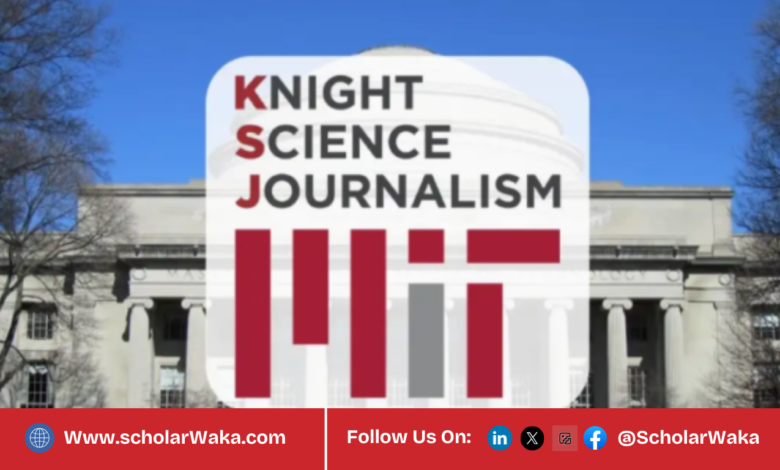
MIT’s Knight Science Journalism Program runs two separate fellowship tracks each year, and understanding the difference matters if you’re a Nigerian science journalist weighing your options. The flagship Academic-Year Fellowship selects 10 journalists globally for a full nine-month residency, with an $85,000 stipend.
Also, Check Out: Top Fully Funded Master’s Scholarships in Europe
Running alongside it is the Fellowship for Advancing Science Journalism in Africa and the Middle East — a one-semester programme built specifically for reporters and editors from this region, offering a $40,000 stipend for roughly half the time commitment. Both are now closed for this cycle: applications opened 15 November 2025 and closed 9 January 2026, with final selections announced in April 2026. This post covers both tracks and what to prepare for the 2027-2028 cycle.
Don’t Miss: Top Fully Funded Scholarships for International Students
About the Two KSJ Fellowships
The Academic-Year Fellowship is the better-known of the two — a nine-and-a-half-month residency in Cambridge, Massachusetts, open to journalists worldwide who demonstrate genuine professional excellence and long-term commitment to science reporting, with all countries competing on equal footing.
Also Read: How to Write a Personal Statement for Scholarship | Tips and Free Template
The Africa and Middle East Fellowship exists because MIT recognised that a full nine-month commitment away from home and newsroom is a genuinely different proposition for journalists in regions where career structures, funding, and institutional support for extended leave look different from those in wealthier media markets — so this track compresses the core experience into one semester, while still offering the same fundamental access: MIT resources, science course auditing at MIT and Harvard, seminars, and mentorship from KSJ’s Director and Associate Director.
Both fellowships share the same underlying purpose — sharpening journalists’ ability to report accurately and thoughtfully on science’s intersection with human culture — but the Africa/Middle East track is worth serious consideration for Nigerian journalists specifically, given its shorter, more logistically manageable structure without sacrificing the substance of the MIT experience.
MIT Knight Science Journalism Fellowship Summary
| Scholarship Name ⇒ | MIT Knight Science Journalism Fellowship |
| Host Country ⇒ | USA |
| Study Level ⇒ | Fellowships |
| Benefits ⇒ | Academic-Year Fellowship (9-9.5 months, 10 fellows, $85,000) and Fellowship for Advancing Science Journalism in Africa and the Middle East (1 semester, $40,000) |
| Funded by ⇒ | African Development Bank (AfDB) and the Government of Japan |
| Eligible Countries ⇒ | All countries (Academic-Year); Africa and Middle East region specifically (second track) |
| Application Deadline ⇒ | Both tracks closed 9 January 2026 (recommendation letters due 15 January). Semifinalist interviews ran in early March 2026; final selections announced April 2026. Next cycle expected to open around November 2026. |
What Fellows Actually Receive
The Knight Science Journalism Program at MIT offers two distinct fellowship tracks designed to provide science, health, and environmental journalists with the financial freedom and academic access required to expand their technical knowledge and advance their reporting.
1. Full Academic-Year Fellowship
Designed for a global cohort of 10 experienced journalists, this 9.5-month residency (running August through May) offers intensive academic immersion and independent project development.
Financial & Relocation Package
- $85,000 Base Stipend: Disbursed in bi-weekly or monthly installments over 9.5 months (~$8,900/month) to cover living expenses in the Cambridge/Boston area.
- Housing & Relocation Allowance: A dedicated lump-sum travel and housing stipend paid early in the fellowship term to assist with initial moving costs and securing local accommodation.
- Comprehensive Health Insurance: Basic health insurance premiums fully covered for both the fellow and their immediate accompanying family members (spouse/dependents).
Academic & Institutional Access
- Cross-Registration Privileges: Full access to audit courses at MIT, Harvard University, and other neighboring Boston-area institutions.
- Mandatory Course Load: Fellows must audit at least one science-focused course per semester, but are given the flexibility to tailor their broader study plan across engineering, humanities, and policy departments.
- MIT Campus Benefits: Access to MIT’s library systems, media labs, computing resources, research centers, public transit subsidies, and local museum networks.
Professional & Project Support
- Independent Research Project: Dedicated time, staff mentorship, and institutional resources to execute a self-directed journalism capstone—such as long-form investigative series, book proposals, multimedia pieces, or podcasts.
- Seminars & Workshops: Weekly private seminars with world-leading scientists, policy experts, and veteran journalists, alongside technical workshops in data journalism, digital security, audio production, and mobile video.
- Scientific Field Trips: Fully funded study trips to major regional research centers—such as the Woods Hole Oceanographic Institution on Cape Cod, the Jackson Laboratory in Maine, or the Harvard Forest.
- Cohort Integration: A tightly-knit social and professional network supported by welcome receptions, community dinners, holiday gatherings, and collaborative working spaces at the KSJ headquarters.
2. Africa and Middle East Fellowship
A targeted, single-semester residency (running from mid-August through mid-December) tailored specifically for mid-career journalists based in Africa and the Middle East to strengthen regional science reporting capacity.
Financial & Relocation Package
- $40,000 Semester Stipend: A fixed grant providing significant financial security over the 4-month term.
- Relocation & Travel Allowance: Direct coverage or stipend support for round-trip international airfare, visa processing, and upfront housing setup costs in Cambridge.
- MIT Individual Health Cover: Full individual health insurance coverage through MIT’s student/fellow health plan.
Academic & Professional Benefits
- Auditing & Coursework: Full access to audit science, technology, and journalism courses at both MIT and Harvard.
- Curriculum Integration: Fellows participate alongside the full Academic-Year cohort in all weekly expert seminars, skills workshops, and scientific field trips.
- Institutional Integration: Complete access to MIT libraries, public transit discounts, specialized labs, and international student advisor support (including J-1 visa processing).
Eligibility Requirements (both tracks)
- You must be a full-time journalist — staff or freelance, across print, digital, audio, video, or multimedia. Freelancers are eligible if journalism is their primary income source; part-time writers or producers are not eligible
- You must have at least three consecutive years of professional experience covering science, health, technology, or environmental topics
- Your work must demonstrate strong reporting skills, accuracy, and clear focus on science-related fields
- You must not have completed a fellowship of four months or longer within the two years prior to applying
- You must be proficient in English, since all coursework, seminars, and workshops run in English
- For the Africa and Middle East Fellowship specifically, you must be a journalist based in, or reporting primarily on, this region
- International fellows selected for either track must be able to obtain the appropriate US visa

Required Documents
Submitting a competitive application for the Knight Science Journalism (KSJ) Fellowship at MIT requires building a dossier through KSJ’s online Submittable portal. Because review panels evaluate both technical journalism skills and academic readiness, all materials must adhere strictly to submission formatting guidelines and ethical standards.
1. Core Professional Documents
- Curriculum Vitae (CV) / Résumé:
- A concise document detailing professional work history, educational background, media positions, major reporting honors, and journalism awards.
- Freelance Requirement: Freelancers must include an itemized breakdown of all journalism assignments completed over the past 12 months, listing story titles, media outlets, and exact publication/broadcast dates.
- Professional Autobiography / Personal Statement (Max 500 words):
- A focused narrative articulating your journey as a journalist, your motivation for joining the KSJ program at MIT, and how this specific fellowship aligns with your long-term career trajectory.
- Fellowship Project / Research Proposal (Max 500 words):
- A detailed plan for a self-directed journalism project to be executed during the fellowship. Projects can take various formats—such as long-form narrative series, audio/podcast concepts, video documentaries, or book proposals.
- Book Contract Prohibition: While book proposals are permitted, candidates cannot arrive with an active publisher contract or sell their proposal during the fellowship year.
2. Work Samples & Professional References
- Three Representative Work Samples:
- Published or broadcast journalism samples (print, digital, audio, or video) that demonstrate reporting capabilities, narrative quality, and expertise in science, health, technology, or environmental topics.
- Translation Requirement: Any work sample not originally published in English must be accompanied by an accurate, complete English translation.
- Three Confidential Letters of Recommendation:
- Recommenders must be editors, line managers, or senior colleagues who can evaluate your reporting rigor, professional integrity, and leadership potential.
- Submittable Workflow: Recommender names and email addresses are entered into the Submittable platform, which generates automated upload links directly to your references.
- Selection Mechanics: KSJ does not notify candidates when or if specific recommendation letters are opened or evaluated by the selection committee during preliminary review rounds.
3. Eligibility Verification & Identity Verification
- Proof of Full-Time Professional Status:
- Applicants must prove at least three consecutive years of full-time experience covering science, health, technology, or the environment.
- Employment Verification: Staff journalists submit an official employer letter confirming full-time status and approved leave of absence; freelancers submit publication logs and client contracts confirming continuous full-time work. Part-time writers, PR professionals, and academic communicators are ineligible.
- Passport Bio-Page / Official Government Identification:
- High-resolution color scan verifying identity and citizenship to assist MIT’s International Scholars Office (ISchO) with J-1 visa processing upon selection.
- English Language Proficiency Verification:
- Formal language test scores (e.g., IELTS or TOEFL) are optional during the initial Submittable application phase.
- However, because MIT sponsors J-1 scholar visas, shortlisted international candidates must verify English proficiency through a live virtual panel interview and/or language test evaluation before final fellowship confirmation.
How to Apply
- Visit the official KSJ Fellowship page (ksj.mit.edu) once the next cycle opens, and decide which track fits you — the full Academic-Year Fellowship or the Africa and Middle East Fellowship specifically.
- Create an account through KSJ’s Submittable-powered application portal.
- Complete the online application, detailing your professional experience and journalism background.
- Upload your CV, personal statement, project proposal, and three work samples.
- Initiate your three reference requests through Submittable early, since referees can submit up to several days after the main deadline, but shouldn’t be left until the last moment.
- Submit your complete application before the stated deadline.
- If selected as a semifinalist, expect an interview invitation in early March.
- Final fellows are typically announced in April.
How to Prepare for the Next Cycle
With this cycle’s results already announced, the coming months are for preparing ahead of the 2027-2028 cycle, expected to open around November 2026:
- Decide between the two tracks early, since the Africa and Middle East Fellowship’s shorter, semester-long structure may be significantly more feasible for many Nigerian journalists than a full nine-month US residency, without sacrificing genuine MIT access.
- Start drafting your project proposal now, since this needs to reflect a genuinely ambitious, well-scoped piece of science journalism achievable within your fellowship’s timeframe.
- Line up your three references early, briefing them on the specific fellowship and giving them real lead time, since KSJ’s process depends on their timely response through Submittable.
- Select your three work samples carefully, choosing pieces that clearly demonstrate accuracy, strong reporting craft, and genuine science focus.
- Confirm your three consecutive years of qualifying experience are clearly documented, and that you haven’t completed a four-month-plus fellowship within the prior two years.
Deadline
Both KSJ fellowship tracks closed 9 January 2026 (11:59 pm Eastern), with recommendation letters accepted through 15 January. Semifinalist interviews were held in early March 2026, and final fellows were announced in April 2026. Based on this consistent pattern, expect the 2027-2028 cycle to open around 15 November 2026, with a deadline in early-to-mid January 2027.
Frequently Asked Questions
Are there really two separate KSJ fellowships?
Yes — the nine-month Academic-Year Fellowship, open worldwide, and a separate one-semester Fellowship for Advancing Science Journalism in Africa and the Middle East, built specifically for journalists from that region.
Which track is more relevant for Nigerian journalists?
Both are technically open to Nigerian applicants, but the Africa and Middle East Fellowship is specifically designed for this region and offers a shorter, more logistically manageable commitment while still providing genuine MIT access.
What happens if I already missed the 9 January 2026 deadline?
This cycle’s applications are closed, and results have been announced. Use the coming months to prepare ahead of the 2027-2028 cycle, expected to open around November 2026.
Do I need a visa to participate?
Yes. Selected international fellows must be able to obtain the appropriate US visa for their track’s specific duration.
Is there an application fee?
No stated application fee appears in KSJ’s official materials.
Disclaimer: All fellowship details, deadlines, and figures in this post were verified from official and reported sources as of July 2026. Information is subject to change without notice. Always confirm the latest details directly on the official Knight Science Journalism Program page before applying. ScholarWaka is not affiliated with MIT or the Knight Science Journalism Program.
Official Application Portal
Join ScholarWaka Community
Get the latest scholarship updates and study abroad opportunities before anyone else.