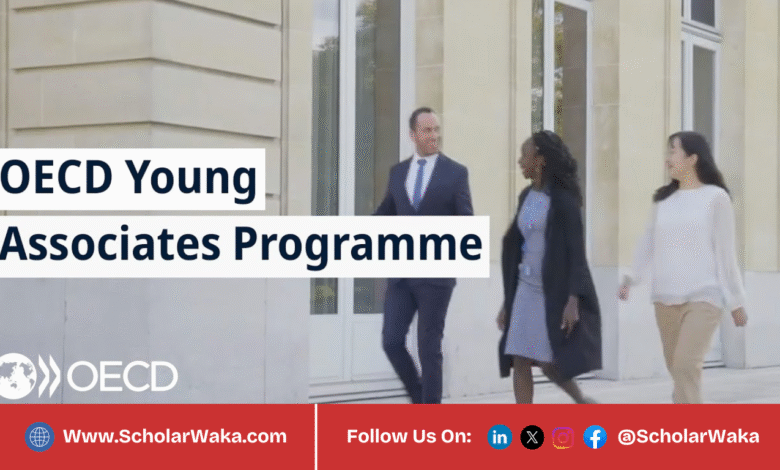
Applications for the OECD Young Associates Programme’s 2026-2028 round closed on 14 December 2025, and the OECD’s own careers page confirms that application review is now underway, with successful candidates set to begin work in Paris this September. If you missed this window, the programme runs on a reliable annual cycle — the previous round covered 2025-2027, this one covers 2026-2028, and a 2027-2029 round is the natural next step.
Don’t Miss: Top Fully Funded Scholarships for International Students
This is a genuinely rare opportunity: a fully paid, two-year professional placement at one of the world’s most influential international organisations, built specifically for recent graduates who haven’t yet moved into a Master’s programme. Young Associates work directly alongside senior OECD managers across directorates covering everything from climate finance to anti-money laundering to digital transformation, gaining the kind of hands-on multilateral policy exposure that’s genuinely difficult to access straight out of undergraduate study. This guide covers exactly who qualifies, what the full compensation package looks like, and what to prepare now for the next round.
Also, Check Out: Top Fully Funded Master’s Scholarships in Europe
Why the Eligibility Window Is So Narrow
Understanding the specific timing rules here matters more than for most graduate programmes, because the OECD enforces them strictly rather than treating them as guidelines. The programme exists specifically to catch graduates at a particular career moment — after finishing a Bachelor’s degree, but before moving into postgraduate study — which is why holding, or being enrolled in, a Master’s or PhD disqualifies you entirely, regardless of how strong your application otherwise is.
Also Read: How to Write a Personal Statement for Scholarship | Tips and Free Template
The graduation window itself shifts with each cycle too: for the 2026-2028 round, eligible graduation dates fell between 1 January 2025 and 1 September 2026, meaning the exact dates you need to meet will move forward again for the next round rather than staying fixed. OECD also runs a free interactive eligibility tester on its official careers site specifically so candidates can check their status before investing time in a full application — worth using early rather than assuming eligibility based on a general sense of when you graduated.
OECD Young Associates Programme Summary
| Scholarship Name ⇒ | OECD Young Associates Programme |
| Host Country ⇒ | France |
| Study Level ⇒ | Internships and Training |
| Benefits ⇒ | Monthly salary, medical insurance, allowances, travel and relocation support |
| Funded by ⇒ | Organisation for Economic Co-operation and Development |
| Eligible Countries ⇒ | OECD Member Countries only |
| Application Deadline ⇒ | 2026-2028 round closed 14 December 2025 at 23:59 CET. Based on the previous cycle’s timing, the 2027-2029 round is expected to open around November 2026, with a deadline in mid-December 2026 |
The Full Compensation Package
This is one of the more financially accessible early-career international placements available, and the structure is worth understanding in full.
- Monthly salary: 3,886 EUR, not taxed under French law, for the duration of the two-year assignment
- Medical insurance: full coverage provided throughout the programme
- Expatriation and home leave allowances: additional financial support recognising the relocation involved in the role
- Installation allowance: one month’s salary for single applicants, intended to ease the cost of settling in Paris
- Relocation cost reimbursement: covering the practical expense of the move itself
- Flights: covered both at the start of the programme and on the return journey after completion
- Leaving allowance: approximately 21,000 EUR paid at the end of the two-year assignment, in lieu of pension contributions — a detail that makes the total package considerably stronger than the monthly salary figure alone suggests
Eligibility Requirements
- You must hold a Bachelor’s degree or equivalent, with your graduation date falling within the window set for that specific round — this shifts each cycle, so always confirm the current exact dates rather than assuming last year’s window applies
- You must not hold, or be currently enrolled in, a Master’s, PhD, or equivalent degree — this applies regardless of how strong the rest of your profile is
- You must hold the nationality of an OECD Member Country specifically; applications from non-member nationals aren’t considered
- You need a minimum GPA of 3.0 on a 4.0 scale, demonstrating overall academic achievement, not just strength in your specific field
- You need fluency in one of OECD’s two official languages, English or French, along with genuine commitment to reach a good working level in the other after joining
- You need to demonstrate both the ability to contribute meaningfully in your chosen work area and clear motivation to pursue postgraduate study in a relevant field after completing the programme — this dual requirement is checked specifically, not assumed from academic credentials alone

How Selection Actually Works
The process runs across several distinct stages after the December deadline closes. Eligible candidates who clear initial screening are invited to an online aptitude test in December, followed by video interviews and written assessment tasks between January and February for those who progress further.
Final offers go out in March and April, giving successful candidates several months’ notice before the September start date — genuinely useful lead time for visa arrangements and relocation planning, which most graduate programmes don’t build in. OECD also runs a live pre-application webinar each cycle specifically covering how to prepare a compelling CV and cover letter, alongside a Q&A session — worth attending if you’re preparing for the next round, since it’s a direct opportunity to hear selection criteria explained by the people running the process.
Documents to Prepare
Applying for the OECD Young Associates Programme (YAP)—a 24-month, Paris-based professional development assignment for recent undergraduate graduates—requires submitting a precise digital dossier through the OECD Taleo/SmartRecruiters platform. Because the OECD is a research- and policy-intensive multilateral institution, dossiers are evaluated strictly on academic rigor, policy alignment, and future graduate study potential.
1. Professional CV & Position-Specific Cover Letter
- Curriculum Vitae (CV / Resume):
- Standard: 1 to 2 pages maximum, formatted cleanly in
.pdf. - Focus Areas: Must highlight relevant undergraduate coursework, quantitative/qualitative research projects, statistical software proficiency (e.g., R, Python, STATA), internships, and extracurricular leadership.
- Standard: 1 to 2 pages maximum, formatted cleanly in
- Role-Specific Cover Letter:
- Placement: Pasted into the “Message to Hiring Manager” section or uploaded as a dedicated PDF.
- Core Requirements: You must address the exact Directorate/position profile applied for.
- Two-Pronged Narrative: Clearly explain (1) how your skills contribute directly to the Directorate’s policy deliverables, and (2) how the 2-year assignment will prepare you for a specific master’s or doctoral degree program after the programme.
2. Academic Records & Degree Verification
- Academic Transcripts & GPA Verification:
- Complete, official scans of undergraduate transcripts showing all completed coursework and your cumulative GPA.
- Minimum Benchmark: Minimum 3.0 out of a 4.0 scale (or international equivalent verified via official GPA conversion keys).
- Bachelor’s Degree Certificate / Expected Graduation Proof:
- Graduated Candidates: Copy of official Bachelor’s degree diploma.
- Current Final-Year Students: Official letter of enrollment/status from your university registrar confirming expected graduation prior to the September start date.
- Ineligibility Trigger: Candidates already holding or enrolled in a Master’s or PhD program are strictly ineligible for the YAP.
3. Statutory Nationality & Supplementary Research Portfolio
- Proof of OECD Member Country Nationality:
- High-resolution color scan of your valid passport bio-page or national identity card.
- Mandatory Condition: You must hold citizenship from an official OECD member state (dual nationals must present their OECD-eligible passport).
- Supplementary Research, Writing Samples & Thesis Extracts (Optional / Recommended):
- While not formally mandatory at stage 1, uploading an extract of your undergraduate capstone, honors thesis, or published policy memo significantly strengthens your application during directorate-level screening.
- Recommended Length: 2 to 5 pages demonstrating structured analysis, literature synthesis, and empirical data interpretation.
How to Apply
1. Check your eligibility
Make sure you meet all the requirements, especially graduation dates and nationality.
2. Visit the OECD Careers website
All applications must be submitted through the official OECD careers portal.
3. Choose the positions that fit your academic background
You can apply for more than one directorate if you qualify.
4. Prepare your CV and cover letter
Make them clear, simple, and relevant to the specific position.
5. Submit your application before the deadline
Applications close on 14 December 2025 at 23:59 CET.
6. Take the online aptitude test
Eligible candidates will be invited for testing in December 2025.
7. Complete interviews and assessments
Between January and February 2026, shortlisted candidates will do video interviews and written tasks.
8. Receive final decisions
Final offers are sent out in March and April 2026.
9. Move to Paris
Successful candidates start the programme in September 2026.
Getting Ready for the Next Round
Since the 2026-2028 window has closed, use the coming months to strengthen exactly what the process screens for. Check the OECD’s eligibility tester as soon as the next round’s specific graduation window is published, rather than assuming your dates automatically qualify.
Watch for the pre-application webinar announcement, typically held in November ahead of the December deadline, and use it directly to shape your CV and cover letter rather than relying on generic scholarship application advice. If you have relevant research, a thesis, or writing connected to one of OECD’s focus directorates — climate finance, health data, digital transformation, and similar areas — start refining that material now, since it’s one of the clearest ways to differentiate a strong application in a genuinely competitive international pool.
Frequently Asked Questions
Is the OECD Young Associates Programme still accepting applications?
No. The 2026-2028 round closed on 14 December 2025, and application review is currently underway, with successful candidates starting in Paris this September. Based on the previous cycle’s timing, the 2027-2029 round is expected to open around November 2026.
Can I apply if I’m currently enrolled in a Master’s programme?
No. Applications from candidates who already hold or are enrolled in a Master’s, PhD, or equivalent degree are not considered, regardless of the strength of the rest of the application.
Do I need to be fluent in both English and French to apply?
No. You need fluency in one of the two official languages, along with a genuine commitment to reach a good working level in the other after joining the OECD.
Is this programme open to applicants from any country?
No. Eligibility is restricted specifically to nationals of OECD Member Countries. Applications from non-member nationals are not considered.
What happens if my graduation date falls just outside the eligible window?
You would not meet the eligibility criteria for that specific round, since OECD enforces graduation date windows strictly. Use the official eligibility tester once the next round’s dates are published to confirm your status precisely.
Disclaimer: All programme details, deadlines, and eligibility criteria in this post were verified from official OECD sources as of August 2026. Information is subject to change without notice. Always confirm the latest details directly on the official OECD Careers website before submitting your application. ScholarWaka is not affiliated with the OECD.
Official Application Portal
Join ScholarWaka Community
Get the latest scholarship updates and study abroad opportunities before anyone else.