Scuola Superiore Meridionale (SSM) PhD Scholarship 2026 in Italy | Fully Funded

As complex socio-legal shifts and rapid technological developments rewrite global challenges, modern doctoral studies can no longer survive inside isolated academic silos. The traditional model of postgraduate education is shifting toward deeply collaborative, globally networked scientific spaces.
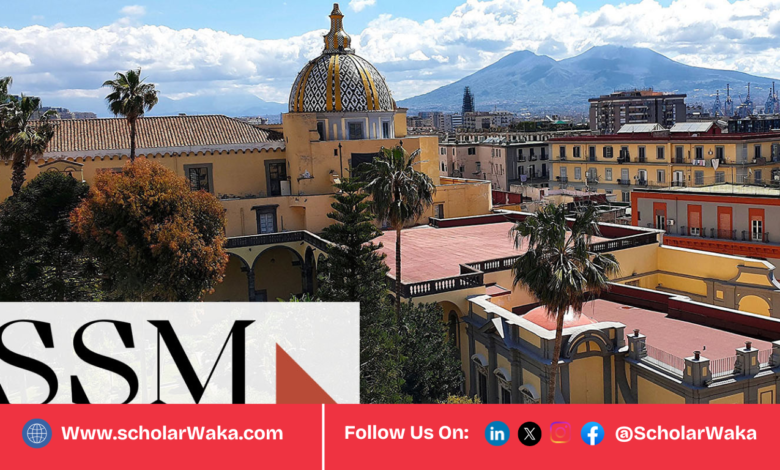
At the absolute forefront of this paradigm shift is the Scuola Superiore Meridionale (SSM) in Naples, Italy. Operating as an elite, autonomous public institution for advanced research, SSM has established itself as an intellectual launchpad. The SSM PhD Scholarship (42nd Cycle, Academic Year 2026/2027) is not merely an educational grant; it is a fully funded, four-year career engine designed to remove financial constraints entirely, allowing international and domestic researchers to run high-impact projects at the intersection of law, humanities, science, and technology.
Scuola Superiore Meridionale (SSM) PhD Scholarship Summary
| Scholarship Name ⇒ | Scuola Superiore Meridionale (SSM) PhD |
| Host Country ⇒ | Italy |
| Study Level ⇒ | PhD |
| Benefits ⇒ | Fully Funded |
| Funded by ⇒ | Scuola Superiore Meridionale (SSM), Naples |
| Eligible Countries ⇒ | All Countries |
| Application Deadline ⇒ | August 27, 2026, at 14:00 CET |
About the Scuola Superiore Meridionale (SSM) PhD Scholarship
Unlike standard three-year European doctoral tracks, SSM’s programs are structured as rigorous four-year journeys. This expanded timeline ensures doctoral researchers have the necessary runway to conduct exhaustive field investigations, Master state-of-the-art laboratory instrumentation, and complete extended international research residencies.
Established with complete academic, scientific, and financial autonomy under Italian law, the school funds a minimum of three fully subsidized positions per program, with a baseline total of 50 fully funded scholarships across the cycle. Scholars are directly integrated into the academic life of Naples, one of Europe’s oldest and most vibrant intellectual centers while being explicitly required to spend semesters abroad collaborating with prestigious global partner institutions.
Targeted Interdisciplinary Divisions
SSM has structured its 42nd academic cycle across ten advanced doctoral programs divided into two core areas of research. Each program is allocated 5 fully funded scholarships:
1. Law and Human Sciences Area
- Ancient Mediterranean Archaeology and Cultures (ACMA): Historical research, preservation, cultural heritage, management, and use.
- Global History and Governance (GHG): Interdisciplinary studies exploring historical global dynamics, transnational trends, and legal systems.
- Law and Organizational Studies for the Promotion of Diversity and Inclusion (LOSPD): Structuring equity, diverse systems, and inclusive policy design.
- Texts, Traditions and Book Cultures (TTCL): Intensive Italian and Romance philology, literary history, and text preservation.
2. Science and Technology Area
- Clinical and Translational Oncology (CTO): Bridging basic cancer biology and cellular mechanisms with clinical medical therapies.
- Genomic and Experimental Medicine (GEM): High-throughput genetics, computational biology, and personalized medicine pathways.
- Modelling and Engineering Risk and Complexity (MERC): Systemic failure calculations, engineering resilient designs, and mathematical modelling of complex networks.
- Molecular Sciences for Earth and Space (MOSES): Chemistry, astrochemistry, and physical science applications for Earth and planetary exploration.
- Mathematical and Physical Sciences for Advanced Materials and Technologies (MPHS): Exploring quantum properties, material engineering, and physics-driven technology development.
- Cosmology, Space Science and Space Technology (SPACE): Astrophysics, observational cosmology, space instrumentation, and deep-space mission design.

Eligibility Requirements
To successfully clear the administrative screening and earn an invitation to the academic interview phase, applicants must satisfy the following criteria:
- Universal Citizenship: Open to all applicants worldwide. There are absolutely no nationality, passport, or country-of-origin restrictions.
- No Age Ceilings: The selection process is open to qualified minds of any age.
- Academic Credentials: You must hold an Italian Laurea Magistrale (or Laurea Specialistica), a traditional four-year-old system Italian degree, or a suitable, equivalent foreign Master’s degree (minimum 5-year overall academic cycle).
- Pending Graduates Track: If you are in the final stages of your Master’s degree, you are fully eligible to apply, provided you officially secure your degree qualification by October 31, 2026.
- English Language Command: Proficiency in English is mandatory to successfully navigate the GEM, GHG, LOSPD, MERC, MOSES, MPHS, SPACE, and CTO doctoral tracks.
What the Scuola Superiore Meridionale (SSM) PhD Scholarship Covers
- Substantial Stipend Value: A gross annual stipend of €19,000, systematically disbursed in 12 monthly instalments.
- International Travel Top-Up: During mandatory research stays abroad (minimum two semesters; up to 12 months, extendable to 18 months for co-tutelle tracks), your monthly scholarship payment is increased by 50%.
- Tuition and Levy Waivers: Complete, unconditional exemption from university tuition fees, enrollment levies, and standard administrative registration costs.
- Independent Research Budgets: Scholars receive an independent operational budget of 10% of their annual stipend in the first year (approx. €1,900), which scales up to 20% annually in years 2, 3, and 4 (approx. €3,800/year). These funds can be used for books, field research, international conferences, and laboratory consumables.
Required Application Portfolio
All application materials must be uploaded directly to the PICA portal. Ensure your application contains these mandatory documents:
- Identity Document: A clear scan of your valid international passport or national ID card.
- Academic Curriculum Vitae: Your CV, which must be structured according to the official SSM template provided on the online PICA interface.
- Master’s Thesis File: A complete copy of your Master’s thesis. If your degree is still in progress, you must upload an extended abstract of up to 1,000 words in English.
- Academic Transcript Affidavit: An official self-certification or transcript document detailing all university exams taken, individual grades received, and credit values.
- Motivation Essay: A maximum 1,000-word statement outlining your scientific interests, your reasons for selecting SSM, and how your trajectory matches the program.
- Scientific Proposal / Project:
- For SPACE, GEM, MERC, MPHS, and MOSES: A structured Scientific Report.
- For ACMA, GHG, LOSPD, TTCL, and CTO: A formal Research Project Proposal conforming to the guidelines attached to the program specifications.
- Reference Letters (Optional but Highly Recommended): Up to two academic letters of recommendation. Referees must upload these directly to the PICA platform by August 31, 2026, at 17:00 CET.
- Scientific Publications (Optional): Up to three scientific papers, articles, or conference proceedings merged into a single PDF file.
How To Apply
The application process is handled entirely online. Follow these steps to submit your candidacy:
- Access the Portal: Navigate to the official CINECA PICA application portal:
- Establish Credentials: Create a secure user account on the PICA platform or log in using your existing credentials.
- Initiate Application: Select your target doctoral program from the list of 10 available tracks. If you wish to apply to multiple programs, you must create and submit a completely separate, distinct application for each.
- Complete the Fields: Carefully fill in your academic history, paste your motivation statement, and upload your required PDF files (ensuring your CV uses the designated SSM template).
- Submit Prior to Deadline: Review your files and lock your application. The absolute submission deadline is August 27, 2026, at 14:00 CET. Late or incomplete entries will not be registered by the system.
Post-Submission Timeline
Once the portal locks, the selection process transitions through the following milestones:
- Stage 1: Document & Qualification Assessment (Early September 2026): Selection committees evaluate the academic transcripts, CVs, and research proposals. Candidates must score a minimum of 40 out of 60 points to clear this stage. Shortlisted candidates will be announced by September 16, 2026.
- Stage 2: Oral Interview (September 17 – September 30, 2026): Shortlisted candidates undergo a rigorous oral defense of their research project. The interview may be conducted online and is held in English for programs where English proficiency is mandatory.
- Stage 3: Final Merit Ranking (Post October 5, 2026): SSM publishes the official ranked lists of admitted scholars on their portal.
- Stage 4: Enrollment and Start of Classes (October 31 – November 2, 2026): Successful candidates must complete their official enrollment paperwork by October 31, 2026. Academic courses and laboratory rotations officially begin on November 2, 2026.
Frequently Asked Questions
Is there an application fee to apply for the SSM PhD scholarship?
No. Unlike several other Italian universities, there is no application fee or processing charge required to submit your doctoral candidacy through the PICA platform for Scuola Superiore Meridionale.
What happens if I fail to graduate by the October 31, 2026, qualification deadline?
Your admission to the doctoral program is strictly conditional on holding the required Master’s degree. If you do not graduate and self-certify your qualification by October 31, 2026, you will forfeit your offer, and your fully funded position will immediately be reassigned to the next eligible candidate on the ranked waiting list.
How does the 50% stipend top-up work while studying abroad?
When you carry out approved, compulsory research phases at an international partner institution (outside of Italy), your monthly rate of approximately €1,583 gross is increased by 50% (amounting to roughly €2,375 gross per month) for the exact duration of your stay, up to a maximum of 12 months (or 18 months for joint co-supervised/co-tutelle doctoral paths).
Can I utilize my research budget for travelling to international conferences?
Yes. Your dedicated research budget (10% of your annual scholarship in your first year, and 20% annually for years 2 through 4) is specifically earmarked to cover academic expenses, including travel, accommodation, registration fees for conferences, book purchases, and technical research equipment both in Italy and abroad.
Do I need to submit an English language certificate (like IELTS or TOEFL) with my application?
While presenting a formal English language certificate can strengthen your portfolio, it is not a rigid administrative exclusion criterion. Your command of the English language will be directly tested and verified during the oral interview phase in September, which is conducted in English for the relevant science and global history tracks.
Disclaimer: All scholarship terms, program codes, stipend metrics, and deadline phases detailed in this briefing were compiled from the official Scuola Superiore Meridionale Call for Applications (42nd Cycle) issued by the registrar. Funding structures, program timelines, and PICA submission protocols are subject to change. Candidates must verify live updates directly on the official university portal at ssmeridionale.it.
Official Application Portal
Join ScholarWaka Community
Get the latest scholarship updates and study abroad opportunities before anyone else.