Japanese Government (MEXT) Scholarship 2027 Fully Funded

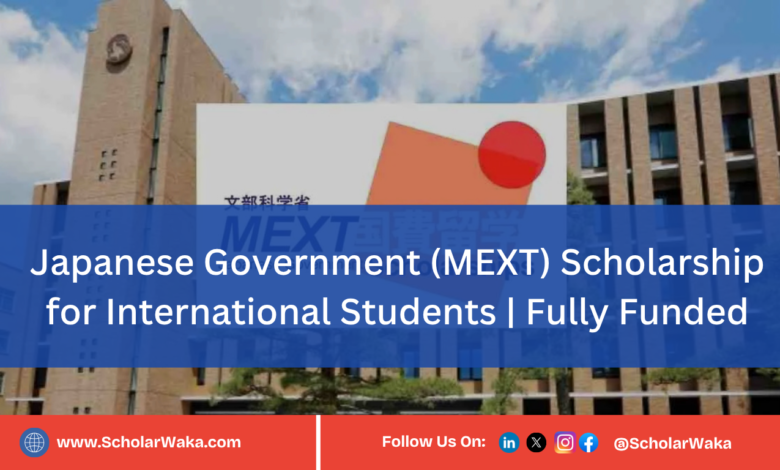
The Japanese Government (MEXT) Scholarship for 2027 entry runs on two separate application tracks with two different timelines, not one fixed deadline. Embassy Recommendation deadlines for most countries fell between April and June 2026 and have largely closed. University Recommendation applications remain open at many Japanese universities from September 2026 to January 2027. This post breaks down both pathways, so you know exactly where you stand.
Don’t Miss: Top Fully Funded Scholarships for International Students 2026
Monthly stipends range from ¥117,000 to ¥242,000 depending on the scholarship category, and all tuition fees are fully exempted. Additionally, scholars receive round-trip travel expenses, making this one of the most comprehensive fully funded scholarship opportunities available for international students seeking to study in Japan.
Must-Read: Top Fully Funded Masters Scholarships in Europe
Japanese Government (MEXT) Scholarship Summary
| Scholarship Name ⇒ | Japanese Government (MEXT) |
| Host Country ⇒ | Japan |
| Study Level ⇒ | Undergraduate | Masters | PhD |
| Benefits ⇒ | Full tuition exemption + monthly stipend (¥117,000–¥242,000) + round-trip airfare |
| Funded By ⇒ | Japan’s Ministry of Education, Culture, Sports, Science and Technology (MEXT) |
| Eligible Countries ⇒ | All countries with diplomatic relations with Japan |
| Application Deadline ⇒ | Varies by pathway and country. Embassy Recommendation for 2027 entry has largely closed (April–June 2026). University Recommendation remains open at many universities through September 2026–January 2027 |
Scholarship Categories to Explore on ScholarWaka— Here are some key scholarship opportunities you should check out on ScholarWaka:
- Study Abroad: Study in USA | Study in Canada | Study in UK | Study in Europe | Study in Asia | Study in Australia | Study in Africa
- Scholarship Category: Undergraduate Scholarships | Postgraduate Scholarships | Masters Scholarships | PhD Scholarships | Diploma Scholarships | Competitions | High School Scholarships | Internships Scholarships | Training | Fellowships
Two Application Pathways, Two Timelines
This is the part most guides skim past, and it’s the reason “deadline” doesn’t have one answer for MEXT. Embassy Recommendation is run entirely by the Japanese embassy or consulate in your home country — they set their own country-specific deadline, conduct their own written exam and interview, and forward successful candidates to MEXT. Because most embassies open this route in February–May and close it by May–June, if you’re reading this in July, your country’s 2027 embassy window has almost certainly already closed; check your embassy’s website directly to confirm rather than assuming.
Don’t Forget To Read: Top Scholarships in Germany for International Students
University Recommendation works differently. You contact a specific Japanese university and, in many cases, a specific professor directly, and the university itself nominates you to MEXT from its own quota. Because each university sets its own internal timeline, deadlines here run much later — several universities, including Toyohashi University of Technology, list a 1st September 2026 deadline for Research Student applicants, and other institutions run recommendation cycles into January 2027. If your embassy deadline has passed, University Recommendation is very likely still open somewhere, but you need to have already identified a university and, ideally, a prospective supervisor.
The Seven Scholarship Categories
| Category | Level | Monthly Stipend |
|---|---|---|
| Research Students | Master’s & PhD | ¥143,000–¥145,000 |
| Teacher Training Students | Undergraduate | ¥117,000 |
| Undergraduate Students | Undergraduate | ¥117,000 |
| Japanese Studies Students | Undergraduate | ¥117,000 |
| College of Technology Students | Undergraduate | ¥117,000 |
| Specialised Training College Students | Specialised | ¥117,000 |
| Young Leaders Programme (YLP) | Graduate | ¥242,000 |

Eligibility Requirements by Category
- Research Students (MSc & PhD): Under 35 years old and eligible for admission to a master’s or doctoral programme at a Japanese graduate school.
- Teacher Training Students: Under 35, holding a college or teacher training degree, with at least five years of active teaching experience at primary, secondary, or teacher training level. Currently serving university or college teachers are not eligible.
- Undergraduate Students: Under 25, having completed 12 years of school education or the equivalent of Japanese high school (prospective graduates included).
- Japanese Studies Students: Between 18 and 29, currently enrolled as an undergraduate in a Japanese language or Japanese culture faculty outside Japan, and required to remain enrolled at your home institution on return.
- College of Technology Students: Under 25, with 11 or more years of education completed (prospective graduates included).
- Specialised Training College Students: Under 25, with 12 years of schooling or the equivalent of Japanese high school completed.
- Young Leaders Programme (YLP): Under 40 in principle, holding a university or college degree, with practical work experience and an expected trajectory toward public administration or leadership roles in Asia and beyond.
Examinations: What to Actually Expect
Embassy Recommendation applicants sit a written exam before the interview stage, and the subjects depend on category: Research Students and Teacher Training Students are tested in Japanese and English; Undergraduate Students face Japanese, English, Mathematics, and a science subject; Japanese Studies Students are tested in Japanese only; College of Technology Students face Japanese, English, Mathematics, and Physics or Chemistry. The Japanese language component is generally introductory, roughly N2–N4 level, so learning to write your name and reviewing past papers goes a long way. Questions are typically multiple-choice, so answer every one even if you’re unsure — there’s no penalty for a wrong guess, only for a blank answer.
Required Documents
Exact requirements vary by embassy and by university, so always confirm with your specific Japanese diplomatic mission or target university before finalising your file. Generally expect to prepare:
- Completed MEXT scholarship application form.
- Academic transcripts and original degree certificates.
- Letters of recommendation from academic or professional supervisors.
- A research plan or study plan for research students and graduate-level applicants.
- A medical certificate of health, using the template from your country’s Japan Embassy website.
- Proof of age via passport or national ID.
- English proficiency evidence and Japanese language test scores if you have them.
- Any additional documents your embassy or recommending university specifies.
How to Apply
Via Embassy Recommendation:
- Check your home country’s Japanese Embassy or Consulate website for available categories, fields, and current deadlines.
- Confirm your intended category is open in your country this cycle.
- Download the application guidelines and forms from the embassy.
- Prepare every required document to the embassy’s specifications.
- Submit to the embassy directly — never send documents to MEXT in Japan.
- Sit the written exam and interview run by the embassy.
- Wait for the embassy’s recommendation decision; successful candidates are forwarded to MEXT for final selection.
Via University Recommendation:
- Identify Japanese universities with an MEXT recommendation quota in your field — not every university has one.
- Contact the university’s international students office to confirm their quota, criteria, and process.
- If you’re currently enrolled at a university with a student-exchange agreement with a Japanese institution, start with your own international office.
- Prepare the documents that the recommending university specifies.
- Submit directly to that university by its own deadline.
- Wait for the university’s internal screening and recommendation; selected candidates go to MEXT for final approval.
- If selected, expect to arrive in Japan around September/October or late March/early April, depending on the university.
Application Deadline
There is no single MEXT deadline. Embassy Recommendation deadlines for 2027 entry ran between April and June 2026 across most countries and have largely closed by now — confirm directly with your embassy rather than assuming yours has passed, since a small number run later. University Recommendation deadlines run considerably later, from September 2026 through to January 2027, depending on the institution, so this route remains genuinely open for many applicants reading this in the coming months.
Frequently Asked Questions
Has the MEXT Scholarship deadline for 2027 already passed?
It depends entirely on your pathway. Embassy Recommendation deadlines for most countries closed between April and June 2026. University Recommendation deadlines are still open at many institutions through September 2026 to January 2027, so check both routes before assuming you’ve missed your chance.
Can Nigerian or other African applicants apply for the MEXT Scholarship?
Yes. MEXT is open to citizens of any country with diplomatic relations with Japan, and Nigeria has an active embassy application process. Confirm your country-specific deadline and category availability directly with the Japanese Embassy in Nigeria, since quotas and open categories can vary by country and year.
Do I need to speak Japanese to apply?
No, Japanese language ability isn’t required at the application stage for most categories. Embassy Recommendation includes a basic Japanese language test, generally at an introductory level, but strong prior fluency isn’t expected.
Is there a return-service obligation after finishing an MEXT-funded degree?
No return-service commitment is attached to the scholarship — recipients aren’t required to work in Japan or for a Japanese employer, or to repay the award after graduating.
Which pathway should I choose, Embassy or University Recommendation?
Embassy Recommendation suits applicants who haven’t yet identified a specific Japanese university or supervisor, since the embassy handles initial placement. University Recommendation suits applicants who already have a target university or professor in mind, since it gives you more certainty over where you’ll study before the scholarship decision is finalised.
Disclaimer: All scholarship details, deadlines, award values, and eligibility criteria in this post were verified from official sources as of July 2026. Information is subject to change without notice, and deadlines vary significantly by country and application pathway. Always confirm the latest details directly with the Japanese Embassy or Consulate in your home country, or with your target Japanese university, before applying. ScholarWaka is not affiliated with the Japanese Ministry of Education, Culture, Sports, Science and Technology.
Official Application Portal
Join ScholarWaka Community
Get the latest scholarship updates and study abroad opportunities before anyone else.