How to Prepare a Strong Admission and Scholarship Application – A Step-by-Step Guide

Getting into a competitive Bachelor’s, Master’s or PhD programme, and securing funding to pay for it, rarely comes down to luck. The applicants who succeed tend to follow a genuinely methodical process – researching early, tracking everything, and treating their essays as the real centrepiece of the application rather than an afterthought. This guide walks through that process step by step, from the research phase months before any application window opens through to the final essay review.
Start With a Plan You Actually Write Down
A plan that exists only in your head is easy to lose track of once you’re juggling multiple deadlines. Before any application window opens, research the specific process for each school or scholarship body you’re targeting directly, and one of the most effective ways to do this is LinkedIn. Search specifically for people who’ve studied your target course at your target school, or who’ve previously held the scholarship you’re pursuing. Reaching out directly to someone whose situation closely mirrors your own – same country, same course, same funding route, tends to surface far more useful, specific answers than generic advice ever will.

Track Everything in One Spreadsheet – Get A Tracker
Application windows typically run two to six months, and a tracking spreadsheet – Google Sheets, Excel, or even a simple table in Word – makes it far easier to manage multiple applications without losing track of critical details. A useful template includes:
- Funding status per school. If you’re applying somewhere without funding attached to your course, this comes up often with German universities, for instance – note it clearly, and decide whether to keep that school on your list while actively searching for external scholarships to cover it.
- Country. This opens a networking angle. Someone studying in that same country, even at a different university, may still know useful details about how applications generally work there, since many countries’ universities share broadly similar processes.
- Requirements, tracked separately and early. This is where most applicants trip up. Find out exactly what each specific course and school requires before the application window opens, if possible, particularly around English proficiency. Requirements vary more than people expect: some schools require TOEFL or IELTS specifically with no alternative, some accept either, some waive it entirely if your undergraduate study was conducted in English, and some simply want a Medium of Instruction letter from your prior institution confirming English was the teaching language.
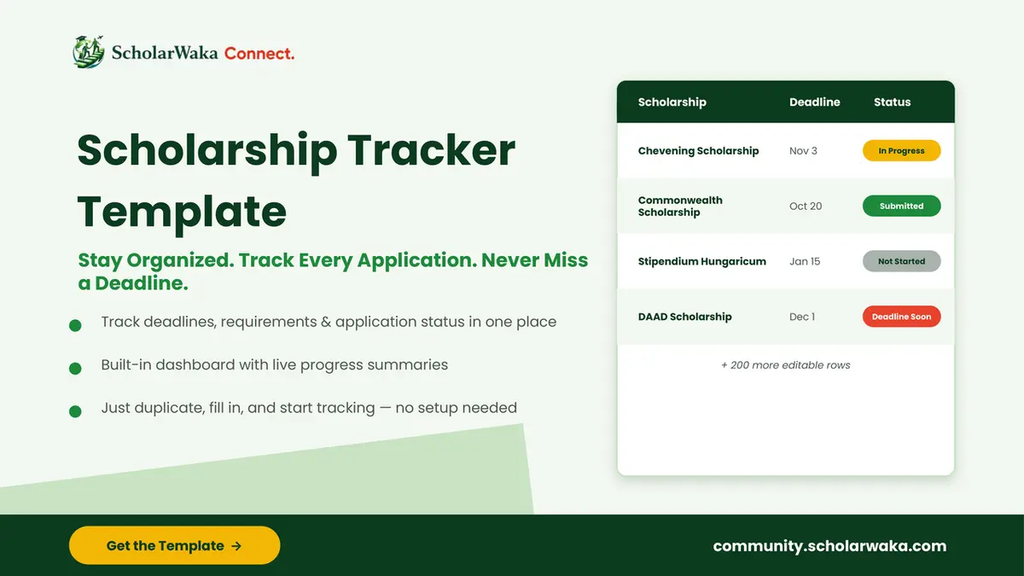
Stay on top of every application and never miss a deadline again – Get a Scholarship Tracker template

Use the Lead Time Deliberately
If an application portal opens in November and closes the following July, that’s genuine time to get your degree certificate processed, request transcripts, prepare for and sit an English proficiency exam, and properly draft your essays rather than scrambling in the final weeks. One detail worth knowing: you don’t need every document finalised before you submit. It’s common for schools to issue admission offers before formally requesting a degree certificate, following up by email afterward for anything still outstanding. Don’t let one missing document stop you from submitting on time.
Sitting an English proficiency test well ahead of your applications rather than during the application window itself gives you a real edge. Having a strong score already in hand when you submit signals genuine preparation, and removes one major source of last-minute stress.
Be Deliberate About Your Referees
Rather than using one fixed CV and reference set for every application, it’s worth maintaining multiple versions of the same academic CV, pairing each with different referees depending on the specific course and which referee’s qualifications or seniority best matches that application. Reach out to potential referees directly by email or phone to confirm willingness before assuming anyone will say yes – most will ask for a draft reference to review rather than writing one cold. For scholarships specifically, check the exact referee categories required: some, including several major Commonwealth-affiliated schemes, expect referees who can speak to your personal, professional, and academic relationships all three, not just one or two. Always send your academic CV alongside any request, so your referee has real material to work from.
Want to learn more from scholars – Join the ScholarWaka Connect Community
If Your Course Requires a Supervisor, Cast a Wide Net
Some programmes require you to secure a prospective supervisor before you can even apply. The most effective approach is reviewing the profile of essentially every relevant lecturer or professor in the department, connecting with as many as possible on LinkedIn, and separately emailing each one directly – departmental and faculty websites usually list staff email addresses, always attaching your academic CV. The logic is straightforward: the more people you reach out to, the higher your odds that at least one will be genuinely willing to take you on as a research student.
Also Learn How to Find and Apply for Scholarships Through Cold Emails
Your Essays Are Where the Real Work Happens
This is the part of the application you cannot afford to approach lazily and a direct warning against plagiarism or reusing someone else’s work: every school runs essays through plagiarism detection as standard practice. A reliable process looks like this:
- Keep one working document for every essay you write, ideally something collaborative like Google Docs particularly valuable if you’re applying to multiple places, since many application questions overlap and you can adapt a strong existing answer rather than starting from zero each time.
- Understand exactly what the question is asking before you start writing.
- Research extensively into both your intended course and the specific school or scholarship body.
- Draft an outline first, capturing the key point for each paragraph before you write full prose.
- Lead every paragraph with your point, not your story. Open with your topic sentence, then bring in the supporting narrative or example, rather than building up to your point at the end.
- Write to hold attention. Bland, generic essays don’t work. A genuinely effective approach leans on painting a relatable, specific scene – something concrete from your own background or experience that shaped your decision to pursue that particular course or school – rather than abstract statements about passion or ambition.
- Respect word and character limits exactly. Never exceed what’s asked.
Scholarship Essays Specifically Need More Than This
Beyond the general essay advice above, several additional points matter specifically for scholarship applications:
- Have clear long-term and short-term goals worked out before you start writing – not discovered mid-draft.
- Don’t lean on “my country is poor, so I desperately need this.” This framing reads as a plea rather than a genuine case for investment, and selection panels have seen it many times over.
- Understand exactly how the scholarship works before applying, so you’re not later discovering commitments or conditions you wouldn’t have agreed to.
- Make sure every essay demonstrates genuine understanding of your course – specifically how it benefits society, your country, and potentially the scholarship’s own network, not just your personal career.
- Give yourself real time to write, edit, and proofread – not a rushed final week.
- Get multiple people to review your essays, specifically aiming for three different strengths: someone working in your intended field, someone with genuinely strong English grammar, and someone who reads critically rather than just skimming for typos. Since it’s rare to find all three in one person, send your drafts to two or three separate reviewers rather than relying on just one.
Read and Join Our Community: ScholarWaka Connect Community (SCC): A Community for Scholarships, Opportunities and Career Growth
Frequently Asked Questions
Do I need all my documents ready before I submit an application?
Not necessarily. Many schools issue admission offers before formally requesting documents like your degree certificate, following up afterward for anything genuinely missing. Submit once you have most of what’s required rather than waiting for complete readiness.
How early should I start preparing for an English proficiency test like TOEFL or IELTS?
As early as possible, ideally before your target application windows even open. Having a strong score in hand before you start applying removes one major source of pressure and signals genuine preparation to admissions panels.
Do all scholarships require the same type of referees?
No – this varies by scholarship. Some expect referees across three categories specifically: personal, professional, and academic. Always check your target scholarship’s specific referee requirements rather than assuming one CV-and-reference combination works everywhere.
Is it acceptable to reuse the same essay content across multiple applications?
Adapting previously written content is reasonable and efficient, since many application questions genuinely overlap — but submitting identical, unmodified content without tailoring it to each specific school or scholarship isn’t advisable, and plagiarism checking is standard practice across most institutions.
Disclaimer: This guide reflects general best practice drawn from common application and scholarship advice. It does not represent official guidance from any specific university or scholarship body. Always confirm current application requirements directly with your target universities and scholarship organisations.
Join ScholarWaka Community
Get the latest scholarship updates and study abroad opportunities before anyone else.