Canada Graduate Research Scholarships Master’s (CGRS M) 2027 | Fully Funded

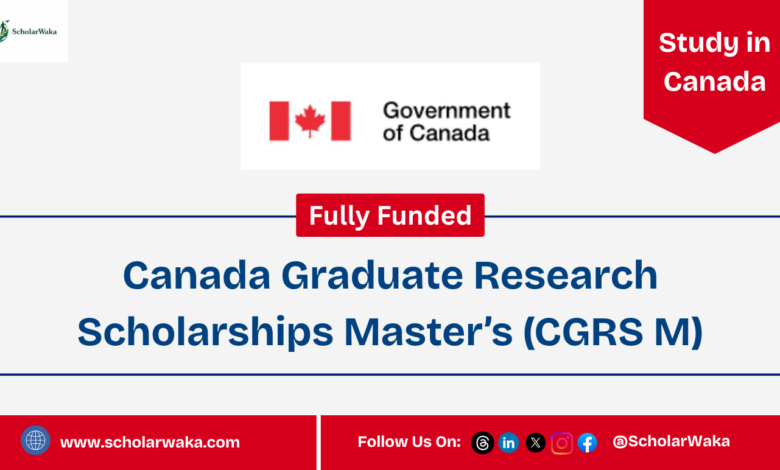
The Canada Graduate Research Scholarships Master’s (CGRS M) program provides prestigious, high-value financial support to exceptional master’s scholars engaged in research-focused programs across all academic disciplines in Canada. Jointly administered by Canada’s three federal research granting councils, CIHR, NSERC, and SSHRC, this national scheme awards up to 3,298 scholarships annually, providing successful recipients with $27,000 over 12 months.
Don’t Miss: Top Fully Funded Scholarships for International Students
The application portal is currently open, with the strict national deadline set for December 1, 2026, at 8:00 PM Eastern Time (which corresponds to 2:00 AM on December 2 in Nigeria). Crucially, candidates should review citizenship criteria before applying: the CGRS M is strictly restricted to Canadian citizens, permanent residents, and protected persons, excluding international students on study permits. Below is an exhaustive overview detailing candidate eligibility, required academic transcripts, Canadian Common CV (CCV) setup, and step-by-step instructions for completing the 11-step portal submission process.
Also, Check Out: Top Fully Funded Master’s Scholarships in Europe
Programme Background
The CGRS M is the master’s-level award in the Canada Research Training Awards Suite, which also contains a doctoral scholarship and a postdoctoral award. Three federal research councils fund and oversee it: the Canadian Institutes of Health Research (CIHR), the Natural Sciences and Engineering Research Council (NSERC), and the Social Sciences and Humanities Research Council (SSHRC). Between them, they cover health research, science and engineering, and the social sciences and humanities.
Also Read: How to Write a Personal Statement for Scholarship | Tips and Free Template
The councils do not pick the winners themselves. Each eligible Canadian university receives a fixed number of awards from each council, and the university’s graduate studies office runs the competition and ranks the applicants. You submit your application through the Research Portal to the university or universities where you plan to study, and that is where it gets judged.
The award exists to fund students whose degrees centre on research. It gives them a year of financial support so they can spend their master’s on a thesis or major research project.
Canada Graduate Research Scholarships Master’s (CGRS M) Summary
| Scholarship Name ⇒ | Canada Graduate Research Scholarships Master’s (CGRS M) |
| Host Country ⇒ | Canada |
| Study Level ⇒ | Master’s |
| Benefits ⇒ | $27,000 for 12 months, with optional supplements of $5,000 to $17,500 for eligible groups and research areas |
| Funded by ⇒ | Canadian Institutes of Health Research (CIHR), Natural Sciences and Engineering Research Council of Canada (NSERC), and Social Sciences and Humanities Research Council of Canada (SSHRC) |
| Eligible Countries ⇒ | Canadian citizens, permanent residents of Canada, and protected persons only |
| Application Deadline ⇒ | December 1, 2026 — 8:00 pm ET (2:00 am WAT, December 2) |
Who Can Apply for the CGRS M
This is the section most readers need first. The rules are strict, and one missed condition makes an application ineligible.
You must:
- Be a Canadian citizen, a permanent resident of Canada, or a protected person under subsection 95(2) of the Immigration and Refugee Protection Act on the application deadline date.
- Be registered in, or have applied (or be about to apply) for admission to, an eligible master’s or doctoral programme at a Canadian institution that holds a CGRS M allocation.
- Meet that university’s own internal deadline for admission applications, which is usually earlier than December 1.
- Have completed between 0 and 12 months of full-time study in the programme you want funded as of December 31 of the application year. This covers a master’s, a direct-entry doctorate straight from a bachelor’s degree, a combined master’s-doctoral programme, a fast-track master’s that moves into a doctorate without a master’s degree, and a master’s whose award continues into a doctorate.
- Alternatively, have completed 4 to 12 months in a master’s that you will finish before the award starts, so you can activate it in the first 12 months of the doctorate that follows.
- Have a first-class average, as the host university defines it, in each of your last two completed years of full-time-equivalent study.
- Never have held, and not currently hold, a master’s-level award from CIHR, NSERC or SSHRC, an Indigenous Scholars Award or Supplement, or CIHR’s designated Indigenous master’s funding.
- Apply to only one Canada Research Training Awards Suite programme in an academic year. If you apply to more than one, only the first eligible application is kept.
Three details cause the most trouble:
- All your graduate study counts toward the 12-month limit, including time at other institutions.
- Part-time study counts proportionally, so two terms at a 50% course load equal one full-time term.
- Universities may accept applicants without a first-class average at their own discretion, so ask your host university before you rule yourself out.
Which programmes qualify? Your programme must be mainly research-based and end in a thesis, major research project, dissertation, scholarly publication, performance, recital or exhibit that a panel of experts reviews. Joint degrees with a professional component, such as MD/PhD, JD/MA or MBA/PhD, and clinical programmes like clinical psychology, qualify if they contain a substantial independent research component. Master’s programmes built only on coursework are typically not eligible. The award is tenable only at eligible Canadian institutions.
What the Award Pays and What You Can Add
The base award is $27,000 for 12 months. Your host university pays it after the relevant council approves the award, and you cannot hold another CIHR, NSERC or SSHRC award at the same time. The one exception is the Research Travel Supplements.
You can add these supplements if your research or background fits:
- Canadian Forest Sector Workforce Diversity supplement
- Canada Research Training Awards Suite – Research Travel Supplements
- CIHR Strategic Master’s Award
- Department of National Defence Mobilizing Insights in Defence and Security (MINDS) supplement, a one-time $10,000 for research tied to the MINDS policy challenges or Canada’s defence policy
- Environment and Climate Change Canada atmospheric and meteorological graduate supplement
- Systematics Research graduate supplement
- Supplement for Research in the Field of Impact Assessment
Funding set aside for specific groups works like this:
- Indigenous Scholars Supplement: $5,000 for successful Indigenous applicants who applied through NSERC or SSHRC. Indigenous applicants on the alternate list may be offered a $27,000 Indigenous Scholars Award plus the $5,000 supplement, within available funding.
- MINDS master’s scholarships for Indigenous students: $17,500, one year, non-renewable.
- Black Scholars Initiative: each council reserves up to 20 additional awards for Black student researchers who self-identify and consent in their application.
You must select each of these options in the application form, and several need extra statements. The MINDS statement of thematic relevance, for example, is capped at 1,500 or 3,000 characters depending on the stream.
How the Selection Works
Each university scores applications on three criteria:
| Criterion | What reviewers look at | Weight |
|---|---|---|
| Academic excellence | Transcripts, awards, scholarships held, programme type and relative standing | 50% |
| Research potential | Research history, quality of your proposal, critical thinking and initiative | 30% |
| Personal characteristics and interpersonal skills | Work and leadership experience, communication skills, volunteering and involvement in academic life | 20% |
Half your score comes from your academic record, so up-to-date official transcripts matter more than any other attachment.
Your choices in the form also affect your odds. You can name up to three host universities, but only one department at each, and that department must match the programme you are applying to. Your application does not go to your current university unless you list it. You cannot change any of these selections after submission.
Choose your field of research carefully. You can pick only one of health, natural sciences and engineering, or social sciences and humanities. The list of universities then narrows to those with an allocation in that field, and a university can relabel an application it considers wrongly categorised.

Documents You Need
A complete application contains five items:
- Application form, including a plain-language summary of your research (1,800 characters maximum, spaces included). If special circumstances affected your record, you get 5,000 characters to explain them.
- Research outline, one page, plus a one-page bibliography, uploaded as a single attachment. Extra pages may be removed before review.
- Official transcripts for all undergraduate and graduate study, including the fall term of the application year even if it shows no grades. Upload one PDF of no more than 15 MB on Letter or A4 paper, with the legend included once. Transcripts in another language need a certified translation, which can take weeks, so request it early.
- Canadian Common CV, created with the CGRS-Master’s funding source and CV type, then linked to your application.
- Two reference assessments from people who know your work, such as a supervisor or thesis advisor.
Reference assessments cause the most late submissions. Your referees must also verify their own Research Portal accounts at least 48 hours before the deadline. Give them a due date well before December 1, because you cannot submit until both assessments are linked to your application.
How to Apply
- Log in to the Research Portal, click Create applications and select the CGRS M programme.
- Complete the application overview: title, field of research, start date, months of study completed, any supplement options and up to three host institutions.
- Fill in the activity details, including themes, certification questions, sex- and gender-based analysis, keywords and any special circumstances. Health applicants must also enter a CIHR PIN.
- Upload your outline of proposed research and bibliography.
- Upload your transcripts.
- Complete and link your Canadian Common CV.
- Invite two referees with a deadline well before December 1.
- Check that every section shows a green checkmark.
- Export the application to PDF and review it. The Submit button appears only after this step, and your CV and reference assessments do not appear in the export.
- Click Submit.
- Accept the terms and conditions. A confirmation email follows, and your status changes to “Received by administrator.”
The portal logs you out after 60 minutes of inactivity, and typing does not count as activity, so save and validate often. If you need technical help, contact the agencies at least 48 hours before the deadline.
Application Timeline
Applications close on December 1, 2026 at 8:00 pm Eastern Time. In Nigeria, that is 2:00 am WAT on December 2, so plan to finish by the evening of December 1. December 1, 2026 falls on a Tuesday, so the weekend and holiday extension does not apply this year.
Portal traffic rises sharply in the final days, and late applications are not accepted. Submit at least a week early, since you cannot edit anything once you submit.
The results follow a fixed timeline:
- Offers appear in the Research Portal from April 1.
- You have 21 days to accept each offer, and you can accept only one.
- Alternate offers can arrive until January 31 of the next year.
- When you accept, you pick one of three start dates, and the portal cannot correct a wrong choice afterwards. You would have to ask your university’s graduate studies office to fix it.
Frequently Asked Questions
Can Nigerian students apply for the CGRS M?
Only if you are a Canadian citizen, permanent resident or protected person; a Nigerian student on a Canadian study permit is not eligible. A Nigerian who holds Canadian permanent residence can apply.
How much does the CGRS Master’s Scholarship pay?
The base award is $27,000 for 12 months. Eligible applicants can add supplements, such as $5,000 for Indigenous scholars or a one-time $10,000 MINDS supplement.
Do I apply to the Canadian government or to a university?
You submit one application through the Research Portal, naming up to three Canadian universities. Each university runs its own competition and decides who receives an offer.
Can I apply without a first-class average?
The rule requires a first-class average in your last two completed years. Universities may accept applicants below that standard at their own discretion, so contact your host university’s graduate studies office before applying.
Can I apply to more than one tri-agency scholarship in the same year?
No. You can apply to only one Canada Research Training Awards Suite programme per academic year, and the councils keep only the first eligible application they receive.
When will I hear the result?
Offers appear in the Research Portal from April 1. Check it regularly until January 31 of the following year, because alternate offers can come at any point.
Disclaimer: All scholarship details, deadlines, award values, and eligibility criteria in this post were verified from official sources as of October 2026. Information is subject to change without notice. Always confirm the latest details directly on the official Canada Graduate Research Scholarships – Master’s (CGRS M) website before submitting your application. ScholarWaka is not affiliated with the Canada Graduate Research Scholarships – Master’s / CIHR, NSERC and SSHRC.
Official Application Portal
Join ScholarWaka Community
Get the latest scholarship updates and study abroad opportunities before anyone else.