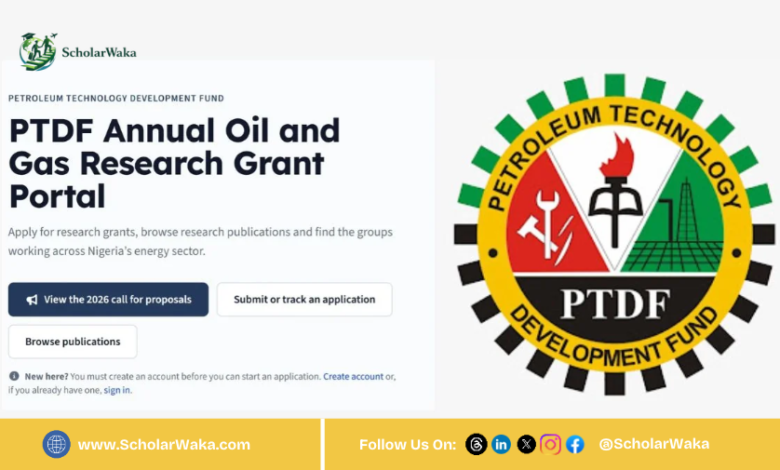
The PTDF Annual Oil and Gas Research Grant 2026 is open now, with project proposals due strictly by Wednesday, February 10, 2027. Administered by the Petroleum Technology Development Fund (PTDF), this competitive funding scheme provides research grants disbursed in milestone-based instalments over a maximum duration of 24 months to Nigerian researchers addressing practical challenges within the oil and gas sector.
Don’t Miss: Top Fully Funded Scholarships for International Students
Unlike student scholarships, this initiative is strictly targeted at established academics; the Principal Researcher must be a senior academic residing in Nigeria leading a multidisciplinary research team. While the official announcement does not disclose specific grant figures, the call outlines eight priority research themes, enforces a strict 5,000-word limit on proposals, and requires shortlisted teams to participate in an oral defence. Below is an exhaustive breakdown of the eight research themes, eligibility requirements, proposal formatting rules, and step-by-step submission instructions.
Also, Check Out: Top Fully Funded Master’s Scholarships in Europe
PTDF Annual Oil and Gas Research Grant Summary
| Scholarship Name ⇒ | PTDF Annual Oil and Gas Research Grant |
| Host Country ⇒ | Nigeria |
| Study Level ⇒ | Competition |
| Benefits ⇒ | Research Grant, Awards and Recognition |
| Funded by ⇒ | Petroleum Technology Development Fund (PTDF) |
| Eligible Countries ⇒ | Nigeria |
| Application Deadline ⇒ | Wednesday 10 February 2027 |
About the PTDF Annual Oil and Gas Research Grant
PTDF is the Federal Government agency that builds Nigerian capacity for the oil and gas industry. This competition aims to enhance, retain and apply Nigerian research capacity to industry problems and to support technology development in the petroleum sector. A Steering Committee of academic and industry experts, policymakers and professional bodies oversees it. PTDF’s office is in Abuja.
Also Read: How to Write a Personal Statement for Scholarship | Tips and Free Template
The Fund calls this the 2026 cycle, even though proposals close in February 2027. Its own news pages describe peer review of earlier awardees, so the programme is already running. A press report says the first round, in 2008, picked five awardees from more than 100 proposals, which suggests places are few.
The Eight Research Themes
Your proposal must sit under one of these themes. The cover page asks you to name it as your “research mission.”
| Theme | Examples named in the call |
|---|---|
| 1. Energy Security, Basin Development and Subsurface Excellence | AI-driven seismic imaging, basin modelling, frontier basins, high-pressure/high-temperature and deepwater systems, digital twins, source-rock modelling |
| 2. Sustainable Production, Enhanced Oil Recovery and Asset Integrity | Smart wells, predictive maintenance, polymer, surfactant, low-salinity and CO₂ recovery, flow assurance, corrosion and scale control, pipeline and subsea integrity, robotics |
| 3. Gas Commercialisation, Utilisation and Flare Reduction | Gas-to-power, gas-to-liquids, mini-LNG and CNG, LPG and petrochemical processing, flare monetisation, modular gas systems, carbon capture, stranded gas |
| 4. Integrated Technologies, Renewables and Low-Carbon Solutions | Solar PV from local materials, hybrid gas-renewable systems, offshore wind, battery storage and microgrids, hydrogen, geothermal, waste-to-energy |
| 5. Environmental Sustainability, Circular Economy and ESG | Bioremediation, nanotechnology cleanup, produced-water treatment, methane reduction, carbon accounting, spill detection, host-community development |
| 6. Digital Oilfield, Automation and Emerging Technologies | AI and machine-learning optimisation, industrial IoT, inspection and drilling robots, cybersecurity, autonomous operations, blockchain, generative AI |
| 7. Facilities Engineering, Infrastructure, Local Content and Industrial Systems | Reliability engineering, brownfield retrofits, energy-efficient operations, local fabrication, additive manufacturing, import substitution, supply chains |
| 8. Energy Economics and Finance, Fiscal Systems, Policy Analytics and Human Capital | Policy evaluation, oil price volatility, fiscal systems, Petroleum Industry Act modelling, carbon markets, green finance, stranded-asset risk, workforce frameworks |
The themes overlap. Digital twins appear in themes 1 and 6, robotics in 2 and 6, and carbon capture in 3 and 4. Choose the theme where your main method sits, because reviewers will read the proposal against that mission.
Eligibility Requirements
You can apply if you are a Nigerian citizen who lives in Nigeria and works in an academic institution, a company, a research organisation or an NGO.
The call adds four conditions:
- The Principal Researcher should be a senior academic. The call does not define “senior,” so ask PTDF if you are unsure whether your rank qualifies.
- Collaboration with industry is strongly encouraged.
- Collaboration with Nigerians abroad is welcome, but the Principal Researcher must reside in Nigeria.
- Multidisciplinary teams have an advantage.
Students are not named as applicants, so a master’s or PhD student should approach a senior academic about joining a team and not apply alone. Researchers living abroad can join a team but cannot lead it.

What the Grant Gives
Successful proposals receive a research grant in instalments, with each release based on milestones. The maximum project length is 24 months.
The call does not say how large the grant is or how many awards PTDF will make. Ask the contacts at the end of this post before you size your budget. The call also lists the costs you may include: personnel, equipment, consumables, data acquisition, travel, institutional charges, digital infrastructure and software licences.
The Budget Rules
The call gives nominal limits for five cost categories:
| Category | Share of budget |
|---|---|
| Equipment | 25% |
| Personnel | 20% |
| Institutional charges | 10% |
| Travel and collaboration | 5% |
| Dissemination | 3% |
PTDF says these limits help you check your own budget before you submit. Two points follow:
- The caps add up to 63%, so 37% of the budget sits outside them. Consumables, data acquisition and software licences fall in that remainder, and the call does not cap them.
- Equipment must come with confirmation that it is available.
A budget close to the caps shows reviewers you read the call. A budget with large uncapped lines needs a strong value-for-money argument.
Writing the Proposal
The call sets out a fixed structure. Your proposal should contain:
- Cover page with your research mission (theme) and project title.
- Executive summary of one page, covering the industry problem, your solution, the commercialisation pathway and the expected technical, economic, environmental or policy impact.
- Background and problem definition, with evidence that the problem matters, such as data, operator needs or regulatory gaps, and its fit with national priorities.
- Literature review and gap analysis, covering current knowledge, existing technologies, gaps, novelty and the Nigerian context.
- Objectives: a main objective, specific measurable objectives and capacity-building objectives.
- Methodology: research design, data sources, tools and models, risk mitigation, ethics and data privacy, and a stakeholder plan where it applies.
- Research plan and timeline, including a Gantt chart with phases, milestones, deliverables and monitoring schedules.
- Commercialisation and adoption plan: technology readiness level, techno-economic analysis, route to market, intellectual property plan, industry role, pilot testing plan and regulatory considerations.
- Research budget and justification, including value for money.
- Capacity-building components: a training plan, knowledge-transfer workshops and expected publications.
- References, tables and figures, and appendices.
The commercialisation plan carries more weight than academic proposals usually give it. It is a required section, and the call lists it among the scoring criteria, so give it real content: a stated technology readiness level, a costed route to market and a named industry partner.
Formatting rules. The maximum is 5,000 words, set in Times New Roman size 12 with 1.5 line spacing and 2.54 cm margins on all sides. Use APA 7 for citations and references. Submissions must carry no personal or institutional identifiers, including names and logos. The call does not say whether references, tables or appendices count toward the 5,000 words, so confirm that with PTDF.
How Proposals Are Judged
A team of academic and industry resource persons shortlists proposals for oral presentation, and shortlisted Principal Researchers defend their work before a panel.
Reviewers assess:
- Industry relevance and problem definition
- Novelty and gap analysis
- Objectives
- Methodology and technical merit
- Research plan and timeline
- Commercialisation and adoption plan
- Budget and value for money
- Team and institutional capacity
The call says these are “among others,” and it publishes no weighting. PTDF has not given a date for shortlisting or results, so watch the portal and your contact channels after you submit.
One rule needs care. The call forbids names, logos and other identifiers in every submission, yet it invites appendices with evidence of collaboration or industry interest. Ask PTDF how to present collaboration letters without breaking the anonymity rule before you assemble your appendices.
How to Apply
- Open the PTDF research portal and create an account. You must register before you can start an application.
- Choose the theme that matches your project.
- Write the proposal to the structure and formatting rules above, and remove every name and logo.
- Build your Gantt chart and budget, and check the budget against the caps.
- Submit through the portal, then track your application there.
Read the full call for proposals before you start writing. For questions, PTDF lists three contacts: Nkechi Ofoegbu ([email protected]), Usman Micheal Oluwasegun ([email protected]) and Seno Albert ([email protected]).
Application Deadline
Proposals are due by Wednesday 10 February 2027. The call gives no closing time, so treat the end of Tuesday 9 February as your limit. You have 86 days, about twelve weeks.
A 5,000-word proposal with a budget, a Gantt chart and a commercialisation plan takes time, and industry partners take longer to answer than you expect. A workable plan is to register on the portal this week, finish an outline by mid-December and submit by the end of January. That leaves the first weeks of February for fixes and for portal problems.
The call mentions no extension and no late entries. The competition is annual, so a later cycle is likely, but PTDF has not published a date.
Frequently Asked Questions
Is the PTDF Annual Oil and Gas Research Grant open?
Yes. Proposals are due by Wednesday 10 February 2027 through the PTDF research portal. PTDF labels it the 2026 cycle.
Can students apply for this grant?
The call does not list students as applicants. The Principal Researcher should be a senior academic. A student can join a team led by one.
Can Nigerians living abroad apply?
They can collaborate, but the Principal Researcher must live in Nigeria. A researcher based abroad cannot lead a proposal.
How much does the grant pay?
The call does not say. It states only that successful proposals receive grants in instalments tied to milestones, for up to 24 months. Ask PTDF’s contacts about the grant size before you prepare your budget.
Can I put my name and institution on the proposal?
No. The call bars personal and institutional identifiers, including names and logos, from all submissions. Follow the portal’s directions for entering your details.
How are proposals chosen?
A panel of academic and industry experts shortlists proposals for oral presentation. Shortlisted Principal Researchers defend them before a panel, and PTDF scores them on the eight criteria listed above.
Disclaimer: All scholarship details, deadlines, award values, and eligibility criteria in this post were verified from official sources as of November 2026. Information is subject to change without notice. Always confirm the latest details directly on the official PTDF Annual Oil and Gas Research Grant Competition website before submitting your application. ScholarWaka is not affiliated with the PTDF Annual Oil and Gas Research Grant Competition / Petroleum Technology Development Fund.
Official Application Portal
Join ScholarWaka Community
Get the latest scholarship updates and study abroad opportunities before anyone else.