The application deadline for the 2026 grant cycle closed on 31 December 2025, and the Fund has since moved through active grant-making — 27 grassroots organisations across 10 countries received awards in a first round announced 11 May 2026, followed by a second round of 31 additional organisations across 18 countries announced 16 July 2026, timed to coincide with the FIFA World Cup 2026 final.
Also, Check Out: Top Fully Funded Master’s Scholarships in Europe
Combined, these two rounds now support 58 organisations reaching more than 400,000 children worldwide. Here’s something worth understanding clearly before planning around a future application: the Fund’s own stated goal was to mobilise USD $100 million specifically by the end of the FIFA World Cup 2026, which means this isn’t structured as a standard recurring annual grant the way most opportunities on this site are — it’s explicitly tied to the World Cup’s fundraising and legacy timeline.
Whether a distinct new application cycle opens after the tournament concludes isn’t yet confirmed, so this guide focuses on what the closed 2026 cycle actually required, while being honest about the uncertainty around what comes next.
Don’t Miss: Top Fully Funded Scholarships for International Students
Understanding the Fund’s Actual Structure
This Fund exists as a joint initiative between FIFA and Global Citizen, deliberately built around the commercial and cultural reach of the 2026 World Cup — funding has come from a mix of philanthropic pledges, corporate donations, and proceeds from major sporting and music events tied to the tournament, including contributions confirmed from the United Arab Emirates, Qatar’s Supreme Committee for Delivery & Legacy, Fox Corporation, and founding donors including Bank of America and MetLife Foundation.
Also Read: How to Write a Personal Statement for Scholarship | Tips and Free Template
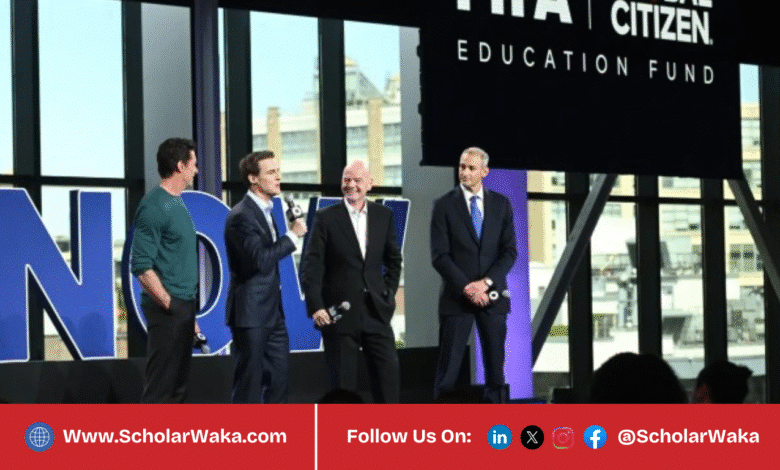
The Fund’s own advisory board includes high-profile figures like FIFA President Gianni Infantino and Global Citizen co-founder Hugh Evans, alongside cultural figures brought in specifically to drive visibility around the World Cup’s social impact legacy.
Because the entire fundraising target was framed around reaching $100 million “by the end of the FIFA World Cup 2026,” it’s reasonable to expect the Fund’s grant-making activity to be concentrated specifically around the tournament period rather than continuing indefinitely as an annual scheme — organisations interested in future funding should watch official channels directly rather than assuming automatic recurrence.
FIFA Global Citizen Education Fund Summary
| Scholarship Name ⇒ | FIFA Global Citizen Education Fund |
| Host Country ⇒ | Global |
| Study Level ⇒ | Competitions |
| Benefits ⇒ | One-time grant of $50,000–$250,000 USD |
| Funded by ⇒ | FIFA and Global Citizen, with corporate and philanthropic donors |
| Eligible Countries ⇒ | All countries |
| Application Deadline ⇒ | Closed 31 December 2025. The Fund’s fundraising goal was explicitly tied to the FIFA World Cup 2026 timeline; future application cycles are unconfirmed |
Who Was Eligible
The FIFA Global Citizen Education Fund—a joint initiative between FIFA and Global Citizen—provides one-year grants (ranging from $50,000 to $250,000 USD) to grassroots organizations expanding access to quality education, literacy, and sports for children in underserved communities worldwide.
To qualify for funding, applicant organizations must meet all mandatory legal, operational, financial, and governance eligibility standards:
1. Organizational Legal Status & Operational Scope
- Legal Registration:
- Must be an officially registered, non-governmental, non-profit organization (NGO), civil society organization (CSO), or community-based organization (CBO).
- In-Country Requirement: The organization must be legally incorporated and compliant within the exact country where the grant project activities will be implemented.
- Grassroots Scale & Direct Beneficiary Threshold:
- Must operate at the community or grassroots level.
- Target Reach: Must provide direct educational, developmental, or sports-based services to between 500 and 10,000 individual children/beneficiaries annually.
- Direct Implementation Requirement (No Intermediaries):
- The applicant organization must possess the internal capacity to implement all proposed project activities directly.
- Prohibition: Subcontracting primary activities, transferring grant funds to fiscal sponsors, or acting as an intermediary funder to third-party sub-grantees is strictly prohibited.
2. Financial Limits, Record History & Child Safeguarding
- Budget Proportionality Constraint (<50% Rule):
- The total grant amount requested (whether for project support or general operating expenses) must be less than 50% of the organization’s total annual operating budget for the proposed grant year.
- Financial Records & Audit History:
- Must demonstrate organizational stability through at least three (3) consecutive years of formal financial statements.
- Verification Standard: Statements must be formally audited by an independent accounting firm or certified by an authorized financial authority.
- Mandatory Safeguarding & Protection Policies:
- Must have established, operational, and legally compliant Child Safeguarding and Protection Policies.
- Must demonstrate formal protocols for background checks, child safety reporting mechanisms, staff ethical conduct standards, and risk mitigation strategies during program delivery.
What Selection Actually Weighed
Applications were assessed against six specific criteria, worth understanding for any organisation considering a future round if one opens. Relevance and impact measured how directly the project addressed real local educational barriers, while equity and inclusion specifically prioritised programmes reaching underserved communities, including girls, learners with disabilities, and other marginalised groups.
Organisational capacity assessed whether the applicant’s structure and leadership could realistically deliver the proposed project, and community participation looked for genuine local engagement and ownership rather than a top-down programme design. Financial responsibility weighed stable financial history and realistic budgeting aligned with the requested grant range, and geographic representation specifically favoured a diverse spread of regions rather than concentrating grants in a small number of countries — reflected in the shift from 10 countries in the first round to 18 in the second.

What the Grant Funded
The FIFA Global Citizen Education Fund provides targeted financial resources, strategic partnerships, and capacity-building mechanisms to strengthen grassroots non-profits expanding access to quality education and sports for children in underserved communities worldwide.
1. Financial Allocation & Grant Structure
- One-Time Direct Grant Allocation:
- Funding Range: Single-year awards ranging from $50,000 to $250,000 USD.
- Budget Proportionality: Sized specifically to match the applicant’s existing capacity, strictly capped at under 50% of the organization’s total annual budget for the proposed funding year.
- Duration: Grants cover a one-year funding term without an automatic renewal or re-application pathway.
- Flexible Funding Tracks:
- General Operating Support: Unrestricted or core funding designed to strengthen the organization’s overarching operational capacity, administrative sustainability, and infrastructure.
- Program / Project Support: Dedicated project-specific funding earmarked for discrete educational campaigns, sports-based learning initiatives, facility enhancements, or inclusive learning programs.
2. Strategic Value, Visibility & Capacity Building
- Global Visibility & Strategic Association:
- Direct association with the global media platforms of FIFA and Global Citizen.
- Heightened exposure to international donors, brand sponsors, and global philanthropy networks tied to major global events like the FIFA World Cup.
- Organizational Development & Impact Enhancement:
- Long-Term Sustainability: Focuses on bolstering grassroots infrastructure, safeguarding systems, and operational frameworks to leave a lasting impact beyond the one-year grant cycle.
- Simplified Due Diligence & Reporting: Grantees receive direct administrative support, mid-term evaluations, and streamlined reporting channels through Foundation Source and Global Citizen platforms.
Documents That Were Required
Applying for the FIFA Global Citizen Education Fund—administered jointly by Global Citizen and FIFA via their electronic portal—requires submitting a complete verification and compliance package. All documents must be clear, high-resolution scans uploaded in PDF format to confirm legal standing, financial health, target beneficiary scale, and child safety compliance.
Incomplete documentation or failure to substantiate any single eligibility threshold results in immediate administrative disqualification.
1. Completed Online Application Form:
- Format: Digital application submitted directly through the official Global Citizen grant portal.
- Required Data Points: Administrative contact info, tax registration numbers, primary operational focus, exact breakdown of grant request (General Operating vs. Project Support), and geographic coordinates of field implementation sites.
2. Proof of Legal Non-Profit Status:
- Document Required: Official Certificate of Incorporation, NGO/CSO registration license, or tax-exempt status certificate issued by the national or sub-national government authority.
- Compliance Rule: The registration must match the exact country where project activities take place. Pass-through or fiscal sponsorship arrangements via foreign umbrella entities are strictly prohibited.
3. Three (3) Consecutive Years of Financial Records:
- Scope: Financial statements covering the last three complete operational fiscal years.
- Certification Standard: Statements must be independently audited by a certified public accounting firm or certified by an authorized national financial body. Must include Balance Sheets, Income/Expense Statements, and cash flow reports.
4. Project / Operational Proposal with Measurable Outcomes:
- Length & Structure: Structured project narrative outlining clear problem statements, target demographics, logic models, and implementation timetables.
- Monitoring Framework: Must define explicit quantitative Key Performance Indicators (KPIs)—such as literacy growth rates, school retention metrics, and sports program participation counts—with a corresponding monitoring and reporting plan.
5. Itemized Budget & 50% Compliance Verification:
- Itemized Budget: Granular cost breakdown covering personnel, program materials, sports/educational equipment, administrative overhead, and monitoring costs.
- Proportionality Verification: Submission of the organization’s total annual budget alongside the grant request to mathematically confirm the requested funding ($50,000–$250,000 USD) represents less than 50% of the overall annual operating budget.
6. Proof of Beneficiary Reach (500–10,000 Range):
- Documentary Evidence: Verified project logs, past annual reports, participant rosters, attendance sheets, or third-party evaluation reports.
- Verification: Must explicitly prove that the organization directly serves a population size of no fewer than 500 and no more than 10,000 individual children/beneficiaries annually.
7. Child Safeguarding & Institutional Policies:
- Safeguarding Policy: Formal, board-approved written policy detailing child protection protocols, code of conduct for staff/coaches/volunteers, and zero-tolerance measures for exploitation or abuse.
- Operational Risk Controls: Documented mandatory background check procedures for all personnel interacting with children, clear incident reporting mechanisms, and data privacy protocols for minor participants
How to Apply
Follow these steps carefully:
- Visit the official website below to begin your application process
- Read the full Grant Overview and prepare your documents on the Fund page.
- Choose your grant type: General Operating Support or Program/Project Support.
- Complete the online form and upload the required documents.
- Ensure the requested amount is <50% of your organisation’s annual budget and that your organisation serves 500–10,000 people.
- Submit before the deadline. After submission, you will receive confirmation. Applicants may hear from Fund staff prior to December 31, 2025, if there are any questions.
What to Do If You’re Interested in Future Funding
Given the Fund’s fundraising target was explicitly framed around the World Cup 2026 timeline, the most reliable step is watching FIFA’s official Global Citizen page and Global Citizen’s own announcements directly for news of any further grant rounds, rather than assuming this reopens on a predictable annual schedule the way a standard recurring grant would.
If your organisation didn’t apply in time for the 2026 cycle, it’s still worth preparing your documentation — audited financials, child-safeguarding policies, and a clear measurable-outcomes proposal — since these are the kind of materials that take genuine time to assemble properly regardless of when or whether a future round opens.
Frequently Asked Questions
Is the FIFA Global Citizen Education Fund still accepting applications?
No. The application deadline for the 2026 cycle closed on 31 December 2025, and two rounds of grants have already been awarded and announced in 2026.
Will there be another application cycle after the World Cup ends?
This isn’t confirmed. The Fund’s fundraising goal was explicitly tied to reaching $100 million by the end of the FIFA World Cup 2026, so future cycles aren’t guaranteed the way a standard annual grant programme would be. Watch official FIFA and Global Citizen channels for updates.
How many organisations have actually received funding so far?
58 organisations across 28 countries combined, following two announced rounds in May and July 2026, benefiting more than 400,000 children worldwide.
Is this grant available to individuals, or only organisations?
Only registered non-profit or community-based organisations. This isn’t an individual scholarship or grant.
What’s the difference between the two funding categories?
General Operating Support strengthens the organisation broadly, while Program/Project Support funds a specific, defined initiative. Applicants choose one category when applying.
Disclaimer: All grant details, deadlines, and eligibility criteria in this post were verified from official FIFA and Global Citizen sources as of August 2026. Whether future application cycles will open is unconfirmed. Information is subject to change without notice. Always confirm the latest details directly on the official FIFA Global Citizen Education Fund page. ScholarWaka is not affiliated with FIFA or Global Citizen.
Official Application Portal
Join ScholarWaka Community
Get the latest scholarship updates and study abroad opportunities before anyone else.