The National Essay Competition isn’t a scholarship in the usual sense — there’s no admission process or funded study abroad involved — but it operates on the same principle: young Nigerians researching, writing, and submitting a case for something real, in this instance a cash prize and national recognition rather than a place at a university.
Don’t Miss: Top Fully Funded Scholarships for International Students
Now in its fourth season, the competition is run by the Nigerian Revenue Service and asks entrants to examine the practical problems NRS faces in implementing recent tax law changes, then argue for solutions. If you’re reading this now, the 2026 entry window has already closed — submissions were due 28 February 2026 — so this post is written primarily for anyone getting ready for the next season, alongside anyone confirming what this year’s competition actually involved.
Also, Check Out: Top Fully Funded Master’s Scholarships in Europe
About the National Essay Competition
The Nigerian Revenue Service organises this competition annually as a way of pulling young Nigerians directly into conversations about tax policy and public finance — subjects that rarely get engaged with outside of professional or academic circles. Season 4’s assigned topic asked entrants to analyze the challenges NRS faces in implementing new tax laws and propose practical solutions to address them, a deliberately specific brief rather than an open-ended essay prompt.
Also Read: How to Write a Personal Statement for Scholarship | Tips and Free Template
The competition sits at the intersection of civic engagement and skill-building: entrants sharpen research and analytical writing ability while contributing ideas that, in principle, feed into national policy discourse on taxation and revenue administration. Entries are judged by a panel assessing clarity, evidence-based reasoning, originality, and how directly the essay engages with the assigned theme — meaning a well-written essay that drifts from the specific topic scores lower than a rougher one that stays tightly focused on it.
National Essay Competition Summary
| Scholarship Name ⇒ | National Essay Competition |
| Host Country ⇒ | Nigeria |
| Study Level ⇒ | Competitions |
| Benefits ⇒ | Cash prizes, national recognition, and certification |
| Funded by ⇒ | Nigerian Revenue Service (NRS) |
| Eligible Countries ⇒ | Nigeria |
| Application Deadline ⇒ | 2026 season closed 28 February 2026. Watch for Season 5 — expect an announcement early in the year, based on this season’s timing. |
Prizes and What Winners Receive
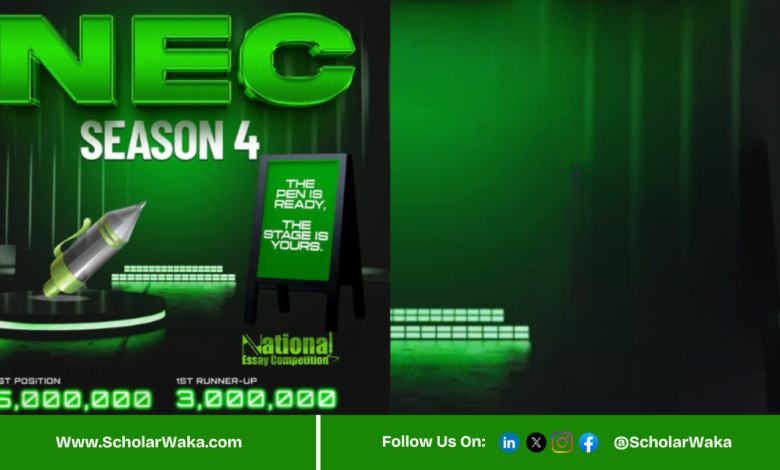
The reward structure is built around a total prize pool, split across the top three positions rather than distributed evenly:
- First prize: ₦5,000,000
- Second prize: ₦3,000,000
- Third prize: ₦2,000,000
- National recognition: strong essays may be featured on NRS’s official platforms, giving winners visibility beyond the cash award itself
- Certification: participants and winners receive formal recognition of their participation and placement
- Skill development: entrants sharpen research, policy analysis, and academic writing ability regardless of where they place — several past entrants have cited the process itself as valuable preparation for further academic or policy work
One detail worth confirming directly with NRS before assuming it applies to you: the exact prize figures are set by the organisers each season and can shift slightly from year to year, so treat the amounts above as this season’s figures rather than a permanent structure.
Eligibility Requirements
- You must be a Nigerian citizen
- You must be between 20 and 35 years old
- Persons with disabilities are explicitly encouraged and eligible to participate — this isn’t a passive accommodation but a stated inclusion
- Your submission must be entirely original work, free of plagiarism
- You may submit only one entry — a second submission doesn’t improve your odds and may disqualify both
Worth noting: some official NRS communications for this competition have described it as open specifically to undergraduate students, while other materials state the broader 20-35 age eligibility without a schooling requirement. If you fall in the 20-35 range but aren’t currently enrolled as an undergraduate, confirm directly on the official NRS competition page before assuming you qualify — this is the kind of detail that’s worth a direct check rather than an assumption either way.

Required Documents
- Typed essay, 1,000-1,500 words, addressing the assigned topic directly. Essays that wander into general tax commentary without engaging the specific brief — analyzing NRS’s implementation challenges and proposing solutions — score lower regardless of writing quality.
- PDF format, and only PDF. Submissions in Word, text, or any other format are not accepted, so convert and check your file opens correctly before uploading — a corrupted or incorrectly converted PDF can render your entry unreadable to judges even after a successful upload.
- Personal information, including your full name, contact details, and any additional identifying information the submission portal requests. Double-check this section before submitting, since a competition run entirely online has no way to contact you about an entry with an incorrect email or phone number.
- Originality confirmation, meaning your essay must be your own unpublished work and must follow the competition’s formatting and plagiarism standards. Some past entrants have run their drafts through plagiarism-checking tools before submission as a precaution — worth doing given how directly this criterion factors into judging.
Two practical notes that don’t always make it into competition announcements: some past seasons of this competition have referenced specific formatting expectations (font, spacing, citation style) in the fine print of the official portal rather than the main announcement, so read the submission page itself rather than relying on secondhand summaries. And because entries are judged on evidence-based reasoning, essays that cite specific tax law provisions or NRS initiatives by name tend to stand out more than essays arguing in generalities.
How to Apply
- Visit the official National Essay Competition submission portal.
- Complete the required personal information fields on the submission form.
- Upload your essay as a PDF, checking the maximum file size and any other technical specifications listed on the portal.
- Confirm your submission is original work and complies with the competition’s stated guidelines.
- Submit your entry before the stated deadline and check for a confirmation email or message verifying your entry was received.
How to Prepare for the Next Season
Since Season 4 has closed, the months ahead are for building a stronger entry rather than waiting for an announcement:
- Follow developments in Nigeria’s tax reform implementation now, since future seasons are likely to assign a topic tied to current NRS priorities — entrants who understand the policy landscape before the topic is announced write stronger essays under time pressure.
- Practice writing to a strict word count. 1,000-1,500 words is tight for a policy argument with evidence, and past entrants have found that trimming a longer draft down is harder than writing concisely from the start.
- Draft and revise before the topic is even announced, using past seasons’ themes as practice prompts — NRS’s essay topics have consistently centered on tax law implementation and revenue administration, so that general area is a safe starting point.
- Check the official NRS competition page directly once a new season is expected, rather than relying on third-party scholarship sites, since deadline and eligibility details have occasionally varied slightly between how NRS states them and how they’re repeated elsewhere.
Deadline
Season 4 closed on 28 February 2026, and late entries were not accepted. Based on this season’s timing, expect Season 5 to open in the earlier months of the following year, though NRS has not published a fixed annual schedule. Check the official NRS competition page directly rather than waiting for a fixed date.
Frequently Asked Questions
Is the National Essay Competition open to Nigerians living abroad?
Eligibility is based on Nigerian citizenship rather than residency in the source materials available, but confirm directly with NRS whether entrants must be resident in Nigeria to submit, since this isn’t stated explicitly across all official communications.
Are there entry fees?
No entry fee is mentioned in the official competition materials. Be cautious of any third-party page asking for payment to “register” for this competition, since the official process runs through NRS’s own portal.
What happens if I already missed the Season 4 deadline?
Season 4 closed on 28 February 2026, but the competition has run for four consecutive seasons, so a Season 5 is a reasonable expectation. Use the time now to practice writing on tax and revenue topics so you’re ready when a new topic is announced.
Is this competition only for undergraduate students?
Sources vary on this point — some official materials describe eligibility broadly as Nigerians aged 20-35, while others reference undergraduate status specifically. Confirm your eligibility directly on the official NRS portal rather than assuming either version applies to your situation.
Disclaimer: All competition details, deadlines, and prize values in this post were verified from official and reported sources as of July 2026. Information is subject to change without notice. Always confirm the latest details directly on the official Nigerian Revenue Service competition page before submitting an entry. ScholarWaka is not affiliated with the Nigerian Revenue Service.
Official Application Portal
Join ScholarWaka Community
Get the latest scholarship updates and study abroad opportunities before anyone else.