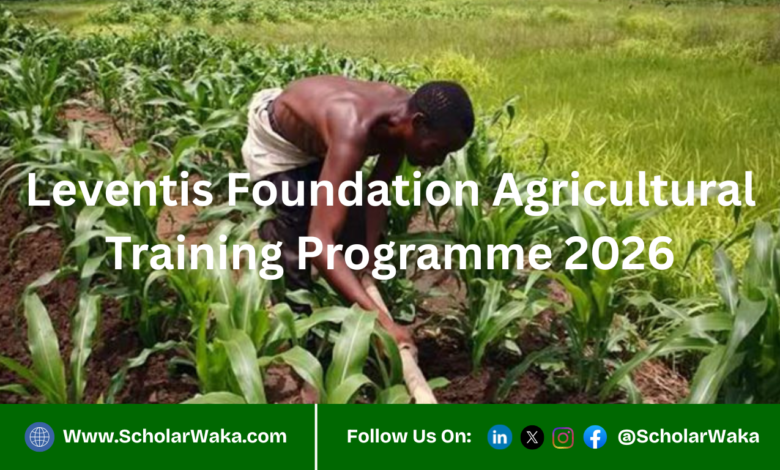
Nigeria’s agricultural sector faces a genuine, well-documented paradox: the country has enormous farmland and a young population eager for opportunity, yet a persistent shortage of people trained in modern, productive farming methods rather than subsistence techniques passed down informally.
Also, Check Out: Top Fully Funded Master’s Scholarships in Europe
The Leventis Foundation has spent nearly four decades working directly against that gap, and its One-Year Agricultural Training Programme represents one of the more substantial, genuinely free responses to it available to young Nigerians today — not a short workshop or a certificate weekend, but a full year of residential, hands-on training designed to turn passionate but untrained applicants into genuinely skilled, employable farmers and agribusiness operators.
If you’re checking this now, the 2026 cycle has already closed on both fronts: applications shut on 21 February 2026, and the entrance examination for shortlisted candidates took place a week later, on 28 February 2026. This post walks through exactly what the programme involves, what makes it distinctive among Nigeria’s agricultural training options, and what to prepare for whenever the next intake opens.
Don’t Miss: Top Fully Funded Scholarships for International Students
Leventis Foundation Agricultural Training Programme Summary
| Scholarship Name ⇒ | Leventis Foundation Agricultural Training Programme |
| Host Country ⇒ | Nigeria |
| Study Level ⇒ | Training |
| Benefits ⇒ | Fully funded tuition, boarding, and feeding |
| Funded by ⇒ | Leventis Foundation Nigeria, co-funded with respective State Governments |
| Eligible Countries ⇒ | Nigeria |
| Application Deadline ⇒ | 2026 cycle closed 21 February 2026, with the entrance examination held 28 February 2026 — both stages complete. Watch for the next intake, likely opening around January, based on this cycle’s timing. |
About Leventis Foundation Agricultural Training Programme
The Leventis Foundation Nigeria was established in 1987 as a charitable organisation with a specific, sustained mission: training farmers in modern, sustainable agricultural practices and the responsible use of natural resources, rather than simply distributing aid or equipment without the skills to use them effectively.
Also Read: How to Write a Personal Statement for Scholarship | Tips and Free Template
Over nearly forty years, that mission has translated into a genuinely substantial physical footprint — six agricultural training schools spread deliberately across different agro-ecological zones of Nigeria, meaning trainees learn techniques suited to the specific climate and soil conditions of the region they’re likely to farm in afterwards, rather than a one-size-fits-all national curriculum.
These schools sit in the Federal Capital Territory (with locations in both Yaba and Abaji), Osun State (Ilesa), Kano State (with locations in both Panda and Albasu), and Gombe State, each co-funded jointly by the Leventis Foundation and the respective State Government — a partnership structure that’s helped sustain the programme’s reach and consistency over the decades.
Beyond the flagship one-year programme, the Foundation also runs shorter, targeted courses and consultancy services in specific areas — poultry production, beekeeping and honey production, fish farming, mushroom production, greenhouse farming and hydroponics, and climate-smart agriculture among them — giving a sense of just how comprehensively the Foundation has built out its agricultural training ecosystem beyond the core residential course.
What the Programme Genuinely Covers
- Full tuition coverage for the entire one-year residential course, with no fees charged to trainees at any point
- Free boarding, meaning accommodation at your assigned training school is provided at no cost throughout the year
- Free feeding, covering meals for the full duration of the programme — a detail worth appreciating fully, since removing food and housing costs entirely changes what’s realistically accessible for a young Nigerian without existing financial resources
- A genuinely comprehensive curriculum, spanning crop production, value-added processing, animal and fishery production, farm management and extension services, agroforestry and beekeeping, and enterprise and agribusiness development — this isn’t narrow technical training in one farming method, but a broad, practical education across the agricultural value chain
- A structured pathway into a farming or agribusiness career, backed by nearly four decades of the Foundation’s track record and reputation within Nigeria’s agricultural sector
What makes this programme’s funding model distinctive compared to many training programmes in this series: there’s no partial coverage, no stipend requiring you to cover remaining costs yourself, and no hidden fees layered on top of the “free” framing. Tuition, housing, and food are genuinely and completely covered for the full year.

Who Can Realistically Apply
- You must be physically fit, given the genuinely hands-on, practical nature of agricultural training
- You must be able to read and write in English, generally evidenced by at least a junior secondary school education
- You must be between 18 and 40 years old
- You must pass both a written and an oral test as part of final selection — this is a genuine, competitive screening process, not a formality following application submission
- You must demonstrate real, perceivable interest in agriculture, assessed through both your application and your performance in the entrance examination
- Proof of a farming background is considered an advantage, though not stated as a strict requirement — applicants without prior farming exposure but with genuine motivation and the right attitude aren’t automatically excluded
The eligibility detail worth being realistic about: passing both written and oral tests is a genuine hurdle, not a rubber stamp. Given how comprehensive and well-regarded this programme is, and that it’s completely free, expect real competition for places, and prepare for the examination with the same seriousness you would any competitive entrance test.
What You’ll Need on Examination Day
- A handwritten cover letter — worth noting this specifically requires handwriting rather than a typed document, a detail some applicants miss
- A letter of attestation, signed either by the Chairman or Secretary of your Local Government of Origin, or by a Justice of the Peace — this needs to come from one of these specific authorities, not a generic reference
- Two recent passport-sized photographs
- Three reference letters
- Photocopies of your academic qualifications, or other relevant supporting documents
These documents are specifically required to be brought on the day of the examination itself, rather than uploaded during the initial online registration — meaning your preparation timeline needs to account for gathering physical documents, particularly the attestation letter, well before the exam date, not just completing the online form.
How the Application Process Works
- Visit the official Leventis Foundation application portal.
- Complete the online registration form, providing details including your state of residence, gender, marital status, highest education level, and your preferred training school from the six available locations.
- Use the “save as draft” option if you need to complete your application across multiple sessions, then return to finish and submit it.
- Submit your completed application before the stated deadline.
- Prepare for the entrance examination, gathering your handwritten cover letter, attestation letter, photographs, reference letters, and academic document copies in advance.
- Attend the scheduled written and oral examination at your chosen training school location, bringing all required physical documents with you.
- Await selection results following the examination.
How to Prepare for the Next Intake
With this cycle’s application window and examination both closed, the coming months are for building genuine readiness ahead of the next intake:
- Start gathering your Local Government or Justice of the Peace attestation letter early, since this depends on an external authority’s availability and process, not something you can produce quickly close to a future deadline.
- Practice both written and oral communication about your interest in agriculture specifically, since the oral component of selection means you need to be able to articulate your motivation clearly in person, not just on paper.
- If you don’t have a farming background, look for ways to build genuine, demonstrable exposure to agriculture now — volunteering, working on a family or community farm, or engaging with local agricultural extension programmes — since this is explicitly noted as an advantage in selection.
- Decide which of the six training school locations genuinely fits your circumstances, considering the specific agro-ecological zone and your own regional ties, since this is a residential commitment for a full year.
- Watch the official Leventis Foundation Nigeria website directly, since this cycle’s window opened in January with a February deadline — a pattern worth anticipating for the next intake.
Deadline
The 2026 application window closed on 21 February 2026, with the entrance examination for shortlisted candidates held on 28 February 2026. Based on this cycle’s timing, expect the next intake’s application window to open around January, though the Leventis Foundation does not guarantee an identical date every year. Check the official Leventis Foundation Nigeria website (leventisfoundation.org.ng) directly rather than relying on a fixed date.
Frequently Asked Questions
Is the Leventis Foundation Training Programme genuinely completely free?
Yes. Tuition, boarding, and feeding are all provided at no cost to successful trainees for the full one-year residential programme, with no partial coverage or hidden fees.
Can applicants without a farming background apply?
Yes. While proof of a farming background is considered an advantage, it isn’t a strict requirement — genuine, demonstrated interest in agriculture matters most, assessed through the written and oral examination.
What happens if I already missed the 2026 deadline and examination?
This cycle has fully closed, with the examination already held on 28 February 2026. Watch the official Leventis Foundation Nigeria website for the next intake’s announcement, likely opening around January.
Can I choose which training school I attend?
Yes. The online application form asks for your preferred training school among the six available locations, though final placement may depend on availability and other factors in the selection process.
Is there an age limit?
Yes. Applicants must be between 18 and 40 years old at the time of application.
Disclaimer: All programme details, deadlines, and eligibility criteria in this post were verified from official and reported sources as of July 2026. Information is subject to change without notice. Always confirm the latest details directly on the official Leventis Foundation Nigeria website before submitting an application. ScholarWaka is not affiliated with the Leventis Foundation.
Official Application Portal
Join ScholarWaka Community
Get the latest scholarship updates and study abroad opportunities before anyone else.