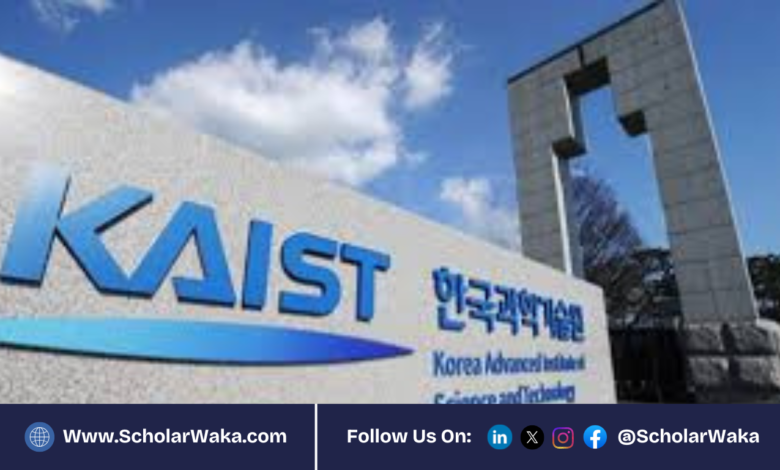
KAIST holds a distinct place in Korea’s academic landscape as the country’s first research-oriented graduate school, founded in 1971 specifically to build the scientific and technical talent base Korea needed to industrialise and compete globally — a mission that’s shaped the institution’s identity for over five decades since.
Also, Check Out: Top Fully Funded Master’s Scholarships in Europe
The KAI-X Research Internship Program is one of the ways KAIST extends that mission internationally, opening its research labs each summer to undergraduate and master’s students from around the world who want genuine, hands-on exposure to advanced scientific research rather than a passive campus visit.
If you’re checking this now, this year’s application window has closed — it ran from 19 January to 15 February 2026 — results were sent out in mid-April 2026, and the seven-week internship itself is currently in progress, running from 1 July through 14 August 2026. This post covers exactly how the programme works and what to prepare for the next cycle, expected to open again around January 2027.
Don’t Miss: Top Fully Funded Scholarships for International Students
About the KAI-X Research Internship Program
KAI-X stands for KAIST Advanced Institute for Science-X, and the programme it runs each summer is deliberately narrow in academic scope — this isn’t a general STEM internship, but one focused specifically on natural sciences, spanning Physics, Chemistry, Mathematics, Biology, Brain and Cognitive Science, and Medical Science.
Also Read: How to Write a Personal Statement for Scholarship | Tips and Free Template
That specificity matters for how the programme is structured: rather than a broad, loosely defined placement, interns are matched into KAIST research laboratories under the direct supervision of faculty and researchers actively working in these fields, contributing to genuine, ongoing research rather than working through a standardised training curriculum.
Applicants select a single major field and can choose up to two specific research areas within it, which shapes exactly which lab and project they’re considered for — meaning the strength of your application is judged not just generally, but against how well your background fits the specific research area you’ve indicated interest in. By the end of the seven weeks, interns are expected to present their findings, giving the programme a genuine capstone structure rather than an open-ended period of general lab exposure.
KAI-X Research Internship Program Summary
| Scholarship Name ⇒ | KAI-X Research Internship Program |
| Host Country ⇒ | South Korea |
| Study Level ⇒ | Internships |
| Benefits ⇒ | Travel reimbursement, accommodation support, and living expense support |
| Funded by ⇒ | Korea Advanced Institute of Science and Technology (KAIST) |
| Eligible Countries ⇒ | All countries |
| Application Deadline ⇒ | 2026 cycle closed 15 February 2026, 24:00 Seoul time. Results were announced mid-April 2026. The programme is currently underway. Expect the next application window to open around January 2027. |
What Selected Interns Actually Receive
- Round-trip airfare reimbursement, up to 1,000,000 KRW — reimbursement rather than an upfront payment, so budgeting for the initial travel cost yourself before reimbursement is worth planning for
- Dormitory accommodation support, up to 500,000 KRW, covering your housing during the seven weeks in Daejeon
- Living expense support of 600,000 KRW, contributing toward day-to-day costs throughout the programme
- No application fee and no IELTS or similar English test requirement, lowering the practical barrier to applying compared to some international research programmes
- Direct supervision from KAIST faculty and researchers, working on genuine, active research rather than a simulated training exercise
- A structured capstone presentation, where interns present their findings by the end of the seven weeks — a concrete, tangible outcome to your placement rather than an open-ended experience with no clear culmination
Worth understanding the funding structure clearly: this is support across three separate categories (travel, accommodation, living expenses) rather than one consolidated stipend, with defined maximum amounts for each rather than a flat total. Treat the figures as ceilings tied to actual costs where relevant, not necessarily guaranteed flat payouts regardless of your specific circumstances.
Eligibility Requirements
- You must be an overseas undergraduate student in your 3rd or 4th year, or a Master’s student — this specific year-of-study requirement for undergraduates matters, since 1st or 2nd year undergraduates generally don’t meet this bar
- Doctoral students are explicitly not eligible for this specific programme
- You must be studying in a natural science-related field: Physics, Chemistry, Mathematics, Biology, Brain and Cognitive Science, or Medical Science
- You must be able to prepare and submit all application documents in English
- You must select one major field and up to two specific research areas within it as part of your application
The eligibility detail worth being precise about: this programme’s natural science focus is a genuine restriction, not a loose guideline. If your field sits in engineering, computer science, or the social sciences rather than the specific list above, this particular KAI-X cycle isn’t the right fit, even if KAIST runs other, separate internship or exchange programmes better suited to your discipline.

Required Documents
- A Statement of Purpose, approximately 1,200 characters — given this tight limit, treat it as a document requiring genuine precision and multiple rounds of editing, not a first-draft submission
- An official academic transcript, issued within the last three months — an older transcript, even if otherwise complete, doesn’t meet this recency requirement
- A letter of recommendation, also issued within the last three months, which must clearly state the programme name (“2026 Summer KAI-X Research Internship Program”) and include your recommender’s full name, email address, university affiliation, and title or position
- Notarized English translations for any documents not already in English — submitted alongside, not instead of, the original documents
All documents need to be combined into a single PDF file before upload — KAI-X’s own guidance is explicit that incomplete submissions, multiple separate PDF files, or incorrect file formats risk exclusion from evaluation entirely, so this isn’t a step to treat casually.
How to Apply
- Prepare a Google account in advance, since the application is hosted entirely through Google Forms and you must be logged in to access, submit, and later edit your application.
- Prepare all required documents in English, including notarized translations for any non-English originals.
- Combine all documents into a single PDF file.
- Complete the official Google Form application, selecting your one major field and up to two research areas of interest.
- Upload your combined PDF to the form.
- Submit the form once — KAI-X explicitly states multiple submissions aren’t permitted and may result in disqualification.
- If needed, edit your responses using the Google Form’s edit link before the deadline, logging in with the same Google account used for your original submission — no edits are possible once the deadline passes.
- Wait for results, expected in mid-April, communicated through the official KAI-X website and individual notification to selected applicants.
How to Prepare for the Next Application Cycle
With this cycle’s results already out and the programme itself nearing its conclusion, the coming months are for building toward the next cycle, expected to open around January 2027:
- Draft your Statement of Purpose early, given its tight 1,200-character limit. Precision under a strict character count takes real revision, so don’t leave this until close to a future deadline.
- Request your academic transcript and recommendation letter with the three-month recency requirement in mind — timing these correctly relative to whenever the next application window opens matters, since requesting them too early risks them expiring before submission.
- Brief your recommender clearly on what needs to be included — the programme name, and their full name, email, affiliation, and title — since a letter missing these specific details risks not meeting the requirement even if the letter itself is strong.
- Arrange notarized English translations early if any of your documents aren’t already in English, since this step often takes longer than expected depending on your country’s notarization process.
- Think carefully about which one major and up to two research areas best reflect your genuine background and interest, since this shapes which specific labs and projects you’re considered for.
Deadline
The 2026 application period ran from 19 January to 15 February 2026, 24:00 Seoul time (UTC+9), and this window has closed. Results were announced in mid-April 2026, and the seven-week internship is currently running through 14 August 2026. Based on this consistent pattern, expect the next application window to open around mid-to-late January 2027, though KAI-X does not guarantee identical dates every year.
Frequently Asked Questions
Is the KAI-X internship fully funded?
Largely, yes. It covers round-trip airfare reimbursement, dormitory accommodation support, and living expense support, each with defined maximum amounts, and there’s no application fee.
Can doctoral students apply?
No. This specific programme explicitly excludes students currently enrolled in a doctoral degree programme.
Do I need to submit an IELTS score to apply?
No. KAI-X does not require IELTS or a similar English proficiency test for this programme.
What happens if I already missed the 15 February 2026 deadline?
This cycle’s applications are closed, results have been announced, and the internship is currently underway. Use the coming months to prepare your Statement of Purpose, transcript, and recommendation letter ahead of the next cycle, expected around January 2027.
Can I apply if my field is engineering or computer science rather than natural sciences?
No, not through this specific programme. KAI-X’s 2026 cycle was restricted to Physics, Chemistry, Mathematics, Biology, Brain and Cognitive Science, and Medical Science specifically.
Disclaimer: All programme details, deadlines, and eligibility criteria in this post were verified from official sources as of July 2026. Information is subject to change without notice. Always confirm the latest details directly on the official KAI-X website before submitting an application. ScholarWaka is not affiliated with the Korea Advanced Institute of Science and Technology.
Official Application Portal
Join ScholarWaka Community
Get the latest scholarship updates and study abroad opportunities before anyone else.