SK Global Scholarship Program 2026 at Korea University | Fully Funded

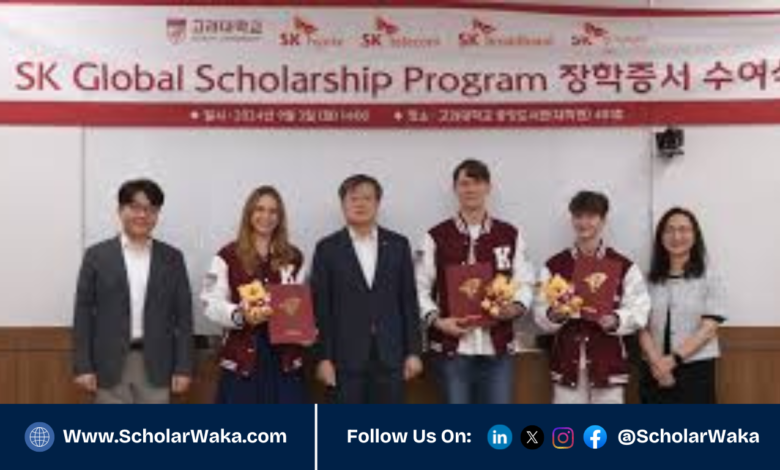
There’s a specific kind of scholarship that only makes sense once you understand exactly what problem it’s solving, and this is one of them South Korea isn’t just funding graduate education here, it’s specifically recruiting the next generation of talent in the two fields it considers most strategically critical to its economic future: semiconductors and artificial intelligence. That focus is precisely why the SK Global Scholarship splits its 20 annual places exactly in half between AI/IT and Semiconductor Engineering, rather than spreading funding thinly across every discipline Korea University offers.
Worth knowing as you read this: the 2026 application window closed on 31 March, and Korea University announced final results on 4 or 5 June, so this cycle has already run its full course. This guide covers the full eligibility picture, including the specific country list that determines whether you can apply at all, exactly what the funding breaks down to, and how to prepare properly if you’re aiming for the Fall 2027 intake instead.
SK Global Scholarship Program Summary
| Scholarship Name ⇒ | SK Global Program |
| Host Country ⇒ | South Korea |
| Study Level ⇒ | Masters |
| Benefits ⇒ | Fully Funded — tuition, monthly stipend, airfare, medical insurance, admission fee |
| Funded by ⇒ | Korea University Graduate School, Seoul |
| Eligible Countries ⇒ | 34 regions across Europe, Southeast Asia, East Asia (Semiconductor field only for Japan/Taiwan), and South Asia |
| Application Deadline ⇒ | 2026 cycle: 3–31 March 2026, now closed. Final results were announced 4–5 June 2026 |
What the SK Global Scholarship Program Involves
Korea University runs this scholarship through its Graduate School specifically to build international talent pipelines in the technology sectors South Korea has prioritised nationally. Every year, the programme admits up to 20 students split evenly: ten in AI/IT-related fields and ten in Semiconductor Engineering, spanning departments that include Electrical and Computer Engineering, Physics, Software Engineering, Computer Security, and Radio Communications Engineering.
Unlike many broad international scholarships that welcome any discipline, this one is deliberately narrow, and that narrowness is the whole point it exists to strengthen academic and technological cooperation between South Korea and a specific, defined list of partner regions, funnelling talented graduates directly into the fields Korea University and its industry partners consider genuinely strategic.
What This Scholarship Actually Pays
- Round-trip airfare, up to 3,000,000 KRW
- Full tuition coverage, at 7,392,000 KRW per semester, across the full four-semester Master’s programme
- Admission fee coverage, around 1,142,000 KRW
- A monthly living stipend of 1,500,000 KRW, paid for the full two years of the programme
- Medical insurance coverage throughout the programme
- Optional Korean language training support, where the cost exceeds 1,000,000 KRW
This is a genuinely comprehensive package, covering essentially every major cost from arrival through to graduation, without requiring separate applications for tuition and living support the way some scholarships split funding across multiple bodies.

Eligibility Requirements
- You need citizenship from one of the eligible regions listed below this is a fixed, non-negotiable list, and citizenship from a country not on it disqualifies you regardless of your academic profile
- Your parents need to hold citizenship outside South Korea this scholarship specifically targets non-Korean applicants and their families
- You need to hold, or be expecting to obtain before enrolment, a Bachelor’s degree final-year undergraduate students can apply based on expected graduation
- You need to meet the English or Korean language proficiency threshold through one of several accepted tests
- You need to be applying specifically for a Master’s programme in AI/IT or Semiconductor-related fields at Korea University
- You need to meet Korea University Graduate School’s standard admission requirements on top of the scholarship-specific criteria
Which Countries Actually Qualify
The eligible country list spans four regions, and it’s worth checking directly since it’s more specific than a broad continental grouping:
- Europe: Austria, Belarus, Bosnia and Herzegovina, Bulgaria, Croatia, Czech Republic, Georgia, Hungary, Latvia, Lithuania, Moldova, Montenegro, North Macedonia, Poland, Romania, Serbia, Slovakia, Slovenia, Ukraine
- Southeast Asia: Brunei, Cambodia, East Timor, Indonesia, Laos, Malaysia, Myanmar, the Philippines, Singapore, Thailand, Vietnam
- East Asia: Japan and Taiwan, but only for the Semiconductor field specifically, not AI/IT
- South Asia: India and Pakistan
That East Asia restriction is easy to miss: Japanese and Taiwanese applicants qualify only if they’re applying for the Semiconductor track, not the AI/IT track. If you’re from either country and aiming for AI/IT specifically, this scholarship doesn’t apply to you.
What Language Proficiency You Need
You need to meet just one of the following thresholds, whichever fits your background:
- TOEFL iBT 71 or higher
- IELTS 5.5 or higher
- CEFR B2 level or higher
- New TEPS 326 or higher
- TOPIK Level 3 or higher
If you completed your previous degree entirely in English, this requirement is sometimes waived worth confirming directly with the Graduate School Administration Team if this applies to you, rather than assuming either way.
What Documents You Need to Prepare
- A completed online application form
- Your Bachelor’s degree certificate, or an expected graduation certificate if you’re a final-year student
- Academic transcripts
- Proof of your English or Korean language proficiency
- A copy of your passport or other identification document
- Any additional supporting documents your specific department requests
- A recommendation letter, sent directly by your referee via email by the stated deadline, not submitted by you on their behalf
Every document needs to be uploaded as a clear scanned copy, not a photograph, and anything not originally in Korean or English needs a certified translation attached.
How To Apply
- Visit the Korea University Graduate School admission portal directly
- Refer to the official Online Application System Manual before starting, since the process has specific formatting and upload requirements
- Complete the online admission application in full
- Select your preferred field of study AI/IT or Semiconductor at the point of application, since this determines which of the 10 available places in each track you’re competing for
- Upload every required document as clear, legible scans
- Ensure your referee sends their recommendation letter directly by email, ahead of the stated deadline
- Review your entire application carefully before submitting Korea University does not allow edits after submission, so errors need to be caught beforehand
- Submit before the deadline and wait for review, which is conducted through document evaluation by the relevant academic department, with interviews requested only in some cases rather than as a universal stage
- Wait for final results, published online through Korea University’s official channels
Application Timeline
- Online application submission: 3–31 March 2026, now closed
- Document submission window: Extended slightly beyond the application deadline in some cycles, running through to mid-April
- Review process: Conducted by the Graduate School and relevant academic departments, based primarily on document evaluation
- Final results: Announced online around 4–5 June 2026 this has already happened for the current cycle
- Programme start: Fall 2026 intake, for successful applicants from this cycle
- Next expected cycle: Based on this year’s pattern, expect the Fall 2027 intake’s application window to open again in early March 2027, closing at the end of that month
What to Do Before the Next Cycle Opens
- Secure your language test score well ahead of time aim to have a TOEFL iBT 71 or IELTS 5.5+ result in hand by January if you’re targeting the following March window, since testing and results can take longer than expected
- Since this is a STEM-focused scholarship, build a clear, organised record of your research achievements and any project experience relevant to AI, IT, or Semiconductor Engineering specifically
- Start building a relationship with a potential referee early, since your recommendation letter needs to be sent directly by them, and rushed requests rarely produce your strongest possible letter
- Confirm which specific track AI/IT or Semiconductor best fits your academic background and research interests before the application opens, since your choice determines which of the two separate applicant pools you’re competing within
- Double-check the eligible country list closely if you’re from Japan or Taiwan specifically, given the Semiconductor-only restriction that applies to those two countries
Frequently Asked Questions
Is the SK Global Scholarship Program still accepting 2026 applications?
No. The application window closed on 31 March 2026, and Korea University announced final results around 4–5 June 2026.
Can applicants from Japan or Taiwan apply for the AI/IT track?
No. Japan and Taiwan are eligible only for the Semiconductor Engineering track under this scholarship, not AI/IT.
Do I need to already speak Korean to apply?
No. English proficiency alone, evidenced through TOEFL, IELTS, or another accepted test, is sufficient. Korean proficiency through TOPIK is one of several accepted alternatives, not a requirement.
Can final-year undergraduate students apply?
Yes. You can apply with an expected graduation certificate, provided you’ll hold your Bachelor’s degree before enrolment begins.
Is there an application fee?
No. The application process is entirely free, and Korea University explicitly notes there’s no charge to apply.
Disclaimer: All scholarship details and figures in this post are verified from official Korea University sources as of July 2026. Information is subject to change without notice. Always confirm the latest details directly on the Korea University Graduate School admission portal, or by contacting the Graduate School Administration Team. ScholarWaka is not affiliated with Korea University or SK Group.
Official Application Portal
Join ScholarWaka Community
Get the latest scholarship updates and study abroad opportunities before anyone else.