Erasmus Mundus IMAPP Scholarship 2026/2027 (Fully Funded)

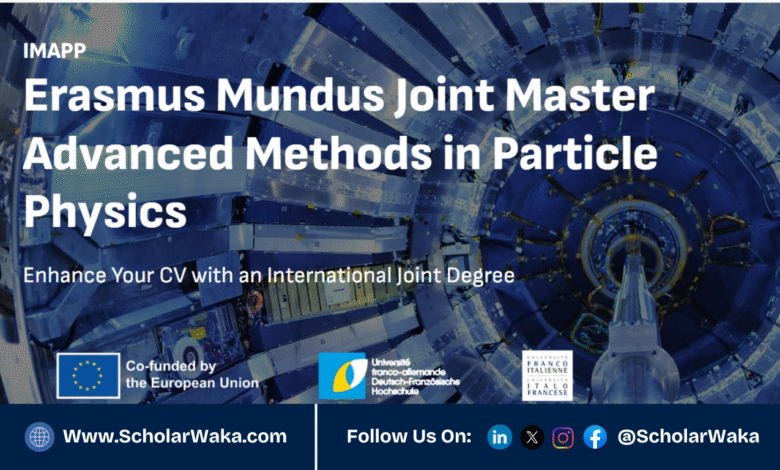
There’s a particular kind of academic experience only a joint European Master’s can offer: spending your first semester in the volcanic hills of Clermont-Ferrand, your second in the industrial heart of Germany’s Ruhr region, and your third in one of Italy’s oldest university cities, all while working toward a single, unified degree recognised by all three institutions. That’s exactly the structure of IMAPP, the International Master of Advanced Methods in Particle Physics, and the Erasmus Mundus scholarship funding it is one of the EU’s most comprehensive Master’s-level awards, covering tuition, living costs, travel, visas, and health insurance in full.
Don’t Miss: Top Fully Funded Scholarships for International Students
Worth knowing as you read this: the application window for the 2026/27 cohort ran from 2 January through 15 March 2026, with preliminary scholarship decisions communicated by 31 March, meaning this cycle has fully concluded, and successful students are now preparing for their September start in France. This guide covers exactly how the programme’s three-country structure works, the precise scoring system the selection board uses, and a genuinely thorough breakdown of what documents you need, what the funding actually covers, and how the application process runs from start to finish.
Also Read: How to Write a Personal Statement for Scholarship | Tips and Free Template
What the Erasmus Mundus IMAPP Involves
Three universities—the University of Clermont Auvergne in France, TU Dortmund University in Germany, and the University of Bologna in Italy—jointly deliver IMAPP as a 120-ECTS Master’s degree. The EU’s Erasmus Mundus Joint Master’s Degree scheme funds the programme, which trains the next generation of particle physicists for careers in academic research and private-sector roles where physics expertise increasingly overlaps with data science, computing, and instrumentation.
Also, Check Out: Top Fully Funded Master’s Scholarships in Europe
Rather than studying at one institution with occasional exchange opportunities, every IMAPP student follows the same structured path: one semester at each of the three partner universities, followed by a final semester dedicated to your research thesis, giving you genuine, sustained exposure to three distinct academic and research cultures rather than a single home base with brief visits elsewhere.
Erasmus Mundus IMAPP Scholarship Summary
| Scholarship Name ⇒ | Erasmus Mundus IMAPP |
| Host Country ⇒ | Germany, France and Italy |
| Study Level ⇒ | Masters |
| Benefits ⇒ | Fully Funded — tuition, monthly stipend, accommodation support, travel, visa fees, medical insurance |
| Funded by ⇒ | European Union, via the Erasmus Mundus Joint Master’s Degree (EMJMD) programme |
| Eligible Countries ⇒ | All Countries |
| Application Deadline ⇒ | 15 March 2026, now closed |
What the Programme Structure Actually Looks Like Semester by Semester
- First semester — University of Clermont Auvergne, Clermont-Ferrand, France: Focused on Statistics and Machine Learning, building the quantitative and computational foundation the rest of the programme builds on
- Second semester — TU Dortmund University, Germany: Focused on Instrumentation and Detector Physics, giving you hands-on grounding in how particle physics experiments are actually built and run
- Third semester — University of Bologna, Italy: Focused on Scientific Computing, sharpening the computational skills needed for modern particle physics research
- Fourth semester: Your Final Research Thesis, worth 30 ECTS, completed at one of the partner institutions or an affiliated research placement
Across the full programme, the curriculum breaks down into 36 ECTS in Statistics, Artificial Intelligence, Detector Development, Electronics, and Computer Science; 36 ECTS in Experimental Techniques; 18 ECTS in Theoretical Foundations; and the 30-ECTS thesis itself.
What Makes You Eligible for This Scholarship
- You need to hold a Bachelor’s degree in Physics, or a closely related field such as engineering or mathematics
- If you’re still completing your final year of undergraduate study, you can still apply, provided you submit your final Bachelor’s certificate before enrolment
- Applicants of any nationality are eligible — both EU and non-EU citizens are treated equally under this scheme
- You need to submit two reference letters, sent directly by your referees to the selection committee rather than passed through you
- If English isn’t your first language, you need to provide proof of proficiency through a recognised test such as TOEFL or IELTS; if you don’t have current test results, IMAPP arranges an online interview instead to assess your English level directly

How the Selection Board Actually Scores Your Application
This is worth understanding in detail, since it explains exactly where to focus your preparation effort. The Selection and Examination Board rates every eligible application against three weighted components:
- Academic grades — 60 points. Your final Bachelor’s degree grade, or, if you haven’t yet graduated, your average marks across examinations taken up to the point of your application
- Motivation letter and CV — 20 points. Your motivation letter specifically needs to run to two pages, making a clear, specific case for why you’re the right candidate for this particular joint degree
- Reference letters — 20 points. Assessed on the strength and specificity of what your two referees say about your academic and research potential
Since academic grades alone account for 60% of your total score, your prior academic performance carries the heaviest weight in this scholarship — but with 40 points spread across your motivation letter, CV, and references combined, a genuinely strong application still has real room to compensate for a merely solid, rather than outstanding, academic record.
What The Erasmus Mundus IMAPP Scholarship Covers
- Full tuition coverage — every academic fee across all three partner universities is fully funded, with no partial payment expected from you at any stage
- A monthly stipend to cover your ordinary living expenses throughout the full two years, adjusted to reflect the different costs of living you’ll encounter as you move between Clermont-Ferrand, the Dortmund area, and Bologna
- Accommodation support, helping offset housing costs at each of your three host locations, rather than leaving you to independently arrange and fund housing three separate times with no assistance
- Mobility grants specifically covering your travel between the three host universities — since you’re required to physically relocate three times over the two-year programme, this is treated as a core funded cost, not an incidental expense you absorb yourself
- Visa fee reimbursement, covering the costs connected to obtaining the visas you’ll need across however many of the three host countries require one for your specific nationality
- Comprehensive medical insurance, covering your health needs throughout the full two years, regardless of which of the three countries you’re currently based in
- Access to world-class research facilities and equipment at all three institutions, alongside genuine exposure to active research groups working in cutting-edge experimental and theoretical particle physics
Together, this is designed so that a genuinely talented physics graduate faces no financial barrier at any stage of the programme — from your first day in France through to your final thesis defence, whichever institution that ends up being hosted at.
What Documents You Need to Prepare
1. Academic transcripts, covering both your secondary education and your Bachelor’s degree
These need to show your complete academic record clearly, since your grades form 60% of your total application score, so accuracy and completeness here matter more than in almost any other part of your application
2. A comprehensive CV
Beyond simply listing your education, this should highlight any research experience, relevant coursework, technical skills (particularly in programming, statistics, or data analysis), and any academic or extracurricular achievements connected to physics or a related quantitative field
3. A motivation letter, running to two pages
This needs to go well beyond a general statement of interest in physics; it should explain specifically why the IMAPP joint-degree structure appeals to you, how your prior academic background prepares you for the programme’s demanding mix of theoretical and experimental coursework, and what you intend to do with the degree afterwards, whether that’s academic research or industry work in fields like data science or instrumentation
4. A copy of your passport or national ID
Used for identity verification and to help the consortium anticipate visa requirements across the three host countries
5. TOEFL, IELTS, or equivalent English test results, if available
If you don’t currently hold a valid test result, don’t treat this as disqualifying; IMAPP arranges an online interview instead specifically to assess your English proficiency directly
6. Two reference letters
Critically, these are not uploaded by you as part of your own application package. Your two referees need to submit their letters directly to the selection committee themselves, and IMAPP sets a slightly later deadline for this specific document, giving your referees a short additional window beyond the main application deadline
What the Application Process Requires
- Visit the official IMAPP programme website to review full, current programme and scholarship details directly from the source, rather than relying solely on secondary summaries
- Complete the online application form, entering your personal and academic details accurately and in full — the application process is managed online, coordinated through TU Dortmund University on behalf of the consortium
- Prepare and upload your supporting documents — your transcripts, CV, motivation letter, passport copy, and English proficiency evidence, ensuring every document is clear, complete, and properly formatted before submission
- Notify your two referees early and ask them to prepare and submit their letters directly to the selection committee — since this carries its own slightly later deadline than your main application, don’t leave this step until the final days
- Submit your complete application before 15 March 2026 — for the 2026/27 cycle, this was the firm cutoff for the application form itself
- Ensure your referees submit their letters by 16 March 2026, the separate deadline specifically for reference letters
- Wait for the Selection and Examination Board’s review, which scores every eligible application against the 60/20/20 academic-grades/motivation-and-CV/references breakdown described above
- Receive your preliminary decision — for this cycle, communicated by 31 March 2026
Application Timeline
- Application period: 2 January through 15 March 2026 — now closed
- Reference letter deadline: 16 March 2026, one day after the main application deadline
- Preliminary scholarship decision: Communicated by 31 March 2026
- Programme start: September 2026, beginning at the University of Clermont Auvergne in France
- Next expected cycle: Based on the programme’s consistent annual pattern, expect the 2027/28 application window to open again around 2 January 2027, closing in mid-March 2027
What to Do Before the Next Cycle Opens
- Start strengthening your academic transcript and any research experience now, given that academic grades alone determine 60% of your total score
- Draft your two-page motivation letter well ahead of the January opening, focusing specifically on why the three-country mobility structure and IMAPP’s particular blend of theoretical and experimental physics suits your goals
- Identify and approach your two referees early, ideally academics who’ve directly supervised your coursework or research, since strong, specific letters carry real weight in the 20-point reference component
- Book your TOEFL or IELTS test well in advance if you don’t already hold current results, though remember an online interview remains available if testing isn’t feasible for you
- Given that scholarships are capped at roughly a maximum of two per nationality on average, understand that you’re competing within your own country’s applicant pool as much as against the wider international field
Frequently Asked Questions
Is the Erasmus Mundus IMAPP Scholarship still accepting applications?
No. The 2026/27 application window ran from 2 January through 15 March 2026, and this cycle is now closed, with preliminary decisions already communicated by 31 March 2026.
Do I need to submit my reference letters myself?
No. Your two referees submit their letters directly to the selection committee, on a slightly later deadline than your main application.
What happens if I don’t have IELTS or TOEFL results?
IMAPP arranges an online interview specifically to assess your English proficiency instead, so a missing test result doesn’t disqualify you.
How many scholarships are typically awarded each year?
Around 18 to 19 per intake, with roughly a maximum of two scholarships awarded per nationality on average, reflecting the programme’s genuinely international selection approach.
Can final-year undergraduate students apply before graduating?
Yes. You can apply while still completing your Bachelor’s degree, provided you submit your final degree certificate before enrolment begins.
Disclaimer: All scholarship details and figures in this post are verified from official IMAPP and Erasmus Mundus sources as of July 2026. Information is subject to change without notice. Always confirm the latest details directly on the official IMAPP programme website. ScholarWaka is not affiliated with the European Union, Erasmus Mundus, or the IMAPP consortium.
Official Application Portal
Join ScholarWaka Community
Get the latest scholarship updates and study abroad opportunities before anyone else.