2026 Texas Christian University Master’s Scholarship in USA | Fully Funded

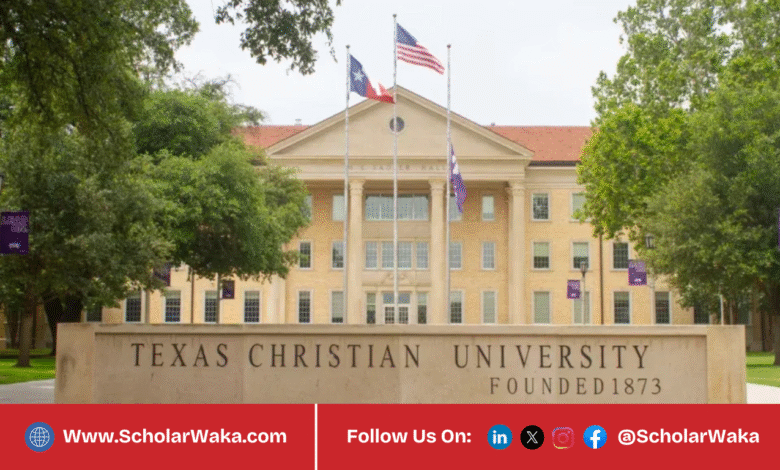
The application window for this specific opportunity closed on 15 January 2026 for Fall 2026 entry, and here’s something worth being upfront about: this wasn’t a standing institutional scholarship — it was a funded graduate assistantship tied directly to Dr Brendan Lavy’s specific urban and community forestry research programme within TCU’s Department of Environmental and Sustainability Sciences.
Don’t Miss: Top Fully Funded Scholarships for International Students
That distinction matters for anyone hoping this simply reopens next year on the same terms. Opportunities structured this way depend on continued grant funding and a specific faculty member actively recruiting graduate researchers, not a renewable university-wide scholarship line, so its return isn’t guaranteed the way an established annual programme’s would be. This guide covers exactly what the closed opportunity involved, so you understand what to look for if a similar position opens, and what to check directly with the department before assuming it’s coming back in the same form.
Also, Check Out: Top Fully Funded Master’s Scholarships in Europe
Why This Wasn’t a Typical University Scholarship
Understanding the funding source here changes how you should think about future availability. This position was explicitly framed as a Graduate Teaching Assistant role tied to active urban forestry research, including work connected to disaster recovery, ecosystem services, and community resilience to environmental hazards like ice storms — the kind of research that depends on specific grant cycles and a faculty member’s ongoing project pipeline, not a fixed university endowment renewing automatically each year.
Also Read: How to Write a Personal Statement for Scholarship | Tips and Free Template
It’s also worth noting directly: available public information suggests Dr Lavy’s academic affiliation may have shifted since this position was posted, which raises a genuine question about whether TCU’s Department of Environmental and Sustainability Sciences is continuing to recruit for this specific research track under the same funding arrangement. Rather than assuming continuity, the responsible move is contacting the department directly to confirm current status before building an application plan around this exact opportunity reopening.
Texas Christian University Master’s Scholarship Summary
| Scholarship Name ⇒ | Texas Christian University Master’s |
| Host Country ⇒ | USA |
| Study Level ⇒ | Masters |
| Benefits ⇒ | Full tuition, $16,500 annual stipend, up to $3,000 summer research support |
| Funded by ⇒ | Texas Christian University (via faculty research grant funding) |
| Eligible Countries ⇒ | All countries |
| Application Deadline ⇒ | Closed 15 January 2026 for Fall 2026 entry. Continuation of this specific position for Fall 2027 is unconfirmed — contact the department directly rather than assuming automatic recurrence |
Eligibility Requirements
Academic Degree & Minimum GPA:
- Requirement: A Bachelor’s degree with a minimum GPA of 3.0 on a 4.0 scale (or international equivalent).
- Evaluation: Admissions committees use this cutoff to verify academic readiness for graduate-level coursework. Applicants holding a GPA slightly below 3.0 may occasionally be considered under conditional admission if supported by strong professional experience or exceptional recommendations.
Acceptable Academic Backgrounds:
- Primary Majors: Environmental Science, Biology, Geology, Chemistry, Physics, Natural Sciences, Engineering, or Social Sciences (e.g., Environmental Studies, Geography, Economics).
- Alternative Majors: Applicants with degrees outside these disciplines remain eligible upon individual profile review, provided they meet or plan to fulfill foundational science prerequisites.
Mandatory Undergraduate Prerequisites:
- Biology: 1 full year (2 semesters / 3 quarters) of college-level introductory or general biology with laboratory components.
- Chemistry: 1 full year (2 semesters / 3 quarters) of general or physical chemistry.
- Geology: 1 semester (or 1 quarter) of Physical Geology or Earth Systems Science.
- Quantitative Mathematics: 1 semester of College Calculus or Introductory Statistics.
- Note: Course deficiencies must generally be completed before enrollment or during the first year as conditional requirements.
Work Experience:
- Requirement: 0 years required. No prior professional or industry work experience is necessary to qualify for admission or funding eligibility.
Standardized Testing (GRE):
- Status: Optional. Submitting Graduate Record Examination (GRE) scores is not mandatory.
- Strategic Impact: Candidates with a strong quantitative GRE score (e.g., 155+ Quant) are encouraged to submit scores to offset a lower GPA or boost competitiveness for merit-based fellowships and Graduate Assistantships.
Competitive Advantage — GIS Competency:
- Advantage: Applicants who demonstrate hands-on Geographic Information Systems (GIS) knowledge receive weighted preference during review.
- Evidence Pathways: Validated through formal coursework, technical certifications, independent undergraduate spatial analysis projects, or practical field applications.
What the Funded Position Actually Offered
This was structured as genuine paid research and teaching work, not a passive stipend.
- Full tuition coverage: waived entirely for the Master’s programme
- Annual stipend: up to $16,500 per year, tied to a Graduate Teaching Assistant role requiring up to 20 hours of work per week
- Summer research support: a one-time payment of up to $3,000, specifically to support fieldwork or research activity outside the standard academic year
- Genuine research involvement: work grounded in active sustainability science projects, including evaluating urban tree planting programmes after disasters, examining how losing urban forest cover affects ecosystem services, and studying how trees contribute to thermal comfort in walkable communities
- Teaching experience: direct classroom or lab teaching responsibility as part of the assistantship, building genuine instructional experience alongside research skills

Required Documents
Applying for graduate programs and funding opportunities (such as Graduate Assistantships, Tuition Waivers, and Fellowships) at Texas Christian University (TCU) requires compiling a synchronized application package. Because individual colleges—such as the Louise Dilworth Davis College of Science & Engineering, Neeley School of Business, College of Education, and Bob Schieffer College of Communication—set specific department-level requirements, candidates must fulfill both university-wide baseline standards and targeted program guidelines.
1. Academic Credentials & Coursework Verification
- Official Bachelor’s Degree Certificate:
- Proof of a completed baccalaureate degree from a regionally accredited college or university (or an equivalent international degree).
- Provisional Applicants: Students in their final undergraduate semester may apply using an official “Degree In-Progress” letter, with the final degree conferral certificate submitted prior to matriculation.
- Official Academic Transcripts & GPA Records:
- Complete transcripts from all higher education institutions attended, detailing course-by-course grades, cumulative GPA, and credits earned.
- GPA Threshold: TCU Graduate Studies generally expects a minimum cumulative GPA of 3.0 on a 4.0 scale (or international equivalent) for unconditional admission and competitive merit funding.
- Submission Route: Electronic transcripts must be transmitted directly from the issuing institution to
[email protected]or the specific college admissions office.
- Proof of Completed Prerequisite Coursework:
- Specific programs (e.g., Business, Data Analytics, STEM, or Health Sciences) mandate foundational coursework prior to enrollment.
- Examples: College algebra/calculus, quantitative methods, or introductory lab sciences. Deficiencies may result in “Conditional Admission,” requiring prerequisite completion during the first semester.
2. Qualitative & Professional Narrative Files
- Curriculum Vitae (CV) or Professional Resume:
- A clean, 1-to-2 page document outlining academic history, research projects, technical skills, publications, leadership roles, and relevant work/internship experience.
- Funding Evaluation: Departmental review panels assess CVs heavily when awarding Teaching Assistantships (TA), Research Assistantships (RA), and tuition fellowships.
- Statement of Purpose (Academic/Professional Objectives):
- A 500-to-1,000-word narrative outlining your academic background, research interests, career vision, and rationale for choosing TCU.
- Key Requirement: You must explicitly articulate your fit with specific TCU department faculty, ongoing research labs, or specialized program tracks.
- Three (3) Letters of Recommendation:
- Formal endorsements submitted directly through the TCU online application portal by academic or professional references.
- Composition: Ideally, at least two letters should come from university professors who can directly evaluate your intellectual capability, quantitative/analytical skills, and potential for graduate study.
3. Standardized Examinations & Language Compliance
- English Language Proficiency Evidence (For Non-Native Speakers):
- Mandatory for international applicants unless they earned a degree from a recognized English-speaking institution.
- Accepted Standardized Examinations & Baseline Cutoffs:
- TOEFL iBT: Minimum score of 80 to 100 (varies by program; e.g., Neeley Business requires 100).
- IELTS Academic: Minimum overall band score of 6.5 to 7.0.
- Duolingo English Test (DET): Minimum score of 110 to 130 (where accepted).
- GRE / GMAT Test Scores (Optional / Program-Specific):
- Policy: Many TCU graduate programs have transitioned to GRE/GMAT Optional policies.
- Strategic Use: Submitting strong GRE scores (e.g., 310+ combined) is highly encouraged if your undergraduate GPA is near the minimum threshold or if you are applying for university-wide competitive assistantship stipends.
How to Apply
- Visit the official TCU application portal.
- Create an account and start your application
- Fill in your personal and academic information
- Upload all required documents
- Select the MS program in Environmental and Sustainability Sciences
- Indicate your interest in the urban and community forestry research area
- Submit your application before the deadline
- For questions, contact Dr Brendan Lavy at [email protected]
What to Do If You’re Interested
Given the uncertainty around whether this specific research assistantship continues under the same funding and faculty arrangement, the most useful step is reaching out directly to TCU’s Department of Environmental and Sustainability Sciences to ask whether a similar urban forestry-focused graduate assistantship is being offered for Fall 2027 entry, and under whose supervision it would run if so.
If this exact position doesn’t return, it’s also worth browsing TCU’s broader graduate assistantship listings within Environmental and Sustainability Sciences more generally, since funded research positions tied to other faculty members’ active grants may offer a comparable path even if the specific urban forestry focus isn’t repeated.
Frequently Asked Questions
Is this TCU scholarship still accepting applications?
No. The application window closed on 15 January 2026 for Fall 2026 entry. Whether this specific position reopens for Fall 2027 is not confirmed.
Was this a standing TCU scholarship, or something else?
It was a funded Graduate Teaching Assistant position tied to a specific faculty member’s active urban forestry research, not a renewable, university-wide scholarship programme. Its continuation depends on ongoing grant funding and faculty recruitment.
Do I need GIS experience to be considered for a similar opportunity?
GIS experience wasn’t a strict requirement, but applicants with demonstrated GIS skills, through coursework or project work, were noted as having a genuine advantage in the selection process.
Is the GRE required for TCU’s graduate programmes generally?
For this specific position, no. The GRE wasn’t required, though a submitted score would still be factored into the review if provided.
Who should I contact to check if a similar position is available now?
Reach out directly to TCU’s Department of Environmental and Sustainability Sciences, since faculty-funded research assistantships like this one are best confirmed directly with the department rather than assumed from an older listing.
Disclaimer: All programme details, deadlines, and eligibility criteria in this post were verified from official and publicly available sources as of August 2026. Whether this specific position will be offered again is unconfirmed. Always confirm current availability directly with Texas Christian University’s Department of Environmental and Sustainability Sciences before planning around this opportunity. ScholarWaka is not affiliated with Texas Christian University.
Official Application Portal
Join ScholarWaka Community
Get the latest scholarship updates and study abroad opportunities before anyone else.