German Bundestag International Parliamentary Scholarship (IPS) Africa 2027 ( Fully Funded )

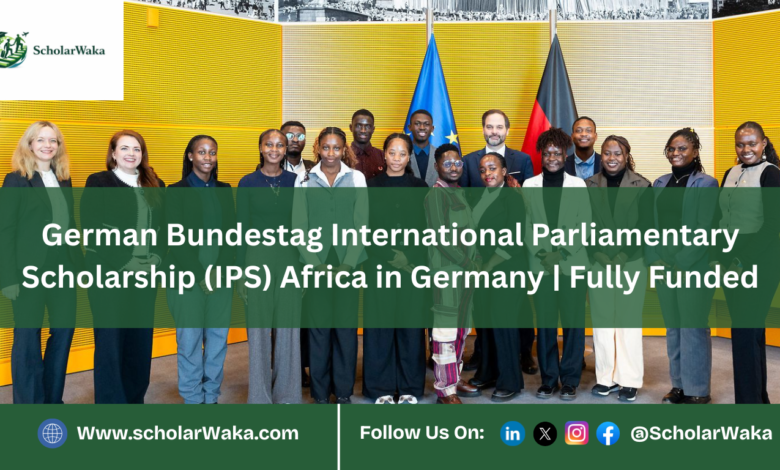
There’s an African graduate spending four weeks working inside a sitting Bundestag member’s office, sitting in on workshops about anti-corruption and minority protection, and walking away with a stipend, free housing, and covered flights — that’s what the German Bundestag’s International Parliamentary Scholarship (IPS) Africa actually delivers for the handful of African graduates it selects each year. This year’s window has already shut: applications for the 2027 cohort closed on May 15, 2026, and the selected group heads to Berlin for the programme itself between January 4 and February 2, 2027.
But a closed deadline doesn’t mean there’s nothing to do right now. The requirements here — B2 German, documented political engagement, a German-language motivation letter — take real months to build, not days, so the smartest move if you missed this cycle is to start preparing today for whenever applications reopen next. This post covers exactly what the programme involves, who typically qualifies, and the specific groundwork worth laying now.
German Bundestag IPS Africa Summary
| Scholarship Name ⇒ | German Bundestag International Parliamentary Scholarship (IPS) Africa |
| Host Country ⇒ | Germany |
| Study Level ⇒ | Training and Fellowships |
| Benefits ⇒ | Monthly stipend, free accommodation, travel costs, insurance, and a Bundestag office internship |
| Funded by ⇒ | German Bundestag |
| Eligible Countries ⇒ | Botswana, Ghana, Kenya, Namibia, Nigeria, Senegal, South Africa, Tanzania, Uganda |
| Application Deadline ⇒ | Closed — May 15, 2026 (2027 programme cycle). Expect the next call for applications around early 2027 for the following intake. |
What This Fellowship Is Built Around
The German Bundestag runs the IPS Africa programme to give young African graduates hands-on exposure to how a functioning parliamentary democracy actually operates, not through lectures alone, but through a real internship inside a sitting member of parliament’s office.
The underlying goal is to equip participants with tools they can bring back to their own countries: an understanding of pluralistic governance, anti-corruption mechanisms, minority protection, and civic engagement, paired with a project management workshop where scholars sketch out ideas for advancing democracy at home.
It’s a competitive fellowship, open only to nine specific African countries, and it demands a level of German language proficiency that rules out casual applicants. This is built for graduates already committed to political or civic work, not simply interested in the subject.
What the Four Weeks in Berlin Actually Look Like
For context on what you’d be preparing for if you apply next cycle: the programme runs January 4 to February 2, 2027, in Berlin. It opens with a preparatory course on parliamentary democracy, followed by workshops covering pluralistic society, minority protection, anti-corruption, and intercultural communication. Midway through, participants complete a one-week internship in the office of an actual Bundestag member, followed by a project management workshop where scholars design their own civic engagement or democracy-focused initiative to bring home.
What the Fellowship Covers
- A monthly stipend of €700 during the programme.
- Free accommodation in Berlin for the full four weeks.
- Travel expenses to and from Germany are fully covered.
- Health, accident, and liability insurance for the duration of the programme.
- A one-week internship placement inside a Bundestag member’s office a level of direct political access that’s hard to find elsewhere.
- Access to structured workshops and professional development training throughout the four weeks.
Who This Opportunity Is For
- Citizenship of one of nine countries: Botswana, Ghana, Kenya, Namibia, Nigeria, Senegal, South Africa, Tanzania, or Uganda.
- Under 30 years old as of January 1 of the programme year.
- A completed university degree.
- German language proficiency at a minimum B2 level; this isn’t negotiable, since the entire application and programme run in German.
- A demonstrated strong interest in political and social issues, backed by evidence rather than stated interest alone.
- Active social or political engagement, such as civic organisation involvement, advocacy work, or community leadership.
The language requirement is worth sitting with if you’re planning: B2 German is a genuine barrier for many otherwise strong candidates, and it’s not something you can pick up in the weeks before an application opens. If this is a fellowship you want for a future cycle, treat German language study as a long-term project, not a last-minute checklist item.
Plan for the Upcoming Cycle
Since this year’s deadline has passed, use the months ahead to get genuinely ready rather than scrambling once the next call opens:
1. Get your German to B2 and keep it there.
This is the single biggest gate on this fellowship. If you’re not already at B2, start structured study now — through a language school, tandem partner, or certified course — and aim to have a certificate or clear proof of proficiency ready well before the next application window.
2. Build a documented record of political or civic engagement.
The eligibility criteria ask you to demonstrate active engagement, not just express interest. Volunteer with a civic organization, contribute to advocacy work, or take on a visible role in student or community governance — and keep records of what you did.
3. Draft your letter of motivation in German early.
The letter must be written in German, signed, and capped at two pages — start drafting and revising it well ahead of time rather than translating a rushed English version at the last minute. Have a fluent German speaker review it if you can.
4. Line up your recommender now.
A letter from a professor or employer takes time to arrange properly. Reach out to someone who knows your political or civic work well before the application period opens, so they’re not writing under time pressure.
5. Have your core documents ready in advance.
Your passport or national ID copy and university degree certificate should already be in order — these are quick to gather but easy to forget until the deadline is close.
6. Prepare for a possible interview at a German diplomatic mission.
Shortlisted candidates are interviewed as part of the final selection. If you make it that far next cycle, practice discussing your political engagement and motivation clearly in German, not just in your written materials.
Frequently Asked Questions
Has the 2027 programme cycle definitely closed for new applicants?
Yes. The deadline was May 15, 2026, and the programme itself runs from January to February 2027 for those already selected. New applications will need to wait for the next cycle’s call, expected around early 2027.
Can Nigerian students apply for this fellowship?
Yes. Nigeria is one of the nine eligible countries, alongside Botswana, Ghana, Kenya, Namibia, Senegal, South Africa, Tanzania, and Uganda.
Do I need to already speak German fluently to apply?
You need a minimum of B2 level German proficiency, which is intermediate-to-upper-intermediate — not full fluency, but solid working competence, since the application and the four-week programme are conducted in German.
Is this fellowship the same as a Master’s or PhD scholarship?
No. This is a four-week training fellowship focused on parliamentary democracy and civic engagement, not a degree programme. It suits graduates looking for practical political exposure rather than an academic qualification.
Disclaimer: All scholarship details, deadlines, award values, and eligibility criteria in this post were verified from official sources as of July 2026. Information is subject to change without notice. Always confirm the latest details directly on the official German Bundestag website before submitting your application. ScholarWaka is not affiliated with the German Bundestag.
Official Application Portal
Join ScholarWaka Community
Get the latest scholarship updates and study abroad opportunities before anyone else.