Hopkins Engineering Summer Research Scholars 2026 (PROPEL Program)

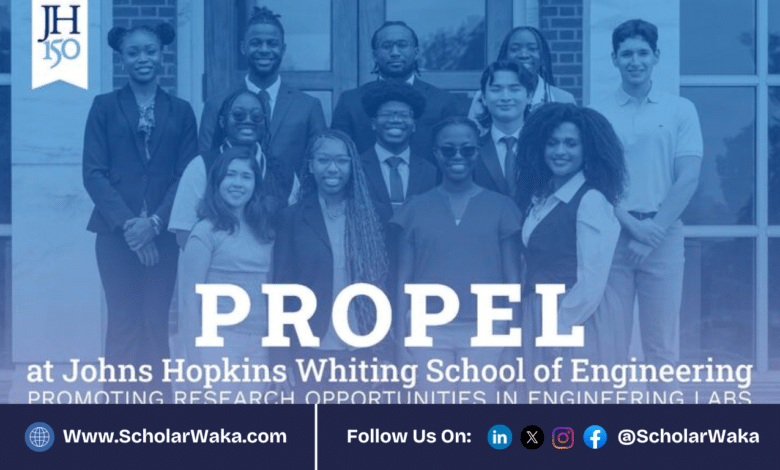
The Promoting Research Opportunities in Engineering Labs (PROPEL) program sits within a broad ecosystem of summer research initiatives run through Johns Hopkins University’s Whiting School of Engineering (WSE). Operating alongside specialized NSF-funded Research Experiences for Undergraduates (REU) sites—such as those in Computational Sensing and Medical Robotics (CSMR), Nanotechnology for Biology and Engineering (INBE), and Materials Growth (PARADIM)—PROPEL serves as WSE’s premier diversity, equity, and institutional research pipeline. The 2026 PROPEL application window closed on February 3, 2026, at 11:59 PM Eastern, with admission decisions dispatched by early April. The resulting eight-week residential cohort completed their research residency on the Homewood campus in Baltimore from May 27 through July 24, 2026, concluding with a university-wide research symposium.
Also, Check Out: Top Fully Funded Master’s Scholarships in Europe
Designed specifically for high-achieving undergraduates—with strong preference given to rising juniors and seniors from under-resourced institutions or underrepresented backgrounds in STEM—PROPEL provides direct entry into JHU’s advanced engineering laboratories. Scholars work one-on-one under the direct mentorship of Hopkins faculty across departments like Biomedical Engineering, Computer Science, Mechanical Engineering, and Chemical and Biomolecular Engineering. Beyond bench work and computational modeling, the program incorporates structured professional development modules focused on scientific writing, technical presentation design, and strategic preparation for competitive PhD applications.
For prospective applicants preparing for the 2027 cycle (which opens applications in late autumn 2026 ahead of an anticipated February 2027 deadline), understanding how PROPEL operates relative to subject-specific REUs is essential for tailoring your research statements and targeting the right faculty mentors. Verified through official Johns Hopkins Whiting School of Engineering disclosures.
Don’t Miss: Top Fully Funded Scholarships for International Students
Hopkins Engineering Summer Research Scholars PROPEL Program Summary
| Scholarship Name ⇒ | Hopkins Engineering Summer Research Scholars (PROPEL Program) |
| Host Country ⇒ | USA |
| Study Level ⇒ | Training |
| Benefits ⇒ | Fully funded — stipend, housing, meal plan, round-trip travel |
| Funded by ⇒ | Johns Hopkins University, Whiting School of Engineering |
| Eligible Countries ⇒ | U.S. citizens/permanent residents, or F-1 international students enrolled at a U.S. institution |
| Application Deadline ⇒ | 2026 cycle closed February 3, 2026, at 11:59 pm ET. Based on this pattern, the 2027 cycle deadline is expected around early February 2027 |
What PROPEL Is Built to Do
PROPEL — Promoting Research Opportunities in Engineering Labs — gives promising undergraduates hands-on exposure to engineering research and graduate education, particularly students who may have limited access to these opportunities. Students from under-resourced backgrounds, and those attending institutions with limited research opportunities in STEM, are explicitly and strongly encouraged to apply, reflecting the programme’s core mission of widening the pipeline into engineering graduate study rather than simply rewarding students who already have strong research access.
Also Read: How to Write a Personal Statement for Scholarship | Tips and Free Template
Because PROPEL sits alongside several other named summer research tracks at Hopkins Engineering — including the Computational Sensing and Medical Robotics REU, the JSALT AI and Human Language Technologies workshop, the Institute for NanoBioTechnology’s programme, and the NSF-funded BioREU — it’s worth knowing these exist as related options if your specific research interests point more precisely toward one of those narrower tracks rather than PROPEL’s broader engineering focus.
Eligibility Requirements
To qualify for PROPEL, applicants generally need to meet the following:
- You must be enrolled full-time at an accredited U.S. college or university, or one of its territories recognized by the U.S. Department of Education
- You must maintain a minimum GPA of 3.0
- You must have completed at least two semesters of undergraduate study, with at least one semester remaining as of summer 2026
- You must have a genuine interest in pursuing a PhD in engineering — this is a stated priority for the programme, not simply a nice-to-have
- You must be a U.S. citizen or permanent resident, or an international student holding a valid F-1 visa and currently studying at a U.S. institution
- You must be at least 18 years old
Because the programme prioritizes rising juniors and seniors specifically, and strongly encourages applicants from under-resourced backgrounds or institutions with limited existing research opportunities, students earlier in their degree, or those already at research-intensive institutions with abundant lab access, may find themselves competing from a somewhat less favored position within the applicant pool.

What the Hopkins Engineering Summer Research Scholars PROPEL Program Covers
The Johns Hopkins PROPEL Program is a fully funded residential research fellowship that removes financial barriers and allows participants to focus entirely on advanced engineering research.
- Competitive Living Allowance (Stipend): A direct stipend provided to cover personal expenses throughout the eight-week residency, compensating scholars for their full-time laboratory commitment.
- On-Campus Housing: Fully funded dormitory accommodations on the Johns Hopkins Homewood campus in Baltimore, providing a secure and convenient living environment.
- Integrated Meal Plan: A comprehensive university dining plan covering meals for the complete duration of the eight-week program.
- Round-Trip Travel Funding: Reimbursement for travel expenses incurred traveling between the scholar’s home institution and Baltimore, Maryland, at the start and conclusion of the exchange.
- Direct Faculty Mentorship & Lab Integration: Hands-on experience working on active, funded engineering projects. Scholars function as full laboratory team members rather than passive observers, gaining direct technical expertise under Johns Hopkins faculty and senior researchers.
- Professional & Graduate School Development Workshops: Weekly structured training sessions focusing on scientific writing, technical presentations, networking strategies, and competitive preparation for PhD applications (including GRE strategy and fellowship drafting).
- Cohort Seminars & Regional Excursions: Collaborative weekly research seminars complemented by cohort outings, social activities, and cultural trips exploring Baltimore and nearby Washington, D.C.
- Culminating Campus-Wide Research Symposium: A formal university-wide poster session and oral presentation showcase at the program’s conclusion. Participants present their findings to faculty, graduate students, and peers, producing a tangible academic deliverable to cite on future graduate school and fellowship applications.
Required Documents
To apply for the Johns Hopkins PROPEL Program, candidates must compile and submit a structured electronic dossier via the central Interfolio portal. Selection committees within the Whiting School of Engineering evaluate files using a holistic rubric that heavily weighs narrative precision, faculty alignment, and demonstrated technical momentum over broad personal summaries.
1. Research Statement (Strictly Capped at 1 Page)
The Research Statement is an analytical overview of your technical background, specific lab interests, and long-term academic trajectory. In a single page (approximately 400–500 words), general statements like “I have always loved engineering” must be replaced by a structured three-paragraph narrative:
- Current Technical Skill Base & Research Background: Explicitly detail past research experiences, independent course projects, or lab techniques. Mention specific methodologies (e.g., microfluidic fabrication, Python data modeling, cell culture protocols) and quantify your contributions.
- Hopkins Faculty & Lab Alignment: Name 2 to 3 specific Whiting School of Engineering faculty members whose current labs align with your goals. Explain why their specific published work or ongoing project fits your technical background.
- PhD Alignment & Future Goals: State explicitly how an eight-week research stint at JHU serves as a bridge toward enrolling in an engineering PhD program.
2. Leadership & Service Statement (Strictly Capped at 1 Page)
Rather than repeating your CV, the Leadership Statement evaluates how you navigate challenges, contribute to inclusive academic environments, and serve your community. It must highlight concrete actions using a focused framework:
- Active Roles Over Titles: Focus on impact rather than formal titles. Detail specific initiatives, such as tutoring underrepresented peers in STEM, organizing departmental events, leading student society chapters (e.g., NSBE, SHPE, SWE, BMES), or overcoming structural hurdles in your educational journey.
- Problem-Solving & Mentorship: Describe a specific instance where you identified a gap or challenge within your academic community and led a practical solution.
- Commitment to Inclusion: Detail how you intend to contribute to equity, peer support, and collaboration within your summer cohort and host lab at Johns Hopkins.
3. Professional Resume / Curriculum Vitae (CV)
A concise 1- to 2-page document formatted specifically for scientific and technical review. Key sections must include:
- Academic Credentials: Cumulative GPA (minimum 3.0 required), major, minor, and anticipated graduation date.
- Relevant Coursework: Advanced mathematics, foundational engineering, and computer science courses.
- Technical & Laboratory Skills: Categorized lists of wet-lab techniques, programming languages (e.g., MATLAB, Python, C++), software tools (e.g., SolidWorks, CAD), and hardware operations.
- Research & Project Experience: Bulleted entries focusing on responsibilities, tools used, and measurable outcomes.
4. Letter of Recommendation (Direct Submission)
One recommendation letter submitted directly by the referee through Interfolio.
- Target Referees: Primary preference is given to research mentors, faculty principal investigators (PIs), or engineering professors who can speak directly to your research potential, analytical problem-solving skills, and academic discipline.
- Secondary Options: If you lack formal lab experience, secure a letter from a professor who taught you in an upper-level, project-based engineering or quantitative course and can evaluate your potential for independent graduate study.
5. Unofficial Academic Transcripts
Upload unofficial transcripts from all post-secondary institutions you have attended.
- Semester Coverage: Transcripts must show completed coursework and grades through the most recent fall term prior to the application deadline.
- F-1 Visa / International Verification: International students enrolled at U.S. universities must ensure their transcript verifies active, full-time enrollment status.
How to Apply for the Next Cycle
The 2026 window is closed, but Johns Hopkins has run this process consistently enough to prepare against:
- Visit the official PROPEL Summer Research Program page on the Johns Hopkins Whiting School of Engineering website for the announcement of the next cycle.
- Create an account on the application platform, typically Interfolio, once applications open.
- Draft your one-page Research Statement and one-page Leadership Statement well in advance, given how tightly both are capped.
- Prepare your resume/CV and gather your unofficial transcripts.
- Identify a strong academic or research recommender and give them ample notice to submit their letter directly through the application platform.
- Complete all sections of the online application and submit by the stated deadline, historically in early February.
- Wait for admissions decisions, typically released between mid-March and early April.
Application Deadline
The 2026 cycle’s application deadline was February 3, 2026, at 11:59 pm Eastern Time, with decisions released between mid-March and early April 2026, and the resulting eight-week residential programme now concluded for the summer. Based on the programme’s consistent annual schedule, the 2027 application deadline will likely fall in early February 2027. Applicants should confirm the exact date on the official PROPEL programme page once Johns Hopkins announces it.
Frequently Asked Questions
Is the PROPEL Program still accepting applications for 2026?
No. The 2026 cycle’s deadline was February 3, 2026, at 11:59 pm ET, and the resulting eight-week residential programme has already concluded for the summer.
Can international students apply?
Yes, international students can apply if they hold a valid F-1 visa and are currently enrolled at a U.S. institution. This makes PROPEL different from programmes restricted to U.S. citizens or permanent residents.
Is there a minimum GPA requirement?
Yes, a minimum of 3.0.
Does PROPEL prioritize any particular year of study?
Yes. The programme prioritizes rising juniors and seniors, but applicants must have completed at least two semesters of undergraduate study and have at least one semester remaining.
Are there other summer research options at Johns Hopkins Engineering besides PROPEL?
Yes. Hopkins Engineering runs several related programmes, including NSF-funded REU tracks in areas like computational sensing and medical robotics, bioengineering, and nanotechnology — worth exploring if your specific research interests point toward one of these narrower fields.
Is PROPEL genuinely fully funded?
Yes. It covers housing, a meal plan, a competitive stipend, and round-trip travel to Baltimore, with no cost to accepted participants.
Disclaimer: All programme details, deadlines, and eligibility criteria in this post were verified from official sources as of August 2026. Information is subject to change without notice. Always confirm the latest details directly on the Johns Hopkins Whiting School of Engineering’s official PROPEL programme page before applying. ScholarWaka is not affiliated with Johns Hopkins University.
Official Application Portal
Join ScholarWaka Community
Get the latest scholarship updates and study abroad opportunities before anyone else.