MARIHE Erasmus Mundus Scholarship 2027 | Fully Funded in Europe

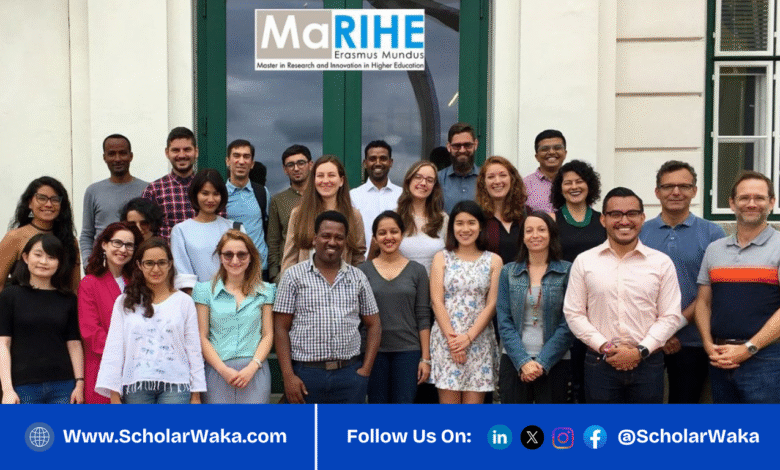
MARIHE stands for Master in Research and Innovation in Higher Education, and it occupies a genuinely specific niche within the Erasmus Mundus Joint Master’s family: rather than training students in a conventional academic discipline, it’s built to produce the people who go on to actually run and shape higher education institutions themselves – university administrators, research managers, and policy leaders who understand how universities function as complex organisations, not just as places of study.
Also, Check Out: Top Fully Funded Master’s Scholarships in Europe
Funded by the European Union and delivered jointly by seven partner institutions across Austria, Finland, Germany, Hungary, Portugal, China, and India, MARIHE genuinely lives up to its “joint” framing: you don’t stay at one university for two years, but move between countries and institutions as part of the programme’s core structure. If you’re planning ahead for graduate study starting September 2027, applications are open right now, with a first-step deadline of 21 September 2026, 10:00 CEST.
Don’t Miss: Top Fully Funded Scholarships for International Students
About the MARIHE Erasmus Mundus Scholarship
MARIHE positions itself as the only Erasmus Mundus Joint Master’s programme built specifically for aspiring higher education leaders, innovators, and change agents – meaning its curriculum sits at the intersection of governance, funding, teaching quality, and the broader societal impact of universities, rather than any single traditional academic subject.
Also Read: How to Write a Personal Statement for Scholarship | Tips and Free Template
The two-year programme structure moves students physically between partner institutions: your first semester is based at the University for Continuing Education Krems in Austria, strong specifically in higher education governance and lifelong learning within a Danube-region focus, before moving to Tampere University in Finland for your second semester, which brings particular expertise in innovation, funding, and the societal impact of universities within a Nordic context. From there, students continue their studies at partner institutions in either China or India, or elsewhere in Europe, before completing the programme with a genuine internship — meaning MARIHE graduates leave with real, applied professional experience layered directly into their degree, not just coursework.
The Consortium and Mobility Path
The programme is delivered by a consortium of seven institutions:
- University for Continuing Education Krems (Austria),
- Tampere University (Finland),
- Osnabrück University of Applied Sciences (Germany),
- Eötvös Loránd University (Hungary),
- University of Aveiro (Portugal),
- Beijing Normal University (China), and
- Thapar Institute of Engineering & Technology (India).
This is open to students study across multiple countries: 1st semester in Austria, 2nd semester in Finland, 3rd and 4th semester in Asia (China or India) and Europe (Austria, Finland, Germany, Hungary, or Portugal), plus a worldwide internship.
The programme is explicit about its values orientation too, built around democracy, diversity, and inclusion, and the green and digital transformation of universities specifically – reflecting the kind of institutional leadership the EU is actively trying to cultivate across the higher education sector globally.
Graduates from this programme go on to work in higher education & research institutions, government agencies, consultancy, start-ups, international and supranational organizations, non-tertiary education institutions, and university alliances.
MARIHE Erasmus Mundus Scholarship Summary
| Scholarship Name ⇒ | MARIHE Erasmus Mundus |
| Host Country ⇒ | Austria, Finland, Germany, Hungary, Portugal, China, and India |
| Study Level ⇒ | Master’s |
| Benefits ⇒ | Fully funded scholarship, up to €33,600 total, plus full tuition/participation cost coverage (€18,000) |
| Funded by ⇒ | European Union |
| Eligible Countries ⇒ | All countries – Open to students from all over the world, with all nationalities. |
| Application Deadline ⇒ | Intake 2027 (starting September 2027) is currently open. First-step deadline: 21 September 2026, 10:00 CEST. Video submission for shortlisted candidates: 11 December 2026, 10:00 CET. |
What the Scholarship Actually Covers
- A monthly stipend of €1,400, paid across the full 24 months of the programme, totalling up to €33,600 — covering daily living expenses, housing, and food
- Full tuition (participation cost) coverage, cited at €18,000, waived entirely for scholarship recipients
- Complete health and accident insurance, covering the full duration of your studies
- Travel and visa cost support, helping offset the genuine expense of moving between multiple countries over the two-year programme
- Access to seven partner universities across Europe and Asia, giving genuine international academic and professional exposure well beyond a single-institution degree
- A built-in internship component, adding real applied professional experience directly into your degree structure
Given that this programme requires physical relocation between at least two, and often three, countries over two years, it’s worth understanding that the travel and visa support specifically addresses one of the more genuinely complex logistical aspects of a joint degree like this — multiple visa applications, multiple relocations — compared to a single-country Master’s programme.
Eligibility Requirements
- You must hold a recognised Bachelor’s degree, equivalent to at least 180 ECTS (three years of full-time study)
- Only your first degree is considered for eligibility — a cumulative combination, such as a two-year Bachelor’s plus a two-year Master’s, does not qualify in place of a genuine first Bachelor’s degree
- You must demonstrate genuine motivation and interest in higher education management, research, and innovation
- You must provide proof of English proficiency through one of the following: TOEFL iBT (minimum 92), IELTS Academic (minimum 6.5, no band below 5.5), PTE Academic (minimum 62), Cambridge C1 Advanced (grade C), or Cambridge C2 Proficiency (grade C1)
- You’re exempt from the English test requirement if you completed a Bachelor’s degree, a two-year Master’s degree, or full secondary education in English while resident in one of the following: EU/EEA countries, Switzerland, Australia, Canada, New Zealand, the UK, or the US
- Work experience isn’t mandatory, but genuinely strengthens an application, particularly if it’s within education or research organisations specifically
PWhile demonstrating strong motivation and interest for this programme, you shall show a strong motivation and interest to learn and work in the field of development and management of research and innovation in higher education. Important to us are your specific motives for choosing the MARIHE programme, with regard to your previous education, working experience (if applicable) and future career plans.
Please note: Work experience is not an admission requirement. However, work experience can be a strong advantage for an application, especially if it has been acquired while working for (higher) education institutions.

Required Documents
For the first application step (by 21 September 2026, 10:00 CEST):
1. Completed Online Application Form
- Submission Portal: Submitted directly through the official MARIHE online application system.
- Core Content: Personal bio-data, academic background, contact details, language proficiency declarations, and formal selection of program tracks/consortium university mobility routes.
- Accuracy: Ensure all entries (names, dates, institution titles) align exactly with your official supporting documents.
2. Proof of Identity (Passport or National ID)
- International Applicants: Clear, high-resolution scan of the main biographical page of a valid International Passport.
- EU/EEA Applicants: Valid International Passport or official government-issued National ID card (both front and back).
- Requirements: Document must show full legal name, date/place of birth, photo, issue/expiration dates, and machine-readable zone (MRZ). The document must remain valid throughout the selection and enrollment period.
3. CV in Europass Format (Strict Rules)
- Standard: Must be generated using the official Europass CV framework.
- Mandatory Constraint: Must NOT include a photograph, in compliance with MARIHE evaluation standards.
- Content: Comprehensive chronological summary of educational background, professional work experience, research projects, publications, awards, language competencies, and relevant digital skills.
4. Letter of Motivation (Official Template Required)
- Format: Must strictly follow the official MARIHE Letter of Motivation Template provided on the program portal.
- Focus Areas:
- Your specific interest in research and innovation within higher education systems.
- How your previous academic or professional background prepares you for the program.
- Your long-term career aspirations and how the MARIHE degree supports them.
- Compliance: Do not substitute with a general or unformatted personal statement.
5. Bachelor’s Degree Certificate or Statement of Expected Graduation
- Graduated Applicants: Official copy of your completed Bachelor’s degree diploma or graduation certificate (minimum equivalent to 180 ECTS).
- Final-Year Students: If your degree has not been formally conferred by the September 2026 deadline, submit an official Statement of Expected Degree / Expected Graduation issued and signed by your university registrar, confirming your active status and target completion date.
6. Official Academic Transcripts
- Scope: Comprehensive official grade records from all previous university studies (Bachelor’s level and any higher/postgraduate coursework).
- Details Required: Course titles, credits earned per course, individual grades, overall Cumulative Grade Point Average (CGPA), and the official grading scale key of the granting institution.
- Translation: If original documents are not issued in English, submit certified, official English translations alongside the original language documents.
7. English Language Proficiency Proof
- Standardized Test Results: Official score report meeting MARIHE’s minimum threshold (e.g., IELTS Academic, TOEFL iBT, C1 Advanced) obtained within valid limits.
- Exemption Proof: If claiming an exemption, provide official documentation demonstrating eligibility according to MARIHE criteria (e.g., completed prior degree where English was the verified sole medium of instruction in an exempt region).
Important Notice on how to prove English proficiency:
- Please carefully read the additional information provided below and refer to the Guideline for Applicants linked below.
- MARIHE consortium can only accept the five English language test certificates listed, and can only grant exemption on basis of the cases explained below (cf. section on Previous Studies).
- If you receive your English test certificate after the application deadline, a late submission might be granted (see below).
- Because of national and institutional requirements of the MARIHE consortium partners, there are no exceptions!
- This means: All applicants have to provide either one of the accepted test certificates or an adequate diploma/degree of previous studies qualifying as exemption, according to our requirements.
- Applicants who do not submit an appropriate proof will be rejected due to formal reasons.
8. Two Letters of Recommendation
- Referees: Issued by academic professors, research supervisors, or professional line managers who can authoritatively speak to your intellectual capabilities and analytical aptitude.
- Format & Details: Written in English, printed on official university/organization letterhead, dated, signed, and including full contact details (official institutional email and phone number) of the referees.
9. Academic Essay (MARIHE Template & Topic)
- Mandatory Guideline: Must be authored strictly according to the official MARIHE Essay Template and address the specific prompt/topic defined for the 2026 intake.
- Evaluation Criteria: Assesses critical analytical reasoning, academic writing ability, structured argumentation, relevant literature synthesis, and precise citation formatting.
For shortlisted candidates (second step, by 11 December 2026, 10:00 CET):
- A video submission, prepared according to MARIHE’s Applicant Guideline
Two important notes worth taking seriously: MARIHE requires that any AI-generated content in your application be clearly declared, and provisional or incomplete degree certificates are explicitly not accepted — if your degree is genuinely still in progress, your statement of expected degree needs to reflect that accurately, rather than submitting an incomplete formal certificate as if it were final.
How the Application Process Works
- Visit the official MARIHE application portal.
- Create an account and complete the online application form.
- Upload every required document for the first application step, ensuring all materials are in English or accompanied by certified English translations.
- Submit your complete application before 21 September 2026, 10:00 CEST.
- Watch for an automatic email confirmation that your submission was received — if this doesn’t arrive, check your spam folder, or confirm your application isn’t still sitting as an unsubmitted draft.
- MARIHE’s two-round process begins with a formal pre-check ensuring eligibility, followed by review by the MARIHE Admission Board.
- If shortlisted, submit your required video document by 11 December 2026, 10:00 CET.
- All applicants, successful or not, are formally notified of the outcome of their application.
How to prove English Proficiency for Admission to MARIHE
You have two options for demonstrating your English language proficiency: a language test certificate or previous studies, meeting the following requirements (updated as of June 2026):
1. Language Tests
MARIHE programme only accepts the following five English language test certificates:
- TOEFL iBT (Test of English as a Foreign Language, internet based test) with a minimum score of 92 (out of 120) with no section below 20 (if test was completed before 21 Jan. 2026); or with a minimum score of 4.5 (out of 6) with no section below 4 (if test was completed on or after 21 Jan. 2026); Note: scores from TOEFL ITP (institutional testing programme) and TOEFL PBT (paper based test) are not accepted.
- IELTS Academic (International English Language Testing System); with a minimum overall score of 6.5 (out of 9) and no individual score below 5.5 .
- PTE Academic (Pearson’s Test of Academic English) with a minimum score of 62 (out of 90).
- Cambridge English C1 Advanced (formerly known as CAE) with a minimum result of grade C.
- Cambridge English C2 Proficiency (formerly known as CPE) with a minimum result of grade C1.
All editions of the above mentioned tests (test center, paper edition, home/online edition) are accepted.
You should book a language test well in advance. There might not be many test dates available, or they may get fully booked early. If applicants cannot provide an English test certificate in time, their application will not be considered for student selection. If you receive your English test certificate after the application deadline, you can ask to be granted a late submission. Please follow the instructions provided here.
The results of the English test will be verified by MARIHE Secretariat (not the applicant) after the application deadline during the eligibility check.
An English language test certificate you have taken in the past may have expired (usually after two years). We kindly advise you to check on your certificate. If an English language test certificate has expired before MARIHE Secretariat receives it, we may not be able to verify it and the application may be rejected due to formal reasons.
2. Previous Studies
An exemption from submitting a language test certificate is only possible based on studies specified and listed below. If you are applying without a valid language test result, carefully review the exemption criteria below. Only studies that meet the stated criteria will be accepted.
Applicants can only be exempted from providing an English test certificate, if they have successfully completed one (or more) of the following:
- A bachelor’s degree or a master’s degree or a doctoral degree (tertiary education) completed in English in one (or more) of the following countries:
- Any EU/EEA country, Australia, Antigua and Barbuda, Bahamas, Barbados, Belize, Botswana, Cameroon, Canada, Dominica, Eritrea, Eswatini, Ethiopia, Gambia, Ghana, Grenada, Guyana, Hong Kong, India, Jamaica, Kenya, Lesotho, Liberia, Malawi, Namibia, New Zealand, Nigeria, Philippines, Rwanda, Saint Kitts and Nevis, Saint Lucia, Saint Vincent and the Grenadines, Sierra Leone, Singapore, South Africa, Switzerland, Tanzania, Trinidad and Tobago, Uganda, UK, USA, Zambia, Zimbabwe.
- Important: Completing previous studies in English does not automatically exempt you from the requirement to submit an English language test certificate! If your degree was taught in English but was not obtained in one of the listed countries, you are still required to provide a valid English test certificate! Due to national laws and the regulations of the MARIHE partner institutions, we cannot make any exceptions or consider individual circumstances.
- Upper secondary education completed in English in a secondary school in one of the following countries:
- Any EU/EEA country, Australia, Canada, New Zealand, Switzerland, UK, USA.
- A student exchange semester or year is no case for exemption.
The language of instruction must be exclusively English.
Exemption can only be granted, if the higher education institution awarding the degree was located in one of the countries listed above. Studies completed entirely on a satellite campus, that is not located in one of the mentioned countries, are not eligible for the exemption.
To be granted the exemption, applicants have to submit an adequate diploma/degree as application document no. 7 (Proof of proficiency in English language). The language of instruction for your degree must be stated on your degree certificate, the official transcript of records, diploma supplement, or another official document issued by the awarding institution (e.g. MOI letter).
Please note that, due to national laws and the regulations of the MARIHE partner institutions, we are unable to make any exceptions! This applies to all applicants equally, and individual circumstances cannot be considered. All applicants are required to provide either one of the five accepted English language test certificates or a degree from previous studies completed in one of the countries listed above. No other certificates, qualifications, or forms of proof can be accepted.
How to Give Yourself the Strongest Chance
- Start your Letter of Motivation and essay well ahead of the September deadline, since both follow specific MARIHE templates rather than open-ended formats — treat these as documents requiring genuine structure and multiple revisions.
- Line up your two recommendation letters early, giving your recommenders real lead time rather than requesting them in the final weeks before the deadline.
- Confirm your English proficiency route now — sit your required test early if you don’t already hold a qualifying score, or gather documentation confirming your exemption if applicable, since test results can take weeks to arrive.
- If you have any relevant experience in education or research organisations, highlight it specifically, since this genuinely strengthens an application even though it isn’t mandatory.
- Prepare for the second-round video requirement conceptually now, even though it’s only required if you’re shortlisted, since knowing this stage exists helps you plan your overall application timeline more realistically.
Read the MARIHE scholarship Guideline for Applicants for more guides.
Deadline
Applications for the September 2027 intake are open now, with a first-step deadline of 21 September 2026, 10:00 CEST. Shortlisted candidates must submit their required video document by 11 December 2026, 10:00 CET. The prior October 2026 intake (deadline 23 November 2025) has fully closed, with all applicants already notified of their results.
Frequently Asked Questions
Is the October 2026 intake still open?
No. That cycle’s deadline was 23 November 2025, and all applicants have already been notified of their results. The currently open intake is for September 2027 entry.
Do I need work experience to apply?
No. Work experience isn’t mandatory, though it can genuinely strengthen your application, particularly if it’s in education or research organisations.
Can Nigerian students apply?
Yes. MARIHE is open to all nationalities worldwide, so Nigerian applicants are eligible provided they meet the academic and English proficiency requirements.
Do I study in one country for the full two years?
No. MARIHE is a genuine joint programme — you move between at least two, and typically three, countries across the two years, including a semester in Austria, a semester in Finland, and further study in China, India, or elsewhere in Europe, plus a built-in internship.
What happens if I’m not shortlisted after the first application step?
You’ll be formally notified of the outcome either way. MARIHE’s two-round process means only shortlisted candidates proceed to the video submission stage in December.
Disclaimer: All scholarship details, deadlines, and figures in this post were verified from official sources as of August 2026. Information is subject to change without notice. Always confirm the latest details directly on the official MARIHE website before submitting an application. ScholarWaka is not affiliated with the European Union or the MARIHE consortium universities.
Official Application Portal
Join ScholarWaka Community
Get the latest scholarship updates and study abroad opportunities before anyone else.