SLE Postgraduate Program 2027 in Germany — Fully Funded

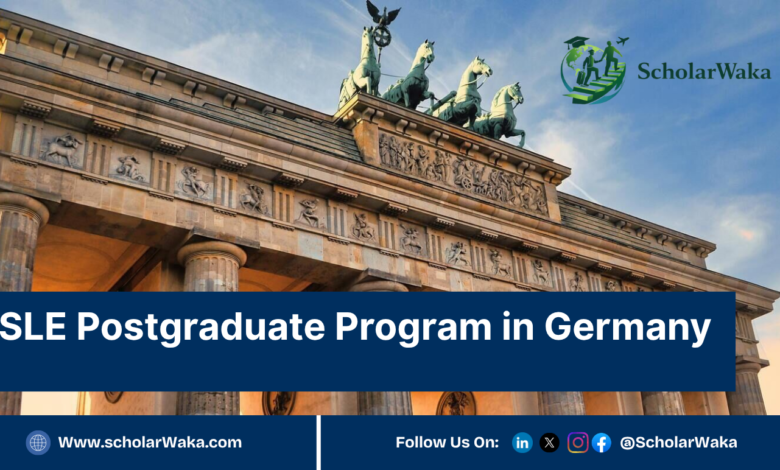
The SLE Postgraduate Program 2027 at Humboldt University of Berlin is open for applications from 1st May 2026, and the deadline is 30th June 2026. The programme is ideal for Master’s graduates who are committed to international development and willing to spend a full year combining intensive academic training with fieldwork in a developing country. Participants receive a monthly scholarship of €1,300 and comprehensive institutional support throughout the programme, making it one of Europe’s most practice-oriented professional development opportunities in the field of international development.
Also Read: Heidelberg University Scholarships in Germany | How to Apply
Only 20 participants are selected each year from a global pool of applicants, which makes this one of the most selective postgraduate development programs in Germany and one of the most distinctive in the world. The program runs for a full calendar year from January to December 2027, dividing your time between an intensive course phase in Berlin from January to May and a field research and project delivery phase from June to December, during which you travel to a partner country to work on a real, live development project alongside peers from different disciplinary and national backgrounds.
Germany’s Federal Ministry for Economic Cooperation and Development, the Berlin Senate, and Humboldt University of Berlin jointly fund the programme. Their support reflects the programme’s strong institutional foundation and commitment to preparing future development professionals through high-quality academic and practical training. Eligibility is open to citizens of EU countries and developing or transition countries listed on the OECD Development Assistance Committee list, meaning Nigerian and African applicants are firmly within the eligible pool. If you hold a completed Master’s degree, have practical experience in development-related work, and are ready to commit fully to a year of the most intensive professional training available in international cooperation, read this post carefully and apply before the June deadline.
Check Out: Central European University Scholarship | How to Apply
SLE Postgraduate Program Summary
| Scholarship Name ⇒ | SLE Postgraduate Program |
| Host Country ⇒ | Germany |
| Study Level ⇒ | Masters | Fellowships |
| Benefits ⇒ | Fully Funded — Monthly Stipend of €1,300 + Training + International Fieldwork + Career Coaching |
| Funded By ⇒ | BMZ (Federal Ministry for Economic Cooperation and Development) + Berlin Senate + Humboldt University |
| Eligible Countries ⇒ | EU Countries + Developing and Transition Countries (OECD DAC List) |
| Application Deadline ⇒ | June 30, 2026 |
Scholarship Categories to Explore on ScholarWaka— Here are some key scholarship opportunities you should check out on ScholarWaka:
- Study Abroad: Study in USA | Study in Canada | Study in UK | Study in Europe | Study in Asia | Study in Australia | Study in Africa
- Scholarship Category: Undergraduate Scholarships | Postgraduate Scholarships | Masters Scholarships | PhD Scholarships | Diploma Scholarships | Competitions | High School Scholarships | Internships Scholarships | Training | Fellowships
About the SLE Postgraduate Program
SLE — the Centre for Rural Development, known by its German acronym — is one of Europe’s longest-standing postgraduate training institutions in international development cooperation. Based at Humboldt University of Berlin, SLE has been operating since 1962 and has trained development professionals from across the world who have gone on to work at the United Nations, the German Development Cooperation agency GIZ, the World Bank, bilateral aid organisations, governments, and international NGOs across dozens of countries.
Founded in 1810, Humboldt University of Berlin ranks among Germany’s most historically significant universities. The institution pioneered the research university model, which later became the foundation for modern higher education systems around the world. Today, it remains one of Germany’s leading research universities and one of Europe’s most internationally connected academic institutions.
The program’s structure reflects this design intention directly. The programme begins with a first phase in Berlin from January to May, where participants receive intensive training in the technical, methodological, and analytical skills used in development practice. This training covers areas such as project design, monitoring and evaluation, development policy analysis, intercultural communication, and fieldwork methodology.
From June to December, participants move into the second phase and work directly on development projects in partner countries. They collaborate in small teams to design solutions, conduct primary research, and produce outputs that partner organisations use in real-world settings.
Three institutional partners fund the programme: Germany’s Federal Ministry for Economic Cooperation and Development, the Berlin Senate, and Humboldt University of Berlin. Together, they support a highly selective programme that admits only 20 participants each year. This is not an incidental detail — it is a deliberate design choice.
Apply For: Churchill Cambridge Scholarship in UK | Fully Funded
What the SLE Postgraduate Program Covers
The program provides the following benefits to all 20 selected participants:
1. Monthly scholarship of €1,300 for the full twelve months of the program
Paid to you every month from January through December 2027. Over the full program duration, this amounts to €15,600 in total stipend support. The scholarship is funded jointly by BMZ, the Berlin Senate, and Humboldt University of Berlin and is designed to cover your living costs in Berlin during the course phase and your basic needs during the international field research phase. It is not a loan and carries no repayment obligation.
2. Child allowance (where applicable)
Participants with dependent children may be eligible for an additional child allowance on top of the monthly stipend. Confirm the current terms and eligibility conditions with the SLE program office when you apply.
3. Full academic and practical training
The course phase from January to May delivers high-quality, intensive professional training in the technical and methodological competencies central to international development work. This training is designed by practitioners and academics with direct field experience and is continuously updated to reflect current challenges and methodologies in the sector.
4. International field research experience
From August to November, you travel to a partner country to conduct primary field research as part of a small project team. This is one of the most professionally valuable components of the program. The fieldwork is not observational — you design a project, collect and analyse data, engage with partner organisations and communities on the ground, and deliver a concrete output. This experience is what sets SLE alumni apart in the development job market.
5. Participation in the Berlin Forum on Global Cooperation (May)
A high-profile event that brings together development practitioners, policymakers, academics, and civil society representatives from across the global development sector. Participating as an SLE scholar gives you direct access to this network at a level that is otherwise difficult to achieve early in a development career.
6. Career coaching and job entry support
The programme incorporates structured career development sessions and individual coaching to help participants present their SLE experience effectively, strengthen their job applications, and build clear career paths in international cooperation and development.
7. Access to SLE’s global professional network
Upon completing the program, you join an alumni community built over six decades that spans senior positions at GIZ, UN agencies, the World Bank, bilateral development organisations, international NGOs, and government ministries across dozens of countries. This network is actively maintained and is one of the most enduring professional benefits of SLE participation.
Also Read: SIIT Graduate Scholarship | Fully Funded

Eligibility Requirements
To be considered for the SLE Postgraduate Program 2027, you must meet all of the following criteria:
1. You must hold a completed Master’s degree or equivalent qualification by January 2027.
Your degree must be completed — not in progress — before the program begins. Applicants who will not have completed their Master’s before January 2027 are not eligible for this cycle. The degree must be of a standard that qualifies you for doctoral studies at Humboldt University of Berlin, which in practice means it must be a full research or coursework Master’s from an accredited institution, not a short postgraduate certificate or diploma.
2. You must have good academic performance.
While no specific GPA threshold is published, the program is highly competitive and selects only 20 participants from a global pool. A strong and consistent academic record at the Master’s level is a baseline expectation. Present your results clearly and accurately in your application.
3. You must be a citizen of an EU country or a developing or transition country on the OECD Development Assistance Committee list.
This is a hard eligibility condition — not a preference or a tie-breaker. Nigerian citizens are eligible under this criterion, as Nigeria is on the OECD DAC list of official development assistance recipients. Confirm your country’s DAC list status before applying if you are uncertain.
4. You must have practical experience relevant to international development.
This includes internships, work placements, employment, or study placements — local or international — that have given you direct exposure to development-related work. Purely academic backgrounds without any practical experience are unlikely to be competitive. The SLE programme targets professionals who are entering or advancing within the development sector. As a result, applicants should demonstrate relevant practical experience and a clear commitment to development work rather than relying solely on academic study of the field.
5. You must demonstrate a strong and genuine interest in development policy and international cooperation.
The selection committee assesses this through your motivation letter and the overall consistency of your application. Your academic background, practical experience, and career goals should work together to present a clear and credible commitment to the field.
6. You must be fluent in English.
The programme uses English as its primary language of instruction. As part of your application, you must provide proof of English language proficiency. Check the accepted language tests and minimum score requirements with the SLE programme office, as IELTS and TOEFL are among the most commonly accepted qualifications.
7. Additional language skills are an advantage but not a requirement.
Proficiency in French, Spanish, Arabic, German, or other languages relevant to international development contexts strengthens your application and increases your suitability for a wider range of field research locations. If you have working proficiency in any additional languages beyond English, include this clearly in your CV and application form.
8. You must be in good health and physically fit for travel to developing countries.
The field research phase takes participants to partner countries, which may include locations with challenging environmental or logistical conditions. The program requires that you are medically fit to travel and work in these environments. A health condition that would prevent safe travel or participation in fieldwork is a disqualifying factor.
9. You must demonstrate strong interpersonal and communication skills.
The program’s team-based fieldwork model depends on participants being able to work effectively across cultural, disciplinary, and personal differences in high-pressure field conditions. Your application should reflect evidence of teamwork, cross-cultural engagement, and professional communication.
Check Out: Western Undergraduate Admission Scholarships | How to Apply
Required Documents
- Completed online application form — filled out in full through the official SLE application portal. Every section must be completed accurately. The form captures your personal details, academic background, language proficiencies, and work and practical experience. Treat the form itself as a substantive written component
- Academic certificates and transcripts — official or certified copies of your Master’s degree certificate and full academic transcripts, along with transcripts from your undergraduate degree. Your documents must confirm that your degree meets the standard required for doctoral study at Humboldt University of Berlin.
- Updated Curriculum Vitae (CV) — a current, well-organised CV that reflects your academic background, work and practical experience, language skills, and any relevant professional achievements or activities.
- Motivation letter — this is one of the most important documents in your application. It should do four things clearly: explain your academic and professional background and how it has prepared you for this program; describe your practical experience in development-related work and what you learned from it; articulate why you are applying for the SLE program.
- Proof of English language proficiency — an official IELTS, TOEFL, or equivalent test score report. Confirm the accepted formats and minimum score requirements with the SLE program office before you sit the test. Native English speakers or applicants whose Master’s degree was conducted entirely in English should confirm with SLE whether a formal test score is still required in their case.
- Proof of work experience or internships — documentation confirming the practical experience you describe in your CV and motivation letter. This may include employer reference letters, internship certificates, confirmation letters from organisations you have worked with, or any other official documentation of your professional activity in development-related contexts.
Also Check: Routledge/Round Table Commonwealth Studentship Awards in UK (£5,500 Funding)
How to Apply — Step by Step
1. Confirm your eligibility before anything else.
Check your citizenship status against the OECD DAC list if you are not an EU citizen. Confirm that your Master’s degree will be completed before January 2027. Verify that you have practical experience to document and that your English proficiency meets the program’s requirements. Do not invest significant time in preparing your application if a fundamental eligibility condition is not met.
2. Read the full program details carefully before you begin writing your motivation letter.
The SLE program follows a defined structure, develops a specific set of professional competencies, and targets a particular type of participant. Your motivation letter and CV should show that you understand the programme’s objectives, training components, and expectations rather than simply expressing a general interest in international development. Read the program structure, the course phase content, and the fieldwork component description carefully, and let that understanding shape how you write.
3. Write your motivation letter from scratch, specifically for this application.
Begin drafting your motivation letter well before the June deadline — a competitive motivation letter for a program of this selectivity requires multiple drafts over several weeks. Structure it clearly around the four things listed in the required documents section above: your background and preparation, your practical experience, your specific reasons for choosing SLE, and your post-program career intentions. Be concrete and specific. Name the development contexts you have worked in, the challenges you encountered, and what you learned. Vague expressions of passion for development will not distinguish you from hundreds of other applicants.
4. Update your CV to reflect the experience most relevant to this program.
Prioritise your development-related practical experience — internships, placements, professional roles, and fieldwork — over purely academic content. For each position or placement, describe your specific responsibilities, the organisation’s work, and the development context clearly. Include your language skills with honest proficiency levels — do not overstate abilities that will be apparent in an interview or selection day.
5. Gather and verify all required documents.
Request your academic certificates and transcripts from your institution early — processing times can be several weeks at many universities. If you need a certified translation of any document, identify a qualified notarised translation service and allow adequate time. Collect your proof of practical experience documentation from relevant employers or organisations — give them adequate notice if you need reference letters or confirmation letters.
6. Arrange your English language proficiency test if required.
If you need a formal test score, book your test immediately — available testing dates may be limited, and your results must be available before the June 30th deadline. Check test booking availability as soon as possible.
7. Access the official SLE application portal from 1st May 2026.
The application window opens on 1st May 2026. Visit the SLE program page at Humboldt University of Berlin’s official website to access the portal. Create your account and review every section of the application form before you begin filling it in — understand what each section asks for and prepare your answers carefully before entering them into the form.
8. Complete the online application form in full.
Work through every section precisely and accurately. Do not leave fields incomplete or mark sections as not applicable without explanation. The quality and detail of your responses throughout the form contribute to your pre-selection evaluation.
9. Upload all required documents.
Check file format and size requirements within the portal. Label each document clearly with your name and document type. Review every uploaded file to confirm it is the correct, complete, and legible version before you proceed to submission.
10. Submit your complete application before 30th June 2026.
After submission, the pre-selection process runs in July and August 2026, followed by the main selection — which includes a selection day — in August and September 2026. If you are shortlisted for the main selection, you will be required to attend a selection day in person or virtually — prepare for this in advance. The program begins in January 2027. Aim to submit no later than 25th June 2026 to account for any technical issues with the portal in the final days of the application window.
Check Out: Midwestern Oil and Gas Scholarship | Fully Funded
Application Deadline
The deadline to apply for the SLE Postgraduate Program 2027 in Germany is June 30, 2026.
Check Out: Sheffield Hallam University Transform Together Scholarships in UK | How to Apply
Frequently Asked Questions
Is the SLE Postgraduate Program 2027 fully funded?
Yes. The program is fully funded through a joint scholarship from Germany’s Federal Ministry for Economic Cooperation and Development, the Berlin Senate, and Humboldt University of Berlin. Selected participants receive a monthly stipend of €1,300 for the full twelve months of the program — totalling €15,600 over the year — along with access to all program training, fieldwork, and career development components at no cost. A child allowance is also available where applicable.
Can Nigerian and African students apply for the SLE Postgraduate Program 2027?
Yes. The program is open to citizens of EU countries and citizens of developing and transition countries on the OECD Development Assistance Committee list. Nigeria is on the DAC list, as are the majority of African countries. African applicants can apply if they have completed a Master’s degree, gained relevant practical experience in development work, demonstrated fluency in English, and can travel to partner countries for fieldwork.
How many participants are selected each year?
Only 20 participants are selected annually from a global applicant pool. This is a deliberate program design choice that enables the intensive, team-based, personalised model of training and fieldwork that distinguishes SLE from larger development programs. It also means the competition is extremely high — every element of your application must be strong.
What does the field research phase involve?
From August to November 2027, participants travel to a partner country to conduct primary field research as part of a small group project team. You work on a genuine development challenge facing a real partner organisation, design a research approach, collect and analyse data in the field, and deliver concrete project outputs that the partner organisation uses. The partner countries and project themes vary by cohort and are determined by SLE in coordination with its institutional partners in the development sector.
Do I need to speak German to apply?
No. German language proficiency is not a requirement for admission. The programme uses English as its primary language of instruction. While additional language skills such as German, French, Spanish, or Arabic can strengthen your application and may support fieldwork placements, the programme does not require them for eligibility.
What happens at the selection day?
Shortlisted candidates are invited to a selection day as part of the main selection process in August and September 2026. The selection day assesses your communication skills, teamwork, analytical thinking, and suitability for the program’s intensive and field-based model. It typically includes group exercises, individual presentations, and interviews. Prepare for the selection day with the same seriousness you bring to your written application — candidates who perform strongly on paper but weakly on the selection day are not selected.
Must-Read: Commonwealth Scholarship | Fully Funded
Disclaimer: All program details, deadlines, stipend values, and eligibility criteria were verified from the official SLE Postgraduate Program 2027 information at Humboldt University of Berlin as of June 2026. Information is subject to change without notice. Always confirm the latest details directly on the official SLE program page at Humboldt University of Berlin before submitting your application.
Official Application Portal
Join ScholarWaka Community
Get the latest scholarship updates and study abroad opportunities before anyone else.