University of Sydney Australian Government Scholarships 2026

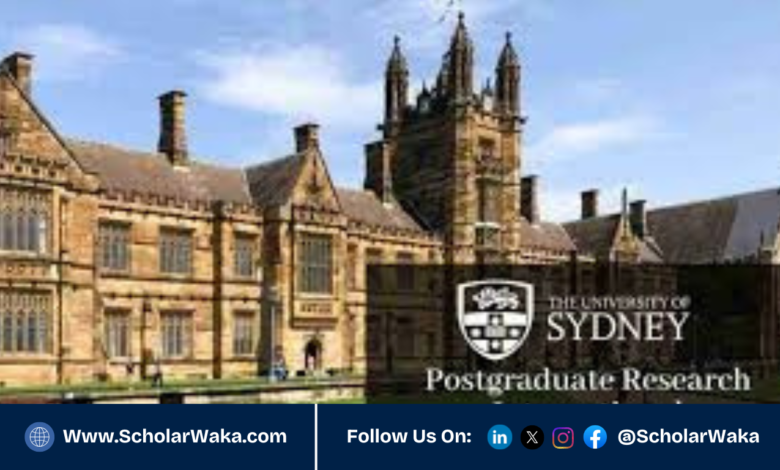
Postgraduate research funding in Australia can be confusing precisely because so much of it runs through the same underlying mechanism with different names attached. At the University of Sydney, “Australian Government Scholarship” isn’t one award; it’s an umbrella covering four distinct funding streams, each with its own eligibility quirks and payment structure, all feeding from the same federal Research Training Program grant.
Understanding which of these four actually applies to you, rather than treating “RTP scholarship” as a single thing you either get or don’t, is the single most useful thing you can do before applying. This guide breaks down each stream, what it actually pays, and the two upcoming deadlines you need to know if you’re targeting a 2027 research period start.
University of Sydney Australian Government Scholarships Summary
| Scholarship Name ⇒ | University of Sydney Australian Government |
| Host Country ⇒ | Australia |
| Study Level ⇒ | Master’s and PhD |
| Benefits ⇒ | $42,754 p.a. stipend (2026 rate), full tuition offset, OSHC, relocation and thesis allowances |
| Funded by ⇒ | Australian Government (RTP) and University of Sydney |
| Eligible Countries ⇒ | All countries |
| Application Deadline ⇒ | Research Periods 1 & 2, 2027: 11 September 2026. Research Periods 3 & 4, 2027: 18 December 2026 (confirm exact date on Sydney’s official timeline page). |
How Sydney’s Scholarship System Actually Works
Sydney doesn’t run a single scholarship application separate from your admission process. Scholarship consideration happens automatically alongside your application for a higher degree by research, provided you tick the right box and submit on time. Behind that simple process sit four separate funding streams.
The RTP Stipend Scholarship and the University of Sydney International Stipend Scholarship (USYDIS) both pay a living stipend at the same 2026 rate, but come from different funding pools: RTP from the federal government grant, USYDIS from the university’s own funds, which matters because it affects which one you’re assessed against if you don’t qualify for the other.
Separately, the RTP Fee Offset and the University of Sydney Tuition Fee Scholarship each cover 100% of your tuition fees, and critically, being awarded either stipend scholarship typically triggers automatic consideration for one of these tuition awards too, so a single successful stipend application can effectively unlock your full funding package at once.
What Each Funding Stream Actually Pays
- RTP Stipend Scholarship $42,754 per year at the 2026 rate, tax-free, paid fortnightly, plus a relocation allowance of up to $1,485 and a thesis allowance of up to $840 for PhD candidates or $420 for Master’s candidates.
- University of Sydney International Stipend Scholarship (USYDIS) is the same $42,754 per year rate and the same relocation and thesis allowances as the RTP Stipend, funded through university resources rather than the federal grant, held for up to 14 research periods for a Research Doctorate or 7 research periods for a Research Master’s.
- RTP Fee Offset: 100% tuition fee coverage for up to 14 research periods, plus Overseas Student Health Cover for the duration of your candidature.
- University of Sydney Tuition Fee Scholarship: 100% tuition fee coverage for up to 14 research periods, functioning as the university-funded equivalent to the RTP Fee Offset.
- Automatic bundling in many cases. If you’re awarded a stipend scholarship, Sydney typically also considers you for a matching tuition fee scholarship, so successful applicants often end up with both a living stipend and full tuition covered from a single assessment process.
Because these funding pools work slightly differently, don’t assume that missing out on one automatically means you’ve missed out on all of them. RTP and USYDIS draw from separate budgets, and a strong application can still succeed under one even if it’s not selected under the other.

Eligibility Requirements
- Be an international student at the time the scholarship is awarded
- Be applying for, or already enrolled in, a higher degree by research, Master’s by Research or PhD
- Be enrolling full-time, with part-time enrolment only permitted in specific, approved circumstances
- Meet all of the University of Sydney’s standard admission requirements for your chosen program
- Submit every required document for both your admission application and your scholarship consideration
- Not exceed Sydney’s residency limits for scholarship eligibility broadly, you’re expected to be at the beginning of your research degree, residing in Australia, and intending to return to your home country after thesis submission
- Demonstrate a genuinely strong academic and research background, since this remains a competitive, merit-based process even after you clear baseline eligibility
One priority group worth knowing about: applicants undertaking their first PhD degree are given priority consideration over those pursuing a second HDR qualification, so if you’ve already completed one doctorate, expect your application to be assessed somewhat differently than a first-time PhD candidate’s.
Required Documents
- A completed admission application for your chosen higher degree by research program, submitted through Sydney Courses
- The scholarship application form, which for new applicants is typically as simple as ticking the relevant box within your admission application rather than a fully separate process
- Academic transcripts, covering your full academic history, not just your most recent qualification
- A research proposal, if required for your specific program this becomes central to how your application is assessed, so treat it with real care rather than a formality
- Proof of English language proficiency, matching your program’s specific requirement
- Academic references, ideally from people who can speak directly to your research potential and capacity for independent scholarly work
One detail Sydney is explicit about in its own guidance: if your course or scholarship application arrives after the deadline, it isn’t discarded; it’s automatically carried over into the next round, as long as you meet specific conditions, such as submitting a deferral request by the next round’s own deadline. That’s a genuine safety net, but it also means a missed deadline can cost you a full research period’s delay, so it shouldn’t be relied on as a backup plan.
Step-by-Step Process to Apply
- Apply for admission to a higher degree by research through the University of Sydney’s course application portal, choosing Master’s by Research or PhD as appropriate.
- Select the relevant checkbox within your admission application to be considered for RTP and equivalent university scholarships. For most applicants, this replaces the need for a fully separate scholarship application.
- Prepare and submit every required admission document, including transcripts, your research proposal if applicable, English proficiency evidence, and references.
- Submit your complete application well before your target deadline, since Sydney assesses scholarship eligibility in conjunction with your admission application, not as an independent later step.
- If you’re a currently enrolled Sydney research student rather than a new applicant, use the separate deferral and scholarship application process instead, since your pathway differs from that of a new commencing student.
- Track which research period you’re targeting. Sydney runs its research degrees on a period-based calendar, so your deadline depends on when you intend to actually start, not on a single fixed annual date.
- Wait for your outcome via email. Because scholarship assessment is bundled with admission, a single notification often confirms both your course offer and your scholarship result together.
Application Deadline
Sydney runs two scholarship deadlines each cycle, tied to the research period rather than a single annual date. If you’re aiming to start in Research Period 1 or 2 of 2027, your deadline is 11 September 2026. If you’re targeting Research Period 3 or 4 of 2027, your deadline is 18 December 2026. A couple of secondary sources list these dates one day later (12 September and 19 December), so confirm the exact date on Sydney’s official RTP scholarship page before you submit, rather than relying on a single third-party listing.
Because scholarship consideration is bundled with your admission application, the practical deadline that matters most is really your complete admission submission: transcripts, research proposal, references, and all, not just the scholarship checkbox itself. Given how document-heavy this application is, particularly if your research proposal still needs real development, starting well ahead of either deadline gives you meaningfully more room to submit a genuinely strong application rather than a rushed one.
Frequently Asked Questions
Do I need to submit a separate scholarship application?
Generally, no, if you’re a new applicant, selecting the scholarship checkbox in your admission application is usually sufficient. Currently enrolled Sydney research students use a separate deferral and scholarship application process instead.
Can Nigerian or other African students apply?
Yes. Eligibility is open to international students from any country, with no nationality restriction, provided you meet the academic and admission requirements for your chosen research degree.
What happens if I miss the deadline?
Your application isn’t automatically rejected — it’s typically carried over to the next round, provided you meet specific conditions such as submitting a deferral request by that next round’s deadline. That said, missing a deadline still costs you a research period’s delay, so it shouldn’t be treated as a reliable backup plan.
Can I hold both a stipend scholarship and a tuition fee scholarship at the same time?
Yes, and this is common. Being awarded a stipend scholarship like the RTP Stipend or USYDIS typically triggers automatic consideration for a matching tuition fee scholarship, so many successful applicants receive both a living stipend and full tuition coverage from the same assessment.
Is a second PhD eligible for the same priority as a first one?
No. Applicants undertaking their first PhD are given priority consideration. If you’ve already completed a doctorate and are pursuing a second one, expect your application to be assessed with less priority than a first-time PhD candidate’s.
Disclaimer: All scholarship details, deadlines, award values, and eligibility criteria in this post were verified from official sources as of July 2026. Information is subject to change without notice. Always confirm the latest details, including exact deadlines, directly on the official University of Sydney website before submitting your application. ScholarWaka is not affiliated with the University of Sydney or the Australian Government.
Official Application Portal
Join ScholarWaka Community
Get the latest scholarship updates and study abroad opportunities before anyone else.