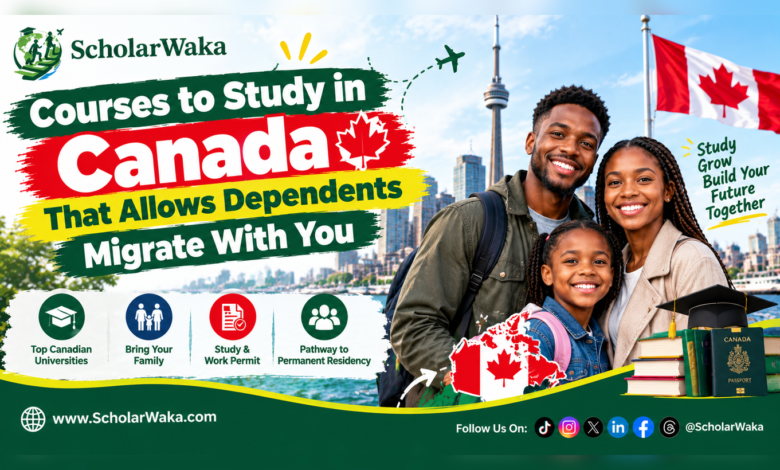
If you’re planning to study in Canada for an undergraduate, Master’s or PhD and want your family (spouse or common-law partner) to be able to work while you’re there, the programme you choose matters enormously, and the rules changed significantly on January 21, 2025. This isn’t a broad “any international student’s spouse can work” system anymore. Eligibility now depends specifically on your study level, your field, or whether your programme falls under a small list of named pilot initiatives.
Check This Out: Canada Graduate Research Scholarships Master’s (CGRS M) 2027 | Fully Funded
This guide walks through exactly which programmes currently qualify, what your spouse or partner needs to apply, and how the process differs depending on whether they’re applying from inside or outside Canada. One clarification worth making upfront: this specific pathway covers spouses and common-law partners only, as dependent children don’t need a separate work permit, since minors aren’t authorised to work regardless, and your dependent children can join you.
What an Open Work Permit Actually Means Here
If your spouse or common-law partner qualifies, they receive an open work permit, meaning they can work for almost any employer in Canada, without needing a specific job offer lined up first. The only restrictions: they can’t work for an employer listed as non-compliant with employment conditions, or for a business that regularly offers striptease, erotic dance, escort services, or erotic massages. Beyond those two exclusions, it’s genuinely open across any industry or employer.
Read More: Pierre Elliott Trudeau Foundation PhD Scholarship 2027 | How to Apply
Which Study Programmes Currently Qualify
Your spouse or common-law partner can be eligible for this open work permit only if you hold a valid study permit and you’re in one of these specific categories:
1. A Master’s degree programme, 16 months or longer. Shorter Master’s programmes don’t qualify – the 16-month threshold is a hard cutoff, not a rough guideline.
2. A Doctoral (PhD) degree programme. No minimum length restriction applies here, unlike the Master’s category.
3. One of eleven named professional degree programmes at a university, regardless of study level otherwise:
- Doctor of Dental Surgery (DDS, DMD)
- Bachelor of Law or Juris Doctor (LLB, JD, BCL)
- Doctor of Medicine (MD)
- Doctor of Optometry (OD)
- Pharmacy (PharmD, BS, BSc, BPharm)
- Doctor of Veterinary Medicine (DVM)
- Bachelor of Science in Nursing (BScN, BSN)
- Bachelor of Nursing Science (BNSc)
- Bachelor of Nursing (BN)
- Bachelor of Education (BEd)
- Bachelor of Engineering (BEng, BE, BASc)
This is the detail most guides miss: these eleven degrees qualify even though most are Bachelor’s-level, because Immigration, Refugees and Citizenship Canada (IRCC) has specifically carved them out as professional or high-demand fields. A general Bachelor of Arts or Science, by contrast, does not qualify your spouse for this permit, regardless of how long the programme runs.
See This: President’s International Scholarship of Excellence 2027 – York University | How to Apply
4. An eligible pilot programme, tied to specific provinces and specific institutions:
| Province or Territory | Programme | Eligible From |
|---|---|---|
| Outside of Quebec | Francophone Minority Communities Student Pilot (FMCSP) | August 26, 2024 |
| Quebec | Le projet de reconnaissance des compétences d’infirmières et d’infirmiers recrutés à l’international | April 30, 2024 |
| Quebec | Projet de reconnaissance des compétences d’inhalothérapeutes formés à l’étranger / Projet de recrutement et reconnaissance des compétences de technologistes médicaux formés à l’étranger | January 21, 2025 |
| Ontario | Supervised Practice Experience Partnership | January 21, 2025 |
| Manitoba | Nurse Re-Entry (Red River College Polytechnic) | January 21, 2025 |
| British Columbia | Internationally Educated Midwives Bridging Program (UBC); Canadian Pharmacy Practice Program (CP3) (UBC); Post-Degree Diploma: Nursing Practice in Canada (Langara College) | January 21, 2025 |
These pilot programmes are heavily concentrated in healthcare credential recognition for internationally trained professionals, worth checking directly if you’re already a nurse, midwife, respiratory therapist, or medical technologist trained abroad and looking to requalify in Canada, since this route is narrower and more specific than the general Master’s or Doctoral pathway.
If your programme doesn’t fall into any of these four categories, your spouse or common-law partner may still be eligible for a different type of work permit – just not this specific open work permit stream tied to your study permit.
Documents Your Spouse or Common-Law Partner Needs
To prove your enrolment, they need one of the following:
- A valid letter of acceptance from your designated learning institution (DLI).
- A proof of enrolment letter from your DLI.
- Transcripts from your current programme.
If you’re studying under one of the eligible pilot programmes specifically, they’ll also need proof of that, either a letter from the relevant province or territory, or a letter of acceptance from a participating DLI showing admission to that specific programme.
They’ll also need to provide proof of your relationship together, alongside any additional documents requested during the application.
Recommended: University of Saskatchewan PhD Scholarship 2026 (Fully Funded)
How Long the Permit Lasts
In most cases, your spouse or common-law partner’s open work permit will be valid for the same period as your study permit – it’s tied directly to your own status, not issued independently.

How to Apply — Step by Step
In most cases, your spouse or common-law partner applies online. Here’s the process:
- Gather what’s needed. They’ll need a scanner or camera to create electronic copies of documents, and a valid credit or debit card for the fee.
- Read the instruction guide before starting. IRCC’s Guide 5553 explains exactly how to complete each field on the application form.
- Answer the online eligibility questions carefully – this generates a personalised document checklist, and IRCC is specific that a technical issue with the standard online tool means you need to answer particular questions in a particular way depending on where your spouse or partner is applying from:
If applying from outside Canada, answer:
- “Will you be coming to Canada under an active public policy or special measure announced by IRCC?” → No
- “Are you a spouse, common-law partner or dependent child of a person who has or is applying for a work permit?” → Yes
- “Are you a spouse or common-law partner of a person who holds a study permit?” → Yes
- “What type of work permit do you want to apply for?” → “A work permit for a spouse of an international student, or for a family member of a worker”
Apply For This: McGill Mastercard Foundation Scholarship 2027 | Fully Funded
If applying from inside Canada, answer:
- “Does one of the following apply to you? I am applying for an open work permit under an active public policy or pilot program announced by IRCC.” → No
- “Are you a spouse, common-law partner or dependent child of a person who holds a valid work permit or is applying for a work permit?” → Yes
- “Are you a spouse or common-law partner of a person who holds a study permit?” → Yes
Getting these answers exactly right matters – answering incorrectly can route the application down the wrong track entirely.
- Pay the required fees, which typically include processing fees for your spouse or partner and anyone else included on the application, paid at the end of the process.
- Create an account or sign in through IRCC’s online portal to pay fees, submit the application, and track its status.
Accepted payment methods: Visa, MasterCard, American Express, and JCB credit or prepaid cards (keep a prepaid card for at least 18 months after payment in case a refund is needed), or a Canadian bank debit card registered for INTERAC Online, including Visa Debit.
If They Can’t Apply Online
A paper application is available if your spouse or common-law partner can’t apply online due to a disability, or if there’s a technical problem with the online system. IRCC provides specific alternate-format instructions for this situation.
Extending an Existing Open Work Permit
If your spouse or common-law partner already holds an open work permit under this stream and needs to extend it, you must meet all of the following:
- You hold a valid study permit.
- You’re physically in Canada, or will be physically in Canada while studying.
- You’re a full-time student enrolled in a PGWP-eligible programme at a designated learning institution.
- You’re not in the final term of your study programme.
Their extended permit cannot extend beyond your own study permit’s expiry date, regardless of these conditions being met.
Documents needed for the extension:
- Proof you’re a full-time student – a letter of enrolment from your DLI, or transcripts from your current programme.
- A copy of your study permit.
You can ready more about how international students can help their spouse or common-law partner work in Canada
Frequently Asked Questions
Does any Master’s or PhD programme automatically qualify my spouse for an open work permit?
For Master’s programmes specifically, only those 16 months or longer qualify, shorter Master’s programmes don’t. All Doctoral programmes qualify regardless of length.
Can my spouse get this permit if I’m studying a general undergraduate degree?
No, not under this specific stream – unless your undergraduate programme is one of the eleven named professional degrees (Nursing, Engineering, Education, and similar fields listed above). A general Bachelor of Arts or Science doesn’t qualify your spouse for this open work permit.
What if my study programme doesn’t fall under any of these categories?
Your spouse or common-law partner may still be eligible for a different type of work permit – just not this particular one tied to your study permit. Check IRCC’s general work permit eligibility pages for other options.
Does my spouse’s work permit last as long as my study permit?
In most cases, yes – their open work permit is generally issued for the same period as your study permit, and any extension can’t run past your study permit’s own expiry date.
Are dependent children covered by this same process?
No. This specific pathway is for spouses and common-law partners applying for an open work permit. Dependent children don’t need a separate work permit, since they’re not authorised to work in Canada as minors regardless of your study permit status.
Disclaimer: This overview reflects IRCC’s official policy on spousal and common-law partner open work permits, current as of the page’s last update on February 3, 2026. Eligible programmes, particularly the pilot programme list, are subject to change without notice. This is a general informational overview, not immigration or legal advice – always confirm current eligibility and application details directly on Canada.ca before applying.
Join ScholarWaka Community
Get the latest scholarship updates and study abroad opportunities before anyone else.