How Brighton Guvamombe Won the Chevening Scholarship on His First Try

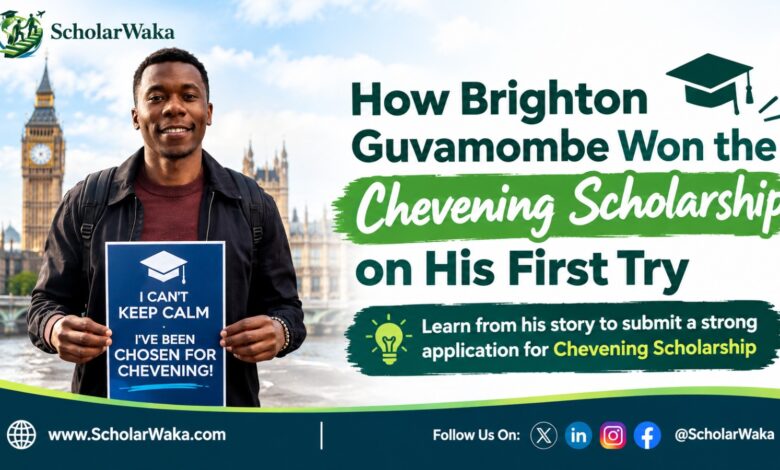
Brighton Guvamombe is a Zimbabwean student who studied a Master’s in Health Data Science and Statistics at the University of Plymouth, fully funded by the UK government’s Chevening Scholarship. The award covered his tuition, a monthly stipend, visa costs, and travel – but what makes his story worth telling isn’t just that he won. It’s the very specific, very personal problem that shaped everything he wrote in his application, and the disciplined process he used to get there.
Brighton studied Information Technology as an undergraduate back in 2016. On paper, a health sciences master’s might look like an unusual next step. In his essays, it wasn’t a leap at all – it was the logical continuation of something that had happened to him personally.
Read about the Chevening Scholarship Brighton won – UK Government Chevening Scholarship
Where the Story Started
The story Brighton tells begins not with a scholarship search, but with a health scare. He fell ill and sought help at one of the largest hospitals in Zimbabwe, but months went by without a proper diagnosis. Eventually he was referred to a hospital in Cape Town, South Africa, where doctors identified his condition within days.
What struck him wasn’t just the speed of the diagnosis, but the systems behind it. The South African hospital used electronic health records. He, on the other hand, arrived with nothing but handwritten discharge notes from Zimbabwe, and doctors were trying to reconstruct his medical history from a stack of loose papers.
That contrast became the seed of his entire academic direction: a conviction that Zimbabwean hospitals needed better systems for capturing and sharing patient data, and that connected records, even something as simple as sharing history through a hospital portal, could have spared him eight months of uncertainty.
It’s the kind of story he says most applicants overlook the value of: something specific, true, and impossible for anyone else to tell in quite the same way.
Also See: Top Selected UK Scholarships for International Students
Researching Before Writing a Single Word
Brighton didn’t start with essays. He started with research and treated the Chevening Scholarship website itself as the primary source of truth. For roughly two months (July and August), he read through everything available: how to apply, the mistakes previous applicants had made, and what the panel was actually looking for.
Only after that groundwork did he begin drafting. He applied in October, interviewed the following March, was selected shortly after, and by September 2025 was in the UK to begin his studies.
His advice for anyone starting from scratch mirrors that order:
- know your story first, then
- decide which universities and courses actually connect to it, then
- look into the cities you’d be living in, and
- only then start drafting.

What Chevening Scholarship Is Actually Looking For
Chevening’s application is built around four essays, and Brighton is careful to point out that they’re not testing academic ability so much as character: can you lead, can you build real relationships, do you have a clear plan for your career, and have you genuinely researched why the UK and the specific course is right for you.
The thread running through all four, in his account, is specificity. Panels reading thousands of applications respond to concrete stories and real numbers, not general claims about being a “team player” or a “hard worker.” He also recommends structuring examples with the STAR method – Situation, Task, Action, Result – so a reader can follow the story quickly and see a measurable outcome at the end, rather than a vague statement of impact.
Read Detailed Guide On – How to Write Your Chevening Scholarship Essays and Prepare for an Interview
Mistakes He Sees Applicants Make Again and Again
A few patterns come up repeatedly in Brighton’s account of common missteps:
- Being generic. Essays that could have been written by anyone tend to blur together for reviewers reading thousands of applications. He argues that unusual, deeply personal stories, even ones involving hardship, stand out precisely because no one else can tell them.
- Letting AI write the essay. He’s clear that AI tools are useful for research, structuring, or tightening sentences, but the actual story and voice have to come from the applicant.
- Unrealistic or vague career plans. A career plan should read like it was written by someone who has already done the homework, not someone guessing.
- Repeating the same clichés. He specifically flags the instinct to lean on a university’s global ranking as a selling point, noting it’s one of the most common lines reviewers see. His suggestion: replace it with something concrete and specific to your own goals, since every word in a limited word count should be earning its place.
Practical Steps for Applicants Starting or Seeking Scholarships Today
Brighton’s suggested sequence for anyone preparing a scholarship application:
- Start researching early – application portals for many scholarships, including Chevening, open around August – December, to the first quarter of the following year.
- Get clear on your own story before choosing universities or courses.
- Draft, review, and refine your essays more than once.
- Reach out to alumni of the scholarship – he points to LinkedIn and dedicated alumni Facebook groups as easy ways to find people willing to review essays.
- Once shortlisted, prepare deliberately for interviews through mock sessions with other applicants and alumni.
- Stay authentic. Every claim in the application should be true and should sound like you.
Also Read – How to Prepare for the Chevening Scholarship
Building a Network From Nothing
Brighton advised that building a good network is an advantage that will support your scholarship opportunities. His approach: figure out what you want to do first, because that clarifies exactly who you need to be talking to – lecturers, peers, and organizations working in the same space. He encourages volunteering, even unpaid, simply for the access and learning it offers, and suggests taking initiative rather than waiting for opportunities to appear – starting an academic club or bringing in guest speakers, for instance, is itself a leadership and networking exercise worth writing about later.
His broader point, echoed by the workshop’s host, was that there’s no ideal starting point or perfect moment to begin. Whether it’s tutoring children in a home community or organizing something small at a local church, the goal is simply to start somewhere and let the record of that work build over time.
Also Read – How to Prepare for Your Chevening Scholarship Year
The Takeaway
Brighton’s path to Chevening wasn’t built on an extraordinary résumé – it was built on a specific, true story connected clearly to a specific, well-researched plan. For applicants chasing similar scholarships, his experience is a reminder that panels reading thousands of essays are drawn to particularity: the one detail, the one number, the one story that only you could have written.
Read about the Chevening Scholarship Brighton won – UK Government Chevening Scholarship
Frequently Asked Questions
How did Brighton Guvamombe win the Chevening Scholarship?
He built his application around a specific, personal story – a delayed diagnosis in Zimbabwe that was resolved within days once he reached a hospital in South Africa with electronic health records. That experience shaped his career plan, his choice of course, and the leadership example he used, giving all four Chevening essays a clear, connected thread instead of generic claims.
What is Brighton studying, and where?
He studied a Master’s in Health Data Science and Statistics at the University of Plymouth, fully funded by the UK government’s Chevening Scholarship.
What does the Chevening Scholarship cover?
Full tuition, a monthly stipend, visa costs, and travel expenses.
How many essays does the Chevening application require?
Four: leadership and influence, networking and relationships, career plan, and study in the UK. A detailed breakdown of what each essay should include is covered in a separate guide.
How do I apply for the Chevening Scholarship?
You can find full eligibility criteria, required documents, and a step-by-step application breakdown on ScholarWaka’s dedicated guide: UK Government Chevening Scholarship.
When does the Chevening Scholarship application open every year?
Chevening’s application window opens in August and closes in October each year, so it’s worth checking the current dates rather than relying on a past cycle. ScholarWaka keeps this updated on its Chevening Scholarship guide. Brighton’s own advice was to start researching as early as possible, since portals have historically opened around August.
How do I write an award-winning Chevening essay?
Brighton’s high-level advice is to keep every example specific, use the STAR method (Situation, Task, Action, Result), and make sure your career plan and study choices clearly connect to one another. For a full essay-by-essay breakdown and interview preparation tips, see ScholarWaka’s guide: How to Write Your Chevening Essays and Prepare for an Interview.
Are there other UK fully funded scholarships besides Chevening?
Yes. The UK offers fully funded opportunities at undergraduate, master’s, and PhD level beyond Chevening. See ScholarWaka’s full list: UK Scholarships for International Students.
What’s Brighton’s biggest piece of advice for other applicants?
Start with your own story before anything else – know what you want to do and why, then choose the universities and courses that connect clearly to that story, rather than starting with essay drafts.
Join ScholarWaka Community
Get the latest scholarship updates and study abroad opportunities before anyone else.