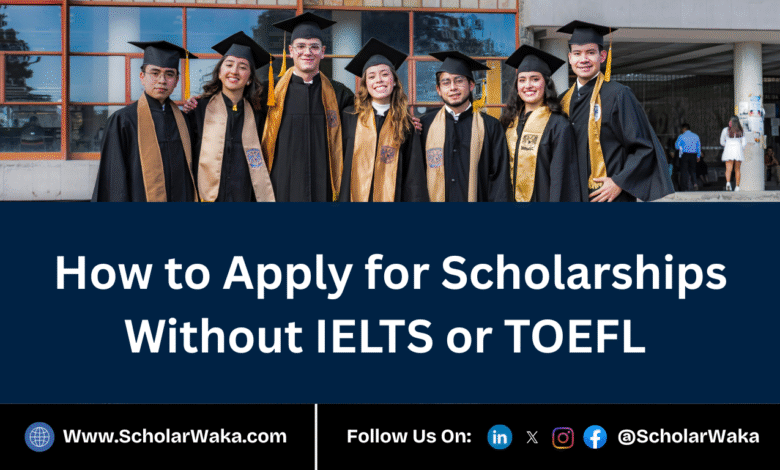
You don’t need IELTS or TOEFL to win a fully funded scholarship. Most guides either bury that fact or get it wrong entirely, treating “no IELTS required” as one simple category when it actually breaks down into distinct situations: scholarships that never ask for it, scholarships that drop their own requirement but leave the real bar with individual universities, and scholarships that accept a specific named alternative instead of a standardized test. If you’re figuring out how to apply for scholarships without IELTS or TOEFL, knowing which of these three situations applies to your target scholarship changes your entire preparation strategy — not just whether you need to study for a test, but which one, if any.
Must-Read: Top UK Scholarships for International Students
Why Some Scholarships Skip IELTS or TOEFL
Some scholarship bodies recognize that a standardized English test creates a genuine barrier, particularly where test centers are scarce, or costs are high relative to local income. Rather than requiring IELTS or TOEFL outright, several accept a document confirming your previous education was delivered entirely in English, or run their own internal English assessment instead. This isn’t universal, and the exceptions matter — some scholarships remove their own English requirement but still leave the actual language bar with the host university, which sets its own policy independently.
Don’t Miss: How to Write a Personal Statement for Scholarship | Tips and Free Template
The Real Alternatives to IELTS or TOEFL
1. A certificate confirming English-medium education: Often called a Medium of Instruction (MOI) letter, or an “English Proficiency Certificate” depending on the country. It’s an official document from your previous school or university confirming your courses were taught and examined entirely in English. This is explicitly recognized by China’s Chinese Government Scholarship system, where an applicant can request one directly from their former university’s registrar’s office as an alternative to IELTS or TOEFL for English-taught programmes.
2. Alternative standardized tests: DAAD’s own scholarship portal explicitly lists Cambridge English, TOEFL Essentials, TOEIC, PTE Academic, onSET English, and the Duolingo English Test as accepted alternatives to IELTS for English-taught programmes — this is confirmed directly on DAAD’s application system, not a third-party workaround.
3. Host-institution-set requirements, not a blanket scholarship rule: Stipendium Hungaricum’s own official Application Guide states that the minimum language proficiency level is “determined by the Host Institution,” not fixed centrally by the scholarship — meaning requirements genuinely vary by university and programme, and checking your specific target programme matters more than checking the scholarship’s general policy.
4. A language-immersion year in place of a test: Türkiye Scholarships provides every scholar, regardless of their programme’s language of instruction, a free one-year Turkish language course. Students choosing Turkish-taught programmes bypass the English test question entirely, confirmed directly on turkiyeburslari.gov.tr.
Also Read: Tips on How to Win a Scholarship

Six Fully Funded Scholarships and How Each One Actually Handles English Proficiency
1. Türkiye Scholarships (Türkiye Bursları): Türkiye’s own scholarship portal states that candidates applying to English-taught programmes must provide TOEFL or another internationally accepted certificate specifically where the university requires it — a rule set at the programme level, not uniformly across the scholarship. Students choosing Turkish-taught programmes sidestep the English question entirely: every scholar, regardless of track, receives a mandatory free year of Turkish language instruction at university-based centers before their degree begins.
2. Stipendium Hungaricum (Hungary): There’s no single scholarship-wide IELTS rule here, according to the programme’s own official Application Guide. The required minimum language proficiency level is set by each Host Institution individually, so the actual requirement depends entirely on which Hungarian university and programme you’re targeting — check the specific programme page directly rather than assuming a universal policy applies.
3. DAAD and German Public Universities: DAAD requires proof of language proficiency from every applicant except US and Canadian citizens, but its own portal accepts a genuinely broad list of certificates for English-taught programmes — Cambridge English, IELTS, TOEFL iBT, TOEFL Essentials, TOEIC, PTE Academic, onSET English, and the Duolingo English Test are all explicitly named as acceptable. German-taught programmes require German proficiency instead, not a lesser bar overall, just a different one. German public universities also charge no tuition fees regardless of nationality, which combined with a DAAD living stipend makes this one of the strongest value combinations on this list.
4. Chinese Government Scholarship (CSC): Chinese-taught programmes require an HSK Chinese proficiency certificate, with the specific level depending on your study level, from undergraduate through doctoral. For English-taught programmes, Chinese embassy application guides list a genuine alternative to a standardized test: an official English Proficiency Certificate from your previous university confirming your degree was taught in English — a real, officially recognized MOI-style option, not a third-party workaround.
5. MEXT Japan (Japanese Government Scholarship): This one needs a correction to a claim that circulates widely but doesn’t hold up. MEXT does typically require standard proof of language proficiency for graduate-level research student applicants — the University of Osaka’s own admissions page lists TOEFL or TOEIC scores among required documents, and Science Tokyo’s scholarship page requires either a CEFR B2+ English test score or JLPT N1/N2 as an alternative. The idea that Japanese embassies simply replace IELTS with their own written test isn’t backed by any official Japanese government or university page. Treat that claim with real skepticism if you encounter it elsewhere, and confirm directly through your country’s Japanese embassy or the specific university instead.
6. Chevening Scholarships (UK): Chevening removed its own standalone English language requirement from the scholarship application back in 2020, so you won’t submit an IELTS, TOEFL, or PTE score as part of the Chevening application itself — this is stated plainly by both gov.uk and the British Council. But Chevening requires an unconditional offer from a UK university as part of the process, and that university sets its own English requirement independently. Most UK universities still require a test score for admission unless you qualify for a specific waiver, commonly based on a previous degree taught entirely in English. Language never blocks your Chevening application directly, but it can absolutely block the university offer your funding depends on.
How to Build a Strong Application Without a Test Score
- Request your English-medium certificate early, whatever your target scholarship calls it — MOI letter, English Proficiency Certificate, or similar. Most universities issue it from the same office that handles transcripts, and having it ready before you need it saves real time during a tight window.
- Make sure your transcripts show your courses were taught in English — course titles, grading notes, and any accompanying documentation in English strengthen your case before a reviewer even opens your certificate.
- Use your personal statement to demonstrate fluency directly, through references to English-language coursework, research, or projects, rather than treating the essay as separate from the language question.
- Ask your recommenders to comment specifically on your English communication ability where relevant. A professor confirming you actively participated and communicated in English carries real weight as a substitute for a test score.
- Prepare seriously for any internal interview or assessment. Where a university replaces a standardized test with its own process, that replacement is not an easier default — treat your preparation for it exactly as you would for a standardized exam.
- When you’re unsure, contact the admissions or scholarship office directly, and confirm against the institution’s own page rather than a third-party scholarship blog — as this guide’s own research showed, claims about language policy circulate and repeat across aggregator sites long after they’ve become outdated or were never accurate to begin with.
Frequently Asked Questions
Does not needing IELTS mean I don’t need to prove my English ability at all?
No. In almost every case, “no IELTS required” means an alternative proof is accepted instead — a certificate confirming English-medium education, an internal test, or a different standardized exam — not that proficiency goes unchecked.
If a scholarship doesn’t require IELTS, does that guarantee my university won’t either?
No, and this is the most common misunderstanding on this topic. Chevening is the clearest example: the scholarship itself dropped its English requirement, but your chosen UK university still sets its own admission requirement independently.
Does the Chinese Government Scholarship really accept a letter instead of IELTS?
Yes, confirmed across multiple official Chinese embassy application guides. For English-taught programmes, applicants can submit an official certificate from their previous university confirming their degree was taught in English, as an alternative to an IELTS or TOEFL score.
Does MEXT really replace IELTS with its own English test?
This is commonly claimed online but doesn’t hold up against Japan’s own university and government sources. Official pages from the University of Osaka and Science Tokyo confirm that standard TOEFL, TOEIC, or CEFR-level test scores are typically required for graduate applicants, with JLPT as an alternative for Japanese-taught tracks specifically.
Is Duolingo accepted as an alternative to IELTS by any major scholarship?
Yes. DAAD’s own scholarship portal explicitly lists the Duolingo English Test as an accepted certificate for English-taught programmes in Germany, alongside Cambridge English, TOEFL, TOEIC, and PTE Academic.
Disclaimer: English-language policies for the scholarships mentioned in this post were verified directly against official sources — including gov.uk, daad.de, turkiyeburslari.gov.tr, stipendiumhungaricum.hu, Chinese embassy application guides, and official Japanese university admissions pages — as of July 2026. Requirements change by institution and by academic cycle, so always confirm current policy directly with your target scholarship or university before applying.
Join ScholarWaka Community
Get the latest scholarship updates and study abroad opportunities before anyone else.