Ayodele Oyesanya’s Commonwealth Scholarship Story – 4 Attempts, 1 Win

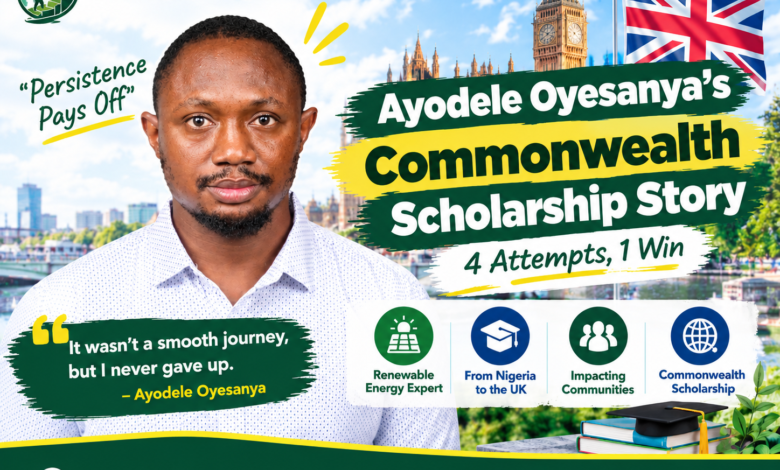
Most scholarship success stories get told after one clean application and one happy outcome. Ayodele Oyesanya’s scholarship story isn’t that – it’s four application attempts until he finally landed a place at a UK university through the Commonwealth Shared Scholarship. He shared what actually changed between his failed attempts and his winning one, how his day job shaped his essays more than any writing guide could, and what he’d tell anyone preparing to apply next.
From Federal University of Technology, Minna – Nigeria, to the Renewable Energy Sector
Ayodele graduated from the Federal University of Technology, Minna, around 2016, and moved into Nigeria’s renewable energy sector after identifying a problem he wanted to solve. He joined First Electric in Lagos, Nigeria, where he built hands-on skills in designing, optimising, installing, and commissioning solar systems, technical grounding that later shaped both his career direction and, eventually, his scholarship essays.
The specific problem that’s driven his work since: solar adoption among small and medium-scale businesses. “We look at SMEs failing, and that’s affected businesses economically,” he explains. Nigeria’s grid instability is pushing many of these businesses toward generators, expensive and a real contributor to carbon emissions. Ayodele saw an opportunity to close that gap directly.
That mission led him to his current role as a Technical Sales Officer at Uwana Energy Company, where he’s now in his second year. The company runs a pay-as-you-go leasing model, letting customers pay for solar systems in small instalments rather than one large upfront cost. It’s this role, sitting at the intersection of his technical background and a genuinely commercial, customer-facing function, that he credits directly with sharpening his scholarship application. “I have a blend of the technical as well as the business side,” he says. “Those two blends helped me in the application process.”
Three Nominations, Three Rejections
Ayodele’s route to the Commonwealth Shared Scholarship ran through the WAAW Foundation, where he began volunteering in 2024, mentoring undergraduate scholars including one who went on to win the Foundation’s own undergraduate scholarship. He was drawn to the Foundation specifically because it gave volunteers a genuine path to advance their own skills, not just contribute to others’.
His first Commonwealth nomination through WAAW Foundation didn’t result in selection. Neither did his second. On his third attempt, in 2025, he made it onto the reserve list – close, but ultimately not selected. “I was on the reserve list, and I couldn’t go through at the end of the day,” he says. “I put in again last year. Let me not give up.”

What Changed on Attempt Four
The turning point came through linking with a fellow scholar who had previously won multiple scholarships and had genuine experience reviewing applications like his. Ayodele sent his essays over, received detailed corrections, revised accordingly, and submitted. On his fourth nomination, he was selected. The lesson here is – you should consider a second look on your application so that you can get feedbacks and corrections.
He’s candid that the essays themselves only became genuinely strong once his day-to-day work gave him something real to write about. “If I don’t have the opportunity to work where I’m working right now, I don’t think I’ll be able to write a convincing essay that will impress the selecting team in the UK,” he says. Every claim in his application, from Essay 1 through Essay 11, was a direct reflection of work he was actually doing – not a projection of what he hoped to eventually do.
Where He’s Headed, and the Plan Waiting on the Other Side
Ayodele was provisionally placed at the University of St Andrews, his first choice, with the University of Aberdeen as his second and the University of Dundee his third. Shortly before this interview, his nominating body shifted his placement from St Andrews to Aberdeen after an English language requirement issue. He is currently studying an MSc Energy Economics & Finance at the University of Aberdeen.
His chosen theme is Access and Inclusion – directly reflecting the communities he’s focused on back home. “There are communities in Lagos State, even now, that don’t have access to the grid at all,” he says, naming Ababu in Ondo State specifically as one area he intends to work in directly. His plan after completing his studies: return to One Energy for two years, using the networks and technical knowledge gained in the UK to bring in investors willing to offer low-interest, concessional financing, capital that’s currently scarce in Nigeria’s renewable energy sector and a major constraint on adoption rates. After that, he plans to start an NGO specifically designed to subsidise solar systems directly, cutting the upfront cost a typical 5-kilowatt system carries (around ₦4 to 4.5 million) down to something genuinely affordable for households and small businesses currently priced out entirely.
Also See: Commonwealth Master’s Scholarship
What He Believes Made His Application Work
Ayodele is honest that no successful applicant can really know for certain. “You will not be able to tell anybody this is what made you to be selected – it’s not possible,” he says. What he can point to is a genuinely holistic application: his employment history directly aligned with the problem he said he wanted to solve; a handful of publications added competitive weight; a CGPA of 4.21 out of 5.0, solid though not first class; a prior scholarship (the Agbami scholarship) included as evidence of track record; and documented leadership and volunteering experience woven directly into his essays.
His core advice on this point: don’t assume any piece of your profile is irrelevant. “Whatever will help you stand out, put it in,” he says. “You don’t know what they will use to assess your application.”
His Advice for Future Applicants
- Prepare properly, and start early. Treat the essay questions seriously and answer exactly what’s being asked, rather than writing around the question.
- Include everything that strengthens your case. Awards, publications, volunteering – don’t assume something is too minor to mention.
- Use the STAR method for your volunteering and leadership essay specifically – walk through the Situation, Task, Action, and Result clearly and concretely.
- Get your essays reviewed by someone else before submitting. Even a strong draft benefits from outside eyes.
- Stay extremely consistent across all eleven essays. This is the piece of advice he returns to most emphatically. If your Impact Essay 1 establishes what skills you’re gaining and how you’ll use them at home, your Impact Essays 2 through 4 need to build on that same thread without drifting into a different narrative. “They are experts when they’re looking at these essays,” he says. “They know when you are consistent and when you drift.” Reviewers often ask similar-sounding questions from different angles specifically to test whether your story holds together – treat every essay as part of one continuous argument, not eleven separate answers.
Read About: Commonwealth PhD Scholarship
Key Takeaways
- Rejection isn’t necessarily a sign to change your underlying story – it can simply mean persistence, revision, and the right feedback at the right time.
- Real, current professional experience tied directly to your stated problem produces far more convincing essays than hypothetical future plans.
- A nominating organisation’s internal network and mentorship can matter as much as the essays themselves – Ayodele’s breakthrough came through a direct connection made within his own foundation, not from writing alone.
- Consistency across every essay, especially the impact-focused ones, is something selection panels actively test for and notice.
Frequently Asked Questions
Does every Commonwealth Scholarship applicant need a nominating organisation?
This varies by scheme and country. Some Commonwealth Scholarship routes require nomination through an approved national nominating agency or partner organisation, as in Ayodele’s case through WAAW Foundation; others, including some Commonwealth Shared Scholarship applications, run through direct university application instead. Check the specific scheme and your country’s process directly with the Commonwealth Scholarship Commission. Read more about the Commonwealth Nomination process here
Is it common to be nominated more than once before being selected?
Based on accounts like this one, yes – multiple nominations before success aren’t unusual, particularly for highly competitive schemes. Being placed on a reserve list, as Ayodele was on his third attempt, means you were a strong candidate who simply wasn’t selected ahead of others that cycle, not that your application was fundamentally weak.
How important is work experience relative to academic grades in a Commonwealth Scholarship application?
Based on this account, genuine, relevant work experience tied directly to your stated development problem can meaningfully strengthen an application alongside, not instead of solid academic performance. A CGPA that isn’t first class clearly didn’t prevent success here, when paired with a strong, consistent, evidence-backed narrative.
What’s the single piece of advice repeated most strongly in this interview?
Consistency across every essay in the application, particularly the impact-focused questions — not introducing a different thread or direction partway through, since selection panels specifically test for this.
Disclaimer: This article is based on a personal interview and reflects one individual’s own experience and opinions about the Commonwealth Scholarship application process. It does not represent official guidance from the Commonwealth Scholarship Commission or any universities named. University placements and nomination routes referenced reflect the interviewee’s status at the time of the interview and may have changed since. Always confirm current application processes directly with the Commonwealth Scholarship Commission and your relevant nominating organisation.
Join ScholarWaka Community
Get the latest scholarship updates and study abroad opportunities before anyone else.