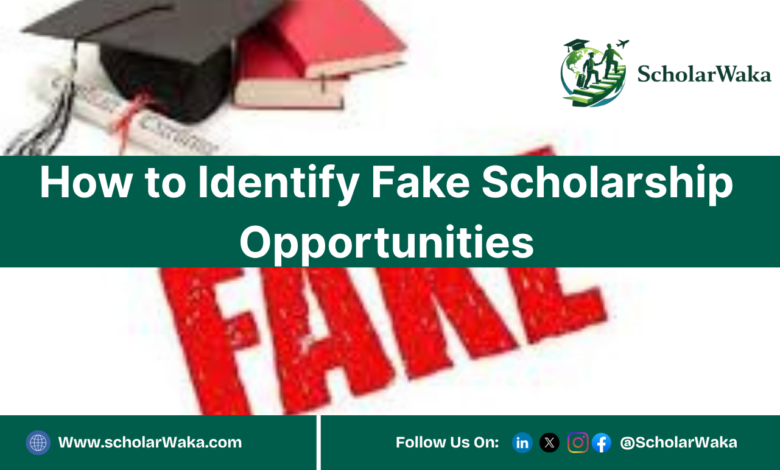
How to identify fake scholarship opportunities is essential knowledge for any student actively searching for funding, since that same eagerness makes genuine applicants easy targets. Fake scholarship offers can cost real money, expose personal information to theft, and waste time that could go toward genuine applications. Some scams are convincing enough that telling them apart from a real opportunity isn’t obvious at first glance. Understanding the actual warning signs — and knowing how to verify a scholarship’s source directly — is what protects you.
Must-Read: Step-by-Step Guide to Securing Scholarships Abroad for Beginners
What Fake Scholarship Opportunities Actually Look Like
Fake scholarships are false offers built specifically to deceive students, and they typically show up as:
- Emails offering a scholarship you never applied for
- Websites claiming to guarantee funding
- Messages requesting payment to “secure” an award
A common example: an email arrives saying “You have been selected for a fully funded scholarship,” even though the recipient never submitted an application anywhere. The message then asks for a payment to “process” the award. That sequence — unsolicited offer, followed by a payment request — is one of the clearest scam patterns in circulation.
Also Read: Tips on How to Win a Scholarship
Payment Requests Are the Clearest Red Flag
Legitimate scholarships never require payment to receive funding. If a message asks for a “processing fee,” “acceptance fee,” or any similar charge, treat it as a serious warning sign, not a normal administrative step. Some scammers claim the fee is refundable — in practice, this is rarely true, and the money is gone the moment it’s sent. Never transfer money without independently verifying the opportunity first, through the institution’s own official channels, not the link or contact details provided in the suspicious message itself.

Offers That Arrive Without an Application
Every legitimate scholarship requires an application process — forms, documents, essays, some form of evaluation. If you receive a message announcing you’ve been awarded a scholarship you never applied for, that alone is close to disqualifying on its own. Real scholarships don’t randomly select applicants without any evaluation process behind it.
Unrealistic Promises and Guaranteed Offers
Be skeptical of language promising:
- Guaranteed selection
- No requirements
- Instant approval
A message claiming you’re “guaranteed a fully funded scholarship with no documents required” doesn’t describe how any genuine scholarship operates. Real opportunities always carry clear, specific requirements — if something sounds too easy, that ease is itself the warning sign.
Verify the Source Directly
Legitimate scholarships come from universities, governments, or genuinely recognized organizations. If a scholarship claims university funding, go to that university’s own official website and search for it directly. If you can’t find any trace of it there, treat that absence as meaningful, not as a gap in the university’s website. Avoid relying on a random third-party website or a social media post as your only source of confirmation.
Check Website and Email Authenticity Carefully
Scammers frequently build websites and email addresses designed to look nearly identical to official ones, often with a small, easy-to-miss difference — a slightly altered spelling of a university’s name, for instance. Legitimate institutional emails come from that institution’s own domain, not a free email service. When in doubt, don’t reply to the suspicious email at all — contact the institution directly through its official website instead.
Be Cautious of Unverified Agents and Middlemen
You don’t need an agent to apply for most scholarships. Some scammers present themselves as agents who can “guarantee” a scholarship in exchange for a fee or personal documents. If someone tells you “pay this fee and we’ll guarantee you a scholarship,” that’s a well-documented scam pattern, not a legitimate service. If you do choose to work with an agent for any reason, verify their credibility independently first — in most cases, applying directly through a scholarship’s official platform is simply safer.
Real Scholarships Have Clear, Detailed Requirements
Genuine scholarships specify exactly what’s needed: academic qualifications, personal statements, recommendation letters, and a real application deadline. A legitimate scholarship explains clearly who can apply and how. If the requirements are vague, minimal, or simply missing, treat that absence as a warning sign, and compare whatever you’ve been told against the scholarship’s official source directly.
Look for Reviews and Independent Feedback
Before trusting any scholarship opportunity, check whether other students have shared genuine experiences with it. If multiple people report a scholarship as fake, that’s a clear signal to walk away. Trusted student communities and forums can also surface warnings that a single Google search might miss.
Don’t Let Urgency Rush Your Verification
Scammers deliberately create time pressure — “apply now or lose the opportunity,” “limited slots available” — specifically to stop you from thinking it through carefully. Legitimate scholarships have real, stated deadlines and don’t need manufactured urgency to get you to act. If a message is pushing you to skip verification because time is supposedly running out, that pressure itself is a signal, not a reason to move faster.
Rely on Trusted Sources, Not Random Links
Use official university websites, government scholarship portals, and recognized education platforms as your starting point, rather than a link that arrived unsolicited. Going directly to a university or government’s own official page, instead of clicking through a forwarded link or a random search result, meaningfully reduces your exposure to a fake opportunity.
Frequently Asked Questions
Do legitimate scholarships ever ask for a processing fee?
No. Legitimate scholarships do not require any payment to receive funding, whether it’s called a processing fee, an acceptance fee, or anything else. Any payment request is a serious warning sign.
If I receive a scholarship offer I never applied for, is it definitely fake?
It’s very likely fake. Every legitimate scholarship requires an application process — you can’t be genuinely selected for something you never applied to.
How can I confirm a scholarship is really offered by the university it claims to be from?
Go directly to that university’s own official website and search for the scholarship there. If you can’t find any trace of it on the university’s own site, treat that as a strong warning sign rather than assuming it’s simply missing from the page.
Do I need an agent to apply for scholarships?
No. Most legitimate scholarships can be applied for directly through the provider’s own official platform. Be especially cautious of anyone who guarantees a scholarship outcome in exchange for payment.
Why do scam scholarships often create urgency?
Urgency is a deliberate tactic to stop you from verifying the offer carefully. Legitimate scholarships have clear, stated deadlines and don’t rely on manufactured pressure to get you to act quickly.
Join ScholarWaka Community
Get the latest scholarship updates and study abroad opportunities before anyone else.