UK Government Chevening Scholarship 2027/2028 | Fully Funded

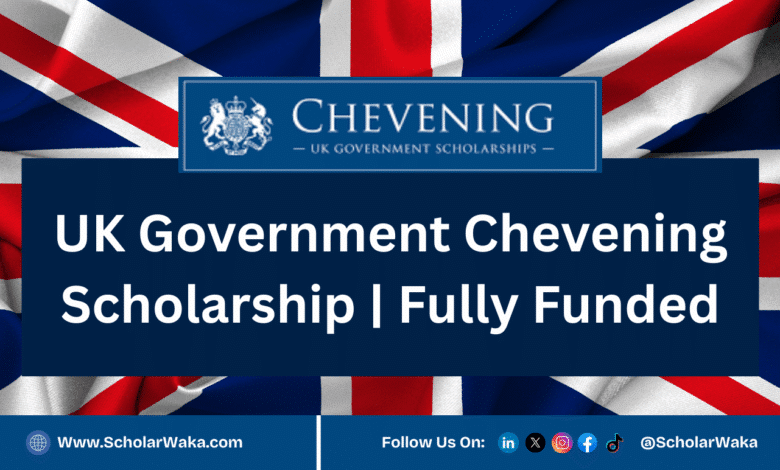
UK Government Chevening Scholarship applications open on 4 August 2026, just a few weeks away, and close on 6 October 2026. If Chevening has been on your radar, this is genuinely the moment to start preparing rather than something to think about later.
The UK Government Chevening Scholarship remains one of the UK government’s flagship awards — a fully funded one-year Master’s at essentially any UK university, built specifically around leadership potential rather than academic achievement alone. This guide covers exactly what makes a UK Government Chevening Scholarship application competitive, the full benefits package, required documents, and the precise application steps. For a deeper look at eligibility traps, the work experience calculation, and course selection specifically, see our companion guide on how to prepare for the Chevening Scholarship. And once you’re ready to write, our guide on how to write your Chevening essays and prepare for interview covers exactly how to make your four essays work as one coherent story.
About the UK Government Chevening Scholarship
Funded by the UK’s Foreign, Commonwealth and Development Office alongside UK partner organisations, the Chevening Scholarship exists to identify future global leaders early in their careers and give them a year in the UK to build the skills, networks, and perspective to drive positive change back home.
Unlike scholarships tied to one university or one narrow field, Chevening Scholars can choose from three Master’s programmes at Chevening’s partner universities, and also select three different course options within their application (confirmed via Chevening’s own guidance on choosing a UK course). Selection weighs three things together: leadership potential, academic excellence, and a genuinely strong, specific plan for what you’ll do with the degree once you return home.
Also read : About UK Government Commonwealth scholarships
UK Government Chevening Scholarship Summary
| Scholarship Name ⇒ | UK Government Chevening Scholarship |
| Host Country ⇒ | United Kingdom |
| Study Level ⇒ | Master’s |
| Benefits ⇒ | Full tuition, monthly stipend, travel costs, arrival allowance, visa fees |
| Funded by ⇒ | UK Foreign, Commonwealth and Development Office (FCDO), with UK partner organisations |
| Eligible Countries ⇒ | Citizens of Chevening-eligible countries, with 2+ years of work experience |
| Application Deadline ⇒ | Opens 4 August 2026, 12:00 UTC. Closes 6 October 2026, 12:00 UTC |
How to Choose Your Three UK Master’s Courses
This is a step worth taking seriously in its own right, since your three course choices aren’t just a formality on the application form — they’re where a genuinely strong case for your career plan actually gets made. You’re free to apply for admission before or after submitting your UK Government Chevening Scholarship application, whichever suits your timeline, but the one thing you can’t do is let a university’s own deadline slip past you while you’re focused on the Chevening form itself. Both processes run in parallel, and you’re responsible for tracking both.
Start with Chevening’s own course finder to confirm each option genuinely qualifies — not every UK Master’s programme is eligible, so this is the first filter, not an optional check. From there, individual university websites are worth exploring in depth for entry requirements, course content, and each institution’s specific deadlines, since these vary considerably and aren’t set by Chevening itself. Our guide on how to prepare for the Chevening Scholarship covers the specific rules around MBA fee caps, London-campus restrictions, and duplicate-course disqualifications in more depth.
Your courses must be: full-time, starting in the autumn term (usually September or October), taught Master’s programmes specifically (not research-focused MRes routes), leading to a recognised Master’s degree, and based in the UK.
Your courses cannot be: part-time or delivered through distance learning, shorter than nine months or longer than twelve, a PhD or DPhil, or structured with more than one month of study taking place outside the UK. A Master’s with a strong international placement component built into a later term, for instance, could fall foul of this rule if time abroad exceeds a month — check the exact structure of any course with an overseas element before locking it in as one of your three.
What Makes You Eligible for the UK Government Chevening Scholarship
Based on Chevening’s own eligibility guidance:
- Citizenship of a Chevening-eligible country or territory — if you’re applying for an award tied to an ODA-eligible country, you need to be resident there too, though not necessarily a citizen of that same country
- A commitment to returning to your country of award for at least two years after your scholarship concludes
- At least two years of work experience gained after completing your undergraduate degree, equivalent to 2,800 hours
- Concrete, demonstrable examples of leadership and influencing skills — not just job titles, but genuine instances where you’ve led or influenced outcomes
- An undergraduate degree qualifying you for UK Master’s study, completed at least two years before the application deadline
- Willingness to apply to three different eligible UK Master’s courses, and secure at least one unconditional offer if selected
- No prior study in the UK on UK government funding
Also Apply : For the Commonwealth Master’s Fully Funded Scholarships

Who’s Explicitly Excluded
- British or dual British citizens, unless you’re a citizen of a British Overseas Territory, or hold BN(O) status and are applying from Hong Kong
- Refugees in a country that isn’t itself Chevening-eligible — though if you’re a citizen of an eligible country and hold refugee status in a different eligible country, you remain eligible
- Anyone currently resident in the UK at the time of application, excluding British Overseas Territories
- Current or recent (within the last two years) employees, or immediate relatives of employees, of a government department, the British Council, a partner UK university, or their subsidiaries
- Anyone who’s previously studied in the UK on a UK government-funded scholarship — though former Chevening Fellows specifically become eligible again five years after completing their fellowship
Already holding a Master’s degree doesn’t disqualify you from applying for a second one, provided you can clearly explain how the new degree fits your career plan and impact goals back home.
What the UK Government Chevening Scholarship Covers
Unlike partial grants, the Chevening Scholarship delivers a fully funded package intended to cover your study, travel, and day-to-day living expenses throughout your one-year Master’s degree:
- 100% Tuition Fee Coverage — full coverage of tuition fees for your chosen taught Master’s programme, with a fee cap applying to executive/MBA programmes specifically. See our companion guide for the exact cap figure and how it works.
- Monthly Personal Living Stipend — a tax-free monthly allowance covering accommodation, food, local transport, and general living costs, set at a higher tier for scholars based in London
- International Travel and Flight Allowance — economy-class flights to the UK at the start of your award, and your return flight home on completion
- Arrival and Relocation Allowance — a one-off payment on landing to help cover initial setup costs
- Full Visa Application Reimbursement — direct coverage of your UK Student Visa fees, plus tuberculosis testing allowances where applicable
- Exclusive Professional and Cultural Access — Chevening-sponsored leadership workshops, cultural trips, policy seminars, and networking with the FCDO and global alumni networks
What Documents You Need to Prepare
Preparing a UK Government Chevening Scholarship application means managing documents across two distinct phases: initial submission, and the shortlisting/interview phase.
1. Identification — a valid international passport or national identity card, confirming citizenship in an eligible Chevening country or territory. Ensure your passport doesn’t expire before or during your intended stay in the UK.
2. Academic qualification documents — your official undergraduate degree certificate and complete academic transcripts, proving you meet the entry standard for UK postgraduate study.
3. Formal scholarship essays — four mandatory short essays, 300 words each, completed directly within the application webform, covering leadership and influence, relationship building and networking, why you chose your three UK courses, and your career plan. Our guide on how to write your Chevening essays and prepare for interview covers exactly how to make these four essays work together as one coherent story rather than four disconnected answers.
4. University offer letters — you don’t need an offer letter at the point of initial application. You apply to your three chosen UK universities independently, and upload at least one unconditional offer to the Chevening portal later in the selection timeline.
5. Two professional or academic references — at the initial stage, you only provide names, designations, and contact details. Full signed reference letters are only required if you’re shortlisted for interview. Per Chevening’s own references guidance, letters must be written in English, and a letter in another language needs a notarised English translation combined into a single file.
Also see : Selected top scholarships in the UK
How to Apply For UK Government Chevening Scholarship
- Confirm you meet every eligibility criterion before starting — ineligible applications are rejected outright
- Check the eligible partner universities for your countries, and find an eligible master’s course.
- Choose three different, eligible UK Master’s programmes — you apply to these universities separately, after submitting your Chevening application
- List two referees within your online application, and submit required academic document (degree certificate and transcript)
- Register and pass Chevening’s own online eligibility checker
- Complete every section of the application form: personal and academic information, work experience, your three chosen UK courses, your two referees, and four 300-word essays
- Review your complete application carefully, then submit
- If shortlisted, attend an interview at your local British embassy or high commission, prepared with all supporting documents
- Secure and submit at least one unconditional UK university offer by the final deadline to be formally awarded the scholarship
Our guide on how to prepare for the Chevening Scholarship covers exactly how Chevening calculates your 2,800 work experience hours, the six most common application errors to avoid, and the specific course-selection rules that catch strong applicants off guard.
Application Timeline
- Applications open: 4 August 2026, 12:00 UTC
- Applications close: 6 October 2026, 12:00 UTC
- Interview invitations: February 2027
- Interviews: March through April 2027
- Final university offer deadline: confirm the exact date and time directly on Chevening’s own application timeline page once published for this cycle, as the exact date has varied slightly between sources
- Courses begin in the UK: September or October 2027
What to Do Before Applications Open
- Start drafting your four 300-word essays now, well ahead of the August opening — strong Chevening essays typically go through multiple rounds of genuine revision
- Research UK Master’s programmes and identify your three genuine course choices early
- Approach your two referees now, giving them real time to prepare
- Gather your undergraduate degree certificate and confirm you meet the two-year post-graduation timing requirement
- Build a clear, concrete account of your leadership experience with specific examples and outcomes
Frequently Asked Questions
When does the UK Government Chevening Scholarship 2027/2028 application open?
4 August 2026, at 12:00 UTC, closing 6 October 2026 at 12:00 UTC.
What is the word limit for Chevening’s application essays?
300 words per essay, across all four required questions.
Do I need to already have a UK university offer to apply?
No. You apply to Chevening first, listing three course choices, and only need to secure at least one unconditional offer later in the selection timeline if you’re selected.
Can I apply if I already hold a Master’s degree?
Yes, provided you can clearly explain how a second Master’s fits your career plan and intended impact in your home country.
Can I use ChatGPT or similar AI tools to help write my essays?
No. Per Chevening’s own FAQs, using AI to generate answers to Chevening’s essay questions is strictly prohibited, and every response must be your own original work. Presenting AI-generated content as your own is treated as a breach of Chevening’s plagiarism and fraud guidelines, with real consequences if discovered.
Disclaimer: All scholarship details and figures in this post are verified from official Chevening sources as of July 2026. Information is subject to change without notice. Always confirm the latest details directly on chevening.org. ScholarWaka is not affiliated with the UK Foreign, Commonwealth and Development Office.
Official Application Portal
Join ScholarWaka Community
Get the latest scholarship updates and study abroad opportunities before anyone else.