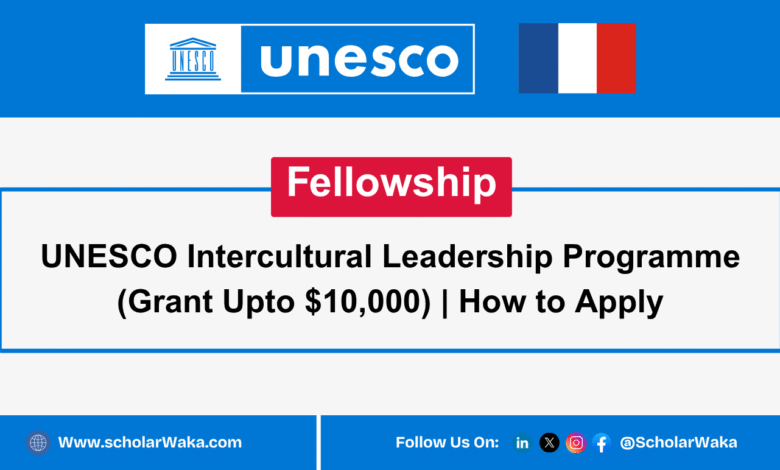
The Youth for Peace: UNESCO Intercultural Leadership Programme sits inside UNESCO’s broader “Road to Peace: Dialogue and Action for Tolerance and Intercultural Understanding” initiative, and its second edition centers on a genuinely current theme: “Human Connection and Dialogue in the Age of Artificial Intelligence.
Don’t Miss: Top Fully Funded Scholarships for International Students
The programme is built on a specific conviction — that intercultural dialogue isn’t just a communication tool, but a genuine, transformative form of leadership capable of building trust across differences and developing shared solutions to common challenges. If you’re checking this now, applications closed 26 July 2026, following a one-week extension from the original 19 July deadline. This post covers exactly how the programme works, and the final cohort of 50 Young Leaders will be notified by mid-October 2026.
Also, Check Out: Top Fully Funded Master’s Scholarships in Europe
About the Programme
Supported by the Kingold Group, the Youth for Peace programme runs across three interconnected phases combining leadership development, practical action, and global engagement, rather than a single training block. Participants first go through an immersive learning journey building their capacity to lead across differences and use dialogue as a genuine catalyst for change; they then design and implement their own intercultural dialogue initiative, aligned specifically with the 2026 AI-and-dialogue theme; and once their action plan is approved, they receive seed funding to actually carry it out.
Also Read: How to Write a Personal Statement for Scholarship | Tips and Free Template
This structure means the $10,000 isn’t a general grant handed over upfront — it’s released specifically to fund an approved project plan you develop during the programme itself, tying the money directly to a concrete deliverable rather than open-ended support.
UNESCO Intercultural Leadership Programme Summary
| Scholarship Name ⇒ | UNESCO Intercultural Leadership Programme |
| Host Country ⇒ | Paris |
| Study Level ⇒ | Fellowships |
| Benefits ⇒ | $10,000 in seed funding, leadership training, mentorship, global alumni network |
| Funded by ⇒ | UNESCO, Paris, with hybrid in-person and virtual components |
| Eligible Countries ⇒ | All Countries |
| Application Deadline ⇒ | Closed 26 July 2026, 23:59 CEST (Paris time), following an extension from the original 19 July deadline. Selected Young Leaders notified by mid-October 2026. |
What Selected Leaders Actually Receive
- Up to $10,000 in seed funding, released to fund your specific intercultural dialogue project once your action plan is approved — not a blanket grant handed over upon selection
- High-impact leadership development training, delivered across the programme’s structured phases
- Professional mentorship, connecting participants with experienced practitioners in dialogue, peacebuilding, and social cohesion
- Access to UNESCO’s own tools and methodologies, including the opportunity to contribute insights directly to the UNESCO Global Intercultural Action Observatory, feeding into future policy and advocacy work
- A platform to present project outcomes and lessons learned, exchange ideas with global leaders, and engage directly with policymakers and institutional stakeholders
- Membership in the Youth for Peace Global Alumni Network, extending collaboration and advocacy opportunities well beyond the programme itself
- Visibility and recognition through UNESCO’s own communication channels
Eligibility Requirements
To be eligible for selection in the Youth for Peace: UNESCO Intercultural Leadership Programme cohort, applicants must satisfy every item on the following list:
1. Age Standard (25–45 Years Old):
You must be between the ages of 25 and 45 as of 22 October 2026. Candidates who fall outside this specific age window—either younger than 25 or older than 45 on the benchmark date—are ineligible.
2. Proven Track Record of Professional Leadership:
You must demonstrate verifiable evidence of personal leadership within your field. This includes documented achievements across sectors such as civil society, community organizing, public policy, academia, media, business, or the creative arts.
3. Demonstrated Commitment to Intercultural Dialogue and Social Impact:
You must show a clear history of using intercultural dialogue to address division, build trust across differences, and drive measurable social cohesion or peacebuilding outcomes.
4. Mindset for Self-Reflection and Collaborative Learning:
Candidates must show genuine openness to self-criticism, feedback, cross-cultural exchange, and joint problem-solving within a highly diverse global cohort.
5. Capacity for Community Action:
You must demonstrate the practical potential and vision to design, implement, and scale positive social change within your local or national community.
6. Mandatory Full Availability Across All Phases:
You must commit to participating fully across all three stages of the programme:
- Phase 1: Interactive online workshops focused on leadership practice, conflict transformation, and dialogue methodologies.
- Phase 2: A 6-month, field-based community action initiative supported by a $10,000 USD seed grant.
- Phase 3: Global convening events, policy dialogue sessions, and alumni network engagements.
Note: Inability to attend or engage fully in any phase will result in automatic non-selection or forfeiture of fellowship status.
7. English Proficiency Standard:
You must demonstrate strong written and spoken fluency in English. Because English serves as the sole official working language of the programme, all written application responses, project proposals, and workshop communications must be submitted exclusively in English.
8. 2026 Thematic Alignment:
Your proposed community action project must directly address the official annual theme: “Human Connection and Dialogue in the Age of Artificial Intelligence”. Specifically, your initiative must explore how intercultural dialogue can be used to resolve AI-related social risks—such as algorithmic bias, digital discrimination, online polarization, disinformation, unequal access to digital infrastructure, or the misrepresentation of diverse cultural identities in technological models.

Required Documents
- A completed online application form, with accurate personal and contact details
- A CV, highlighting your educational background, leadership experience, and relevant achievements, capped at two pages
- A motivation letter, explaining why you’re applying, your commitment to intercultural dialogue, and how the programme aligns with your goals, capped at 300 words
- A community project proposal, aligned specifically with the 2026 theme
- Any supporting documents demonstrating your leadership, advocacy, or community work — certificates, publications, or similar evidence
How the Selection Process Works
- Complete the online application form with all required documentation before the deadline.
- Applications undergo an initial eligibility screening.
- Eligible applications are then evaluated by an international jury against the programme’s specific assessment criteria.
- The final cohort of 50 Young Leaders is selected and notified — for this cycle, by mid-October 2026.
- Selected leaders proceed through the programme’s three phases: leadership development, project design and implementation, and global engagement, with seed funding released once their specific action plan is approved.
How to Prepare for the Next Edition
With this cycle’s applications closed and notification expected in October, the coming months are for building genuine readiness ahead of a likely third edition:
- Start developing a concrete intercultural dialogue project concept now, ideally connected to a theme UNESCO is likely to keep prioritising — dialogue, social cohesion, and technology’s role in human connection have anchored recent editions.
- Draft your 300-word motivation letter with real specificity, given how tight that word limit is — this isn’t a document to write quickly close to a future deadline.
- Document your leadership record clearly and concretely now, since a demonstrated track record is explicitly assessed, not simply claimed.
- Watch UNESCO’s official Call for Applications page directly (unesco.org/en/call-applications), since this is where the programme’s next edition will be announced first, ahead of secondary opportunity-listing sites.
- Confirm your age eligibility against whatever reference date the next edition sets, since this shifts each cycle (22 October 2026 for this edition).
Deadline
Applications for the second edition closed 26 July 2026, 23:59 CEST (Paris time), following a one-week extension from the original 19 July deadline. The final cohort of 50 Young Leaders will be notified by mid-October 2026.
Frequently Asked Questions
Can I still apply for this edition?
No. Applications closed 26 July 2026. Watch UNESCO’s official page for a future edition’s announcement.
Is the $10,000 given upfront upon selection?
No. It’s released as seed funding specifically to implement your intercultural dialogue project once your action plan is approved during the programme — it’s tied to a concrete deliverable, not a general grant.
What’s this year’s specific theme?
“Human Connection and Dialogue in the Age of Artificial Intelligence” — your project proposal needs to align with this theme specifically.
Can Nigerian applicants apply?
Yes. The programme is open globally, so Nigerian applicants are eligible provided they meet the age, leadership, and English proficiency requirements.
When will I know if I’ve been selected?
Selected Young Leaders will be notified by mid-October 2026.
Disclaimer: All programme details, deadlines, and figures in this post were verified from official UNESCO sources as of August 2026. Information is subject to change without notice. Always confirm the latest details directly on the official UNESCO Call for Applications page before applying. ScholarWaka is not affiliated with UNESCO.
Official Application Portal
Join ScholarWaka Community
Get the latest scholarship updates and study abroad opportunities before anyone else.