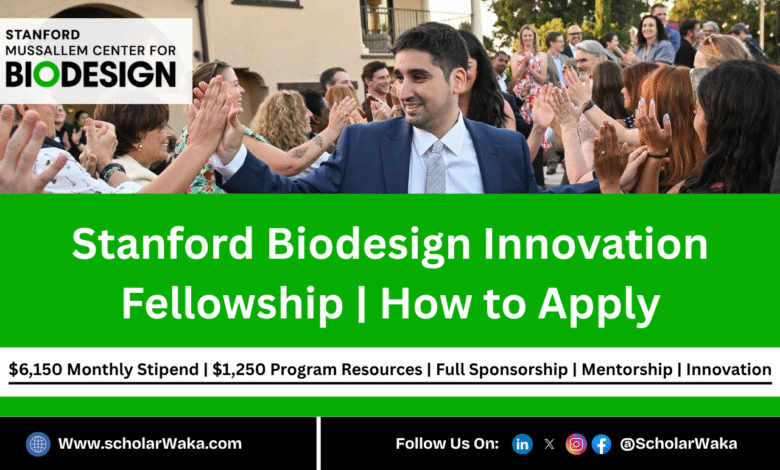
Applications for the Stanford Biodesign Innovation Fellowship 2027-28 opened on June 8, 2026, and the portal closes on August 27, 2026 at 11:59 PM PT — giving you a narrow window to submit everything, including all three recommendations, before that hard cutoff.
Funded and delivered by Stanford Biodesign at Stanford University, this 10-month fellowship selects just 12 people globally per cycle, split into three teams of four, and compensates each fellow with a minimum of $6,150 per month plus a one-time $1,400 programme supplement, with Stanford-funded health insurance covering medical, dental, and vision for the fellow.
Where most fellowships evaluate your academic record and research publications, this programme evaluates five specific competencies — leadership, problem-solving, creativity, teamwork, and communication — alongside your professional track record. A PhD is not required. A background in healthcare is not required. What is required is a demonstrated ability to lead, create, and collaborate at a level your recommenders can speak to with specific examples, not generalisations.
Summary of the Stanford Biodesign Innovation Fellowship
| Scholarship Name ⇒ | Stanford Biodesign Innovation Fellowship |
| Host Country ⇒ | United States of America |
| Study Level ⇒ | Fellowship |
| Benefits ⇒ | Minimum $6,150/month stipend, $1,400 one-time supplement, Stanford-funded health insurance (medical, dental, vision) for the fellow |
| Funded By ⇒ | Stanford Biodesign, Stanford University |
| Eligible Countries ⇒ | All nationalities — subject to US academic visa eligibility and current US visa proclamation restrictions |
| Application Deadline ⇒ | August 27, 2026, 11:59 PM PT |
Eligibility Requirements for the Fellowship 2027-2028
Eligibility is determined by a combination of your most advanced degree and your qualifying professional experience. Find your level in the table below:
| Highest Degree Held | Minimum Professional Experience Required |
|---|---|
| Bachelor’s degree (BA, BS, or equivalent) | At least 4 years of post-graduation professional experience |
| Master’s degree (MS, MBA, MPH, JD, etc.) | At least 3 years accumulated after your undergraduate or master’s degree |
| MD or equivalent (MBBS, MBChB, MMed) | At least 2 years of residency completed by start date, or at least 2 years of post-MD professional experience |
| PhD | PhD fully completed at the time of application |
| MD/PhD | Both degrees fully completed at time of application |
One rule that trips up a lot of applicants: a single qualifying role must have lasted at least 10 continuous months to count as one year of professional experience. Internships, externships, and short-term roles under 10 months do not count toward the minimum, though you can reference them elsewhere in your application. Clinical residencies, clinical fellowships, and postdoctoral research roles count if held for at least one full academic year.
On the upper end: if you have more than 10 years of senior leadership experience in industry, academia, or private practice, this programme is likely not the right fit. It is designed for emerging leaders building their careers, not established executives.
On visa and nationality: all fellows are appointed as non-matriculated graduate students at Stanford and must be eligible to work in the US under an academic visa. Stanford will not sponsor an H1-B visa for this position. At the time of writing, Stanford Biodesign is also unable to accept applications from individuals affected by the June 4, 2025 White House proclamation on nonimmigrant visas. Check the current NAFSA country list before applying if this may affect you.
English proficiency test scores are not required if English is your first language, you are a US citizen or permanent resident, or you earned a degree from a university where all instruction was in English. Otherwise, you must submit a TOEFL iBT or IELTS Academic score with your application.
What the Stanford Biodesign Innovation Fellowship Covers
Every fellow in the 2027-2028 cohort receives:
- A monthly stipend of at least $6,150, paid throughout the 10-month fellowship period from August 2027 to June 2028
- A one-time $1,400 programme supplement
- Stanford University health insurance — medical, dental, vision, mental health, and maternity/paternity benefits — paid by Stanford Biodesign for the fellow. Coverage for spouses and dependants is available but not covered by Biodesign
- Access to Stanford’s prototyping lab, the Product Realization Laboratory, and other engineering and research facilities across campus
- Membership in the Stanford Biodesign global alumni network — a lifelong community of health technology innovators, founders, and executives
The fellowship does not fund housing separately. The stipend is intended to help cover room and board in the Stanford/Palo Alto area, which is one of the most expensive rental markets in the United States. Factor this into your planning before you apply.
There is no application fee.
The 10-Month Curriculum (Month by Month)
The fellowship follows a fixed six-stage process across the academic year, beginning in August 2027:
August — Boot Camp: An intense orientation that includes a crash course in the clinical focus area for the year (chosen by the programme, not by fellows), plus an accelerated mini-project through all six stages of the Biodesign Process.
September — Needs Finding: Clinical immersion at Stanford Health Care and community health settings. Fellows shadow patients and physicians, attend rounds, observe procedures, and aim to identify hundreds of unmet clinical needs.
October to November — Needs Screening: Intensive research and stakeholder interviews to narrow the field down to the four most promising needs, using competitive analysis, market sizing, and validation with clinicians and patients.
December to January — Concept Generation and Screening: Brainstorming dozens of solutions per need, with hands-on prototyping and research into intellectual property, regulatory pathways, and business models. Teams converge on one or two needs and their best accompanying solutions.
February to March — Strategy Development and Business Planning: Building IP, regulatory, clinical, and reimbursement strategies. Teams develop operating plans and pitch materials for a start-up launch, licensing strategy, or research programme.
April — Final Presentations: Each team presents to a panel of clinical, engineering, investment, and corporate experts for structured feedback.
May — Externship: A four to five week custom experience aligned to each fellow’s career goals — a stint at a venture capital firm, a start-up, a design firm, or a continued push on the team’s own project.
June — Graduation
One rule that surprises many applicants: you cannot work on a project you have already been developing. All needs and technologies must be identified and invented as part of the fellowship process itself. The clinical subspecialty focus for the year is also chosen by the programme, not by fellows.

Required Application Materials for the Fellowship
All materials must be submitted through Slideroom by August 27, 2026 at 11:59 PM PT. Create a Slideroom account first, then return to complete and submit your application. You can save and return to an in-progress application before the deadline.
What to prepare:
- CV — maximum 3 pages, explicitly highlighting your leadership, problem-solving, creativity, teamwork, and communication competencies and how they created impact
- Transcript — from your most recent degree programme, in English (include both original and translated copy if not in English). Does not need to be an official submission
- English proficiency scores — if required based on your background
- Leadership examples — four examples, assessed on whether they were long or short term, large or small scale, and individual or team based
- Creativity examples — one creative moment from your personal life, one from your professional experience, and a third demonstrating creative thinking
- Essay 1 (350 words max) — Where are you in 5 to 10 years, and how did the fellowship get you there? Be specific
- Essay 2 (250 words max) — A real problem requiring grit and tenacity. What did you do?
- Video (2 minutes max) — In a creative way, tell us who you are and why you want to join the fellowship. Upload to YouTube or Vimeo (unlisted), then paste the link into Slideroom. Test the link before submitting
- Three recommendations — submitted by your recommenders directly into Slideroom via an automated link. Recommenders assess problem-solving and teamwork specifically, not general character. All three must be in by August 27 or your application is disqualified
On AI: you may use generative AI for basic spelling and grammar checks only. Using it to write, edit, or enhance your essays or answers in any way is a violation of the application policy. You will be asked to certify your compliance at the point of submission.
How to Apply for the Stanford Biodesign Innovation Fellowship 2027-2028 – Step by Step
- Confirm you meet the minimum education and professional experience requirements using the table in the Eligibility section above. If you don’t meet them, wait and apply in a future cycle.
- Confirm your US academic visa eligibility and check whether your country is affected by the June 4, 2025 White House visa proclamation before starting.
- Create a free account on Slideroom and begin your application — you do not need to complete it in one session.
- Enter your three recommenders’ names and contact details into Slideroom as early as possible — the system sends them an automated link, which may go to their spam folder. All three responses must be submitted by August 27, not just requested.
- Complete all application sections: applicant information and uploads, education and professional experience, leadership examples, creativity examples, Essay 1, Essay 2, and video.
- Test your video link before submitting. Once submitted, you cannot change it.
- Complete the AI use attestation at the end of the application.
- Submit your application by August 27, 2026, 11:59 PM PT.
If shortlisted, you will be invited to virtual interviews on November 12 and 13, 2026, with a virtual welcome event the evening of November 11. Block those dates now. Invitations will be emailed by mid-October 2026, with a 48-hour window to confirm. All finalists will receive acceptance or rejection decisions before the end of December 2026.
Application Deadline
The deadline to submit a complete application, including all three recommendations, is August 27, 2026, at 11:59 PM Pacific Time. No incomplete applications will be considered after this time, regardless of the reason. Early submission is strongly advised. The fellowship begins August 2, 2027.
Frequently Asked Questions
How much does the Stanford Biodesign Innovation Fellowship pay?
All 2027-28 fellows receive a minimum of $6,150 per month for the 10-month fellowship period, plus a one-time $1,400 programme supplement. Stanford Biodesign also covers health insurance for the fellow, including medical, dental, vision, and mental health benefits.
How many fellowships are available?
Twelve. Three teams of four fellows each, drawn from clinical, engineering, scientific, design, and business backgrounds.
Can international applicants apply for the Stanford Biodesign Innovation Fellowship?
Yes, but you must be eligible to work in the US under an academic visa. Stanford will not sponsor an H1-B. Additionally, Stanford Biodesign cannot currently accept applications from individuals affected by the June 4, 2025 White House proclamation — check the NAFSA country list to confirm your eligibility.
Do I need a healthcare background to apply?
No. Applicants from outside healthcare are welcome, but must clearly explain in their application what motivated the transition, how their prior experience adds value, and how the fellowship fits into their future plans.
Can I work on my own health technology idea during the fellowship?
No. All projects are built from scratch as part of the fellowship process. Bringing and continuing to develop a pre-existing idea is not permitted.
Can I defer if I am accepted?
No. Stanford Biodesign no longer accepts deferrals or early decision applications for a future year. If you apply in the current cycle, you are only eligible for the 2027-28 cohort.
Is the fellowship full-time?
Yes. Fellows work more than 40 hours per week. Moonlighting — holding another job or professional commitment simultaneously — is not allowed.
Can I use AI to write my essays?
No. AI may only be used for basic spelling and grammar review, equivalent to asking a friend to proofread. Using it to write, edit, or enhance written answers in any way violates the application policy and must be disclosed in your attestation.
Disclaimer: All fellowship details, deadlines, award values, and eligibility criteria in this post were verified from the official Stanford Biodesign website as of July 2026. Information is subject to change without notice. Always confirm the latest details directly on the official Stanford Biodesign website before submitting your application. ScholarWaka is not affiliated with Stanford University or the Stanford Biodesign Innovation Fellowship programme.
Official Application Portal
Join ScholarWaka Community
Get the latest scholarship updates and study abroad opportunities before anyone else.