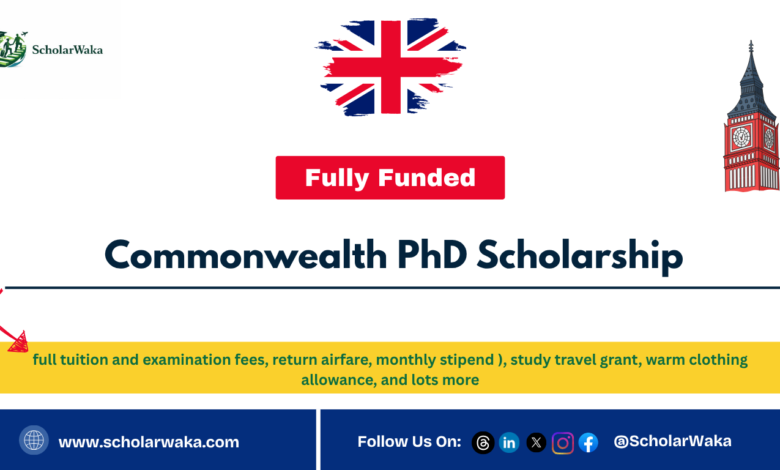
Commonwealth PhD Scholarship 2027/28 | Fully Funded

The Commonwealth PhD Scholarship 2027/2028 cycle will open on Tuesday, 8 September 2026. The closing date for applications to be received is 16:00 BST on Tuesday 20 October. The scholarships are for study in the UK beginning in September/October 2027.
If you’re researching this scholarship for the first time or have applied before, the most important thing to understand isn’t the deadline. It’s that you cannot apply to the Commonwealth PhD Scholarship directly. Every applicant must go through a nominating body in their home country or selected non-governmental organisations and charitable bodies first, and that nominating body sets its own deadline, almost always earlier than anything the Commonwealth Scholarship Commission (CSC) publishes. Missing any of these nomination deadlines means missing the scholarship entirely, regardless of what the CSC’s own portal says.
Also Read: Fully Funded Commonwealth Master’s Scholarship
About the Commonwealth Scholarship
The Commonwealth Scholarship is one of the longest-running international scholarship schemes in the world, funded by the UK government since 1959 under the Commonwealth Scholarship and Fellowship Plan (CSFP) — a shared commitment among Commonwealth nations to fund education across the network rather than a one-directional UK grant. The UK’s share of that plan is administered by the Commonwealth Scholarship Commission (CSC), funded through the Foreign, Commonwealth and Development Office, and it exists specifically to fund students from developing Commonwealth countries who could not otherwise study in the UK, on the condition that they return home to apply what they’ve learned.
Don’t Forget: Marshall Fully Funded Graduate Scholarship in the UK
More than 31,000 people have held a Commonwealth Scholarship or Fellowship since the first group of 175 scholars arrived in the UK in 1960, and the alumni network now includes former prime ministers and cabinet ministers, Nobel laureates, academics, diplomats, and leaders across NGOs and business. Unlike a single-university award, the Commonwealth Scholarship isn’t tied to one institution — recipients can study at any UK university offering an eligible programme under the scheme’s six development themes, which is part of why the application process runs through national nominating bodies rather than a single centralized portal: each Commonwealth country manages its own pipeline of candidates before the CSC makes final selections.
Must Read: Fully Funded Commonwealth Scholarship Application Guides
Commonwealth PhD Scholarship Summary
| Scholarship Name ⇒ | Commonwealth Scholarship |
| Host Country ⇒ | United Kingdom |
| Study Level ⇒ | PhD (full-time doctoral research) |
| Benefits ⇒ | Fully Funded — full tuition and examination fees, return airfare, monthly stipend of £1,712/month (outside London), or £2,000/month (within London), study travel grant, warm clothing allowance where needed, child allowance for qualifying single/widowed/divorced parents, Provision towards the cost of fieldwork undertaken overseas and lots more |
| Funded by ⇒ | UK Foreign, Commonwealth and Development Office (FCDO), administered by the Commonwealth Scholarship Commission (CSC) |
| Eligible Countries ⇒ | Eligible low- and middle-income Commonwealth countries — PhD track restricted to least developed and fragile states specifically |
| Application Deadline ⇒ | 2027/28 cycle will open on Tuesday, 8 September 2026. Closing date for applications to be received is 16:00 BST on Tuesday 20 October, 2026 |
Overview of the Commonwealth PhD Scholarship
Commonwealth PhD Scholarships are for applicants from least developed countries and vulnerable states, as classified by the OECD Development Assistance Committee (DAC), in the Commonwealth, for full-time doctoral study at a UK university.
The Commonwealth Scholarship Commission in the UK (CSC) provides the UK government scholarship scheme led by international development objectives. It operates within the framework of the Commonwealth Scholarship and Fellowship Plan (CSFP) and offers a vivid demonstration of the UK’s enduring commitment to the Commonwealth. By attracting individuals with outstanding talent and identifiable potential from all backgrounds and supporting them to become leaders and innovators on returning to their home countries, the CSC’s work combines sustainable development with the UK national interest and provides opportunities for international partnerships and collaboration.
Also Read and Apply: Commonwealth Master’s Shared Scholarship – Fully Funded in the UK
Purpose: Funded by the UK Foreign, Commonwealth & Development Office (FCDO), Commonwealth PhD scholarships contribute to the development needs of Commonwealth countries by supporting research that will have a developmental impact. They also enhance individual teaching and research capacity leading to increase institutional capacity in academic and other sectors in Commonwealth countries, and will contribute to UK higher education and research by attracting high-calibre international applicants and encouraging links and collaboration, and are aimed at those who could not otherwise afford to study in the UK.
Intended beneficiaries: Commonwealth PhD scholarships are for high-quality graduates who have the potential to undertake world-class research of a developmental nature and to become influential leaders, teachers, or researchers in their home countries.
These scholarships are offered under the six CSC Development themes.
Also Read: Full Funded Chevening Scholarship
Why You Can’t Just Apply to the CSC
This is the single most misunderstood part of the Commonwealth Scholarship, and it’s worth understanding before anything else. The CSC does not accept applications directly from individuals. Every candidate must first be nominated by an approved body — usually a government ministry of education, a national scholarship commission, or a designated national agency. That nominating body reviews applications from within the country, selects its strongest candidates, and only then submits those nominations to the CSC. The CSC makes its final selection decisions exclusively from nominated candidates.
That structure means two separate deadlines exist for every applicant: your nominating body’s internal deadline, and the CSC’s own portal deadline. The nominating body’s deadline is almost always earlier, sometimes by weeks or months, because it needs time to review applications and submit its nominations before the CSC’s own window closes. A strong candidate who waits for the CSC deadline they saw online, without first confirming their country’s nominating body deadline, can miss the scholarship entirely without ever having a CSC-level rejection to explain it.
Also see detailed article on : How you can find and apply for Commonwealth Scholarship Nomination

Eligibility Requirements for the Commonwealth PhD Scholarship
To apply for the Commonwealth PhD Scholarship you must:
- Be a citizen of or have been granted refugee status by an eligible Commonwealth country, or be a British Protected Person.
- Be permanently resident in an eligible Commonwealth country.
- Be available to start academic studies in the UK by the start of the UK academic year in September 2027.
- By September 2027, hold a first degree of at least upper second-class (2:1) honours standard, or a lower second-class degree and a relevant postgraduate qualification (usually a Master’s degree).
- Not be registered for a PhD, or an MPhil leading to a PhD, at a UK university or in their home country before September/October 2026.
- Be unable to afford to study in the UK without this scholarship.
- Have provided all supporting documentation in the required format.
The CSC recognises that disabled people have often faced and overcome challenges or barriers in their education journey which have prevented them achieving the academic requirement for a Commonwealth Scholarship. Disabled applicants who can demonstrate their potential to contribute to international development but who do not hold a 2:1 Undergraduate degree may be considered for a contextualised nomination through the Commonwealth Disabled People’s Forum (CDPF) nominator. For more information, please contact CDPF directly using the details on our NGOs and charitable body nominators page.
There is no age limit for CSC applications. Applicants are advised to confirm with their employers any age restrictions on leave entitlement they may have in place.
Note: All Commonwealth Scholars commit to returning home following the end of their scholarships to contribute to the development of their home countries. Switching to a graduate or other visa to remain in the UK is not permitted.
Also Read: Tips on How to Win a Scholarship
Eligible countries
Please note that only candidates from the eligible countries listed below can apply for Commonwealth PhD Scholarships.
Bangladesh, The Gambia, Kiribati, Lesotho, Malawi, Mozambique, Nigeria, Pakistan, Rwanda, Sierra Leone, Solomon Islands, Sri Lanka, Tanzania, Togo, Tuvalu, Uganda and Zambia.
Scholarship Benefits
The Commonwealth PhD scholarship provides:
- Approved airfare from the Scholar’s home country to the UK and return at the end of the award (the CSC will not reimburse the cost of fares for dependants, nor the cost of journeys made before the award is confirmed).
- Approved tuition fees: full fees are covered by agreement between the CSC and the UK university, and Scholars are not liable to pay for any part of the tuition fee.
- Stipend (living allowance) at the rate of £1,712 per month, or £2,000 per month for those at universities in the London metropolitan area (rates quoted at current levels).
- Study travel grant towards the cost of study-related travel within the UK or overseas.
- Provision towards the cost of fieldwork undertaken overseas (the cost of one economy class return airfare to the fieldwork location), where approved.
- Paid mid-term visit (airfare) to the Scholar’s home country, unless they have claimed or intend to claim spouse and/or child allowances during their scholarship or have received a return airfare to their home country for fieldwork.
- Family allowances, as follows (rates quoted at current levels):
- If a Scholar is accompanied by their spouse but no children: spouse allowance of £313 per month for a maximum period of nine months, if they and their spouse are living together at the same address in the UK (unless the spouse is also in receipt of a scholarship; other conditions also apply).
- If a Scholar is accompanied by their spouse and children: spouse allowance of £313 per month and child allowance of £313 per month for the first child, and £154 per month for the second and third child under the age of 16, if their spouse and children are living with them at the same address in the UK (unless their spouse is also in receipt of a scholarship; other conditions also apply).
- If a Scholar has children and is widowed, divorced, or a single parent, child allowance of child allowance of £622 per month for the first child, and £154 per month for the second and third child under the age of 16, if their children are living with them at the same address in the UK.
If a Scholar shares that they have a disability, a full assessment of their needs and eligibility for additional financial support will be offered by the CSC.
The CSC’s family allowances are intended to be only a contribution towards the cost of maintaining a Scholar’s family in the UK. The true costs are likely to be considerably higher, and Scholars must be able to supplement these allowances to support any family members who accompany them to the UK.
Must-Read: Top UK Scholarships for International Students
Choosing Your Universities — A Step Most Applicants Underprepare For
PhD applicants must identify and rank up to three UK universities and programmes in order of preference, and each choice needs its own clear justification explaining how that specific programme aligns with your academic background and future career plans. This isn’t a formality either — a generic justification repeated across all three choices, with only the university name changed, is one of the most common ways strong candidates undersell themselves. Each course must also connect to one of the CSC’s six development themes.
The Six CSC Development Themes:
- Science and technology for development
- Promoting innovation and entrepreneurship
- Strengthening resilience and response to crises
- Strengthening health systems and capacity
- Strengthening global peace, security, and governance
- Access, inclusion, and opportunity
Separately from your Commonwealth Scholarship application, you’ll also need to submit a standard admissions application directly to each UK university you’re targeting — the scholarship application and the university admission process run in parallel, not one after the other.
Read more about the Six CSC Development Themes here.
Also read and apply for : MARIHE Erasmus Mundus Scholarship 2027 – Fully Funded in Europe
Commonwealth PhD Scholarship Required Documents
Applications must include supporting documentation to be eligible for the Commonwealth PhD Scholarship.
Please note that applicants are required to collect references and supporting statements, either on institution letterhead or an email clearly showing the sender’s details, from referees and proposed supervisors in the UK, and then upload them in PDF format to the application system with their other supporting documentation.
The references and supporting statements must be uploaded to the application system by the deadline for applications and we are unable to accept references and supporting statements any other way or after this date.
Applicants must upload the following documents with the application:
- Proof that they are a citizen or have refugee status in an eligible Commonwealth country: a copy of a valid passport (or national ID card) showing a photograph, date of birth, and country of citizenship.
- Full transcripts detailing all higher education qualifications, including to-date transcripts for any courses currently being studied, with certified translations if not in English. Where any transcripts are missing or do not include all pages, the application will be considered ineligible. If to-date transcripts are not available, the application must include an explanation why this is the case.
- References from at least two individuals, in PDF format, signed and on institutional letterhead or an email clearly showing the sender’s details.
- A supporting statement, in PDF format, signed and either on institutional letterhead or an email clearly showing the sender’s details, from a proposed supervisor in the UK from at least one of the institutions named on the application form.
Applications will be considered ineligible if any of the required documentation is not included by the closing date.
The CSC will not accept supporting documentation submitted outside the online application system.
References must be clearly written by the referee in their own words. When completing the references, referees should be asked to comment as fully as possible on the applicant, keeping in mind the following points for inclusion, as appropriate:
- How long, and in what capacity, the referee has known the applicant.
- The referee’s views on the applicant’s suitability for the proposed Scholarship and the need for the particular subject of study in the UK.
- Information on how, and to what extent, the applicant has shown ability in terms of:
- capability to grasp concepts and reason analytically;
- capacity for original thought;
- and motivation and perseverance in achieving objectives.
- Assessment of the applicant’s particular strengths and weaknesses.
- The applicant’s potential to impact development in their home country.
- Any other general qualities which the referee considers would make the applicant a good recipient of a Scholarship.
Please note that the CSC does not charge apply for any of its scholarships or fellowships through its online application system.
Supporting statements must clearly by written by the proposed supervisor in their own words. When completing supporting statements, proposed supervisors should be asked to confirm that they are, in principle, prepared to have the applicant working with them and that they have the facilities to undertake the research. They should also be asked how the applicant’s plan of study fits with the expertise of their department and to indicate how much of the applicant’s plan of study, if any, they wrote, and to confirm that the study programme can be completed within the proposed 36 month tenure. Any additional comments they make will be appreciated by the Commission.
Don’t Miss: How to Write a Personal Statement for Scholarship | Tips and Free Template
Selection Process and Criteria
Applications for the Commonwealth PhD Scholarship will be considered according to the following selection criteria:
- Candidate merit (including academic experience)
- Quality of research proposal
- Potential impact on the development of the candidate’s home country
For further details, please refer to the Commonwealth Scholarships selection criteria.
Applicants should note the criteria carefully and link their answers in the application form to each point listed.
How to Apply for the 2027/28 Commonwealth PhD Scholarship Cycle
- Identify your country’s nominating body now, before the cycle opens or before you submit your application, and find out its typical deadline pattern from previous years — most nominating bodies close weeks ahead of the CSC’s own portal deadline. See more detailed steps on how to secure a nomination here.
- National nominating agencies – this is the main route of application.
- Selected non-governmental organisations and charitable bodies.
- Research partner UK universities and choose up to 3 PhD programme that connect clearly to one of the six CSC development themes, and start drafting a genuinely distinct justification for each of your three ranked choices.
- Begin your standard university admissions applications in parallel — don’t wait for the Commonwealth Scholarship application to open before starting this, since admissions timelines run independently.
- Gather your academic transcripts and identify two referees who can write from official letterhead or an identifiable institutional email address, well before the portal opens.
- Find and get a potential UK research supervisors. You also need to get a supporting statement from a confirmed supervisor.
- Once the 2027/28 cycle opens, expect nominations to close around December 2026, with CSC results typically announced by July 2027, and study starting that September or October — set reminders around each of these windows well in advance.
Applications to the CSC are made using the application system, CSC Central.
The CSC is unable to accept any applications or documentation not submitted via CSC Central.
Candidates wishing to save a copy of an application that has already been submitted can access the system using the ‘view a submitted application’ function.
It is recommended to prepare answers outside of the system and then adding them to the form once they have been finalised.
There is a template application form and guidance document available to assist applicants when applying.
The form uses a two-factor authentication (2FA) system and will require access to either a smartphone or a second email account when registering. The 2FA system must be passed each time a user logs in to access the form.
Also Apply For: Federation University Fully Funded PhD Scholarship 2027 in Australia
Completing the Application Form
In the application form, applicants are asked to:
- List all undergraduate and postgraduate university qualifications obtained.
- List up to 10 publications and prizes.
- Provide details of employment history and explain how the experience gained supports and is relevant to the programme to be undertaken in the UK.
- List names and positions of three referees who are qualified to comment on both their capacity to benefit from the proposed Scholarship in the UK and their ability to deliver development impact afterwards. One of the referees must be a current employer (if applicable) and at least two references must be included with the application.
- Provide a Development Impact statement in four parts.
In the first part applicants should explain how the proposed scholarship relates to:
- Development issues at the global, national, and local level
- Development issues connected to the chosen CSC development theme and the wider sector
The second part should explain how they intend to apply their new skills once the Scholarship ends.
The third part should outline what they expect will change in development terms following the Scholarship, including:
- The outcomes that they aim to achieve
- The timeframe for their implementation
- Who the beneficiaries will be
In the fourth part applicants should write about how the impact of their work could be best measured and evidenced.
Applicants are also asked to:
- Confirm what their award objectives are and how each of them will be met by the Scholarship programme.
- Confirm what their career plans are for the five years following the Scholarship.
- Confirm their long-term career plans.
- Provide a detailed plan of study.
- Provide a personal statement to summarise the ways in which their personal background has encouraged them to want to make an impact in their home country. Applicants may wish to highlight any areas where they have already made significant contributions, including overcoming personal or community barriers in accessing higher education or within their field.
- Summarise the ways in which they have engaged in voluntary activities and the opportunities they have had to demonstrate leadership.
Also see detailed article on : Fully Funded Commonwealth Scholarship 2027/2028 Application Guides
Advice for applicants
All of the CSC’s scholarship schemes are highly competitive. This means that many very able applicants will be disappointed. Only candidates whose applications are outstanding across the board are likely to be successful. You must therefore consider carefully what you choose to include. This page provides advice and guidance to applicants completing the application form, including feedback from the selection panel and common mistakes to avoid.
Applicants can find general information about applying for a Commonwealth Scholarship on our advice for applicants page.
Frequently Asked Questions
Is the Commonwealth PhD Scholarship 2027/28 cycle open?
The Commonwealth Master’s Scholarship 2027/2028 cycle will open on Tuesday, 8 September 2026. The closing date for applications to be received is 16:00 BST on Tuesday 20 October. The scholarships are for study in the UK beginning in September/October 2027.
Can I apply to the Commonwealth Scholarship Commission directly?
No. The CSC only considers candidates nominated by an approved body in their home country. You must apply through your country’s nominating agency first; the CSC does not accept direct applications from individuals.
Is Nigeria eligible for the Commonwealth Scholarship?
Yes. Nigeria and other African Countries is one of the eligible Commonwealth countries for the Master’s Scholarship track. PhD eligibility is restricted to citizens of the least developed and most vulnerable Commonwealth states specifically — confirm current PhD eligibility with your nominating body before assuming it applies.
What’s the difference between the Commonwealth Master’s Scholarship and the Commonwealth Shared Scholarship?
The Master’s Scholarship (agency-nominated route) requires nomination through your country’s national body. The Commonwealth Shared Scholarship instead runs through individual UK universities, which bid for and allocate their own scholarship places directly, then submit their selected candidates to the CSC for confirmation. Deadlines and processes differ between the two, so confirm which route applies to your situation.
How do my referees/supervisors submit their references/supporting statements?
Applicants must ensure their references and supporting statements from their supervisor (for PhD only) are uploaded on the application portal before submitting their application to the CSC. Applications without the necessary amount of references/supervisor statements are considered incomplete and will be rejected by the CSC. The CSC cannot accept any documents via email or post.
I do not currently have an offer letter from a UK university. Can I apply?
If you are applying for the following programmes a university admission/offer letter is not required at the application stage of the scholarship application process and is not an eligibility requirement for the CSC.
- Commonwealth Master’s Scholarships
- Commonwealth PhD Scholarships
- Commonwealth Shared Master’s Scholarships
- Commonwealth Distance Learning Scholarships
- Commonwealth Split-site PhD Scholarships
However, if you are applying through a nominating agency you should check the eligibility requirements of your nominating agency, they may include additional eligibility criteria which you must meet. You are strongly advised to seek admission to your proposed UK university at the time of, or as soon as possible after submitting your CSC application.
If you are applying for a PhD Scholarship (for high income (as defined by the OECD) countries) you may be required to submit an offer letter at time of application. Please see the programme page for more information.
I have an offer letter for the current academic year. Can I apply?
Applicants can only apply for a Commonwealth Scholarship for the following academic year of study.
Universities may agree to defer your offer whilst you apply for a Commonwealth Scholarship to fund your studies. This is at the individual University’s discretion, applicants should contact the University directly for further information.
Do I require an IELTS certificate?
It is not necessary to have IELTS or any other English language certificate to apply for a CSC scholarship. However, UK universities require candidates from some countries to demonstrate their proficiency in English language by taking the IELTS or another English language certificate. It is your responsibility to check the requirements directly with the university.
See more Frequently Asked Questions HERE
Disclaimer: All scholarship details, deadlines, award values, and eligibility criteria in this post were verified from official sources as of July 2026. Information is subject to change without notice. Always confirm the latest details directly on the official Commonwealth Scholarship Commission (CSC) website before submitting your application. ScholarWaka is not affiliated with the Commonwealth Scholarship Commission or the UK Government.
Official Application Portal
Join ScholarWaka Community
Get the latest scholarship updates and study abroad opportunities before anyone else.