University of Calabria Scholarship 2026/2027 | How to Apply

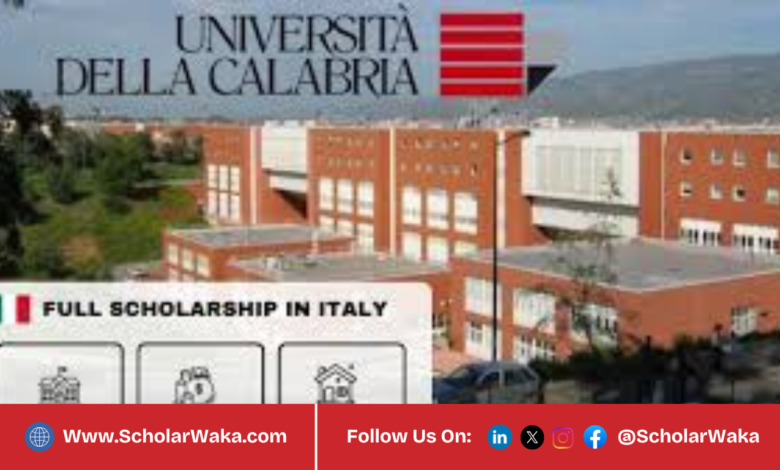
Southern Italy isn’t the first place most international students picture when they think “fully funded Master’s degree in Europe.” Still, the University of Calabria has quietly built one of the more generous non-EU scholarship schemes on the continent, with 132 places, covering tuition, housing, meals, and a cash allowance, decided purely on qualifications with no interview bias toward students who can travel to Italy in person.
Also, Check Out: Top Fully Funded Master’s Scholarships in Europe
Applications for the 2026/27 cycle closed on 30 March, so if you’re reading this now, you’ve missed the window to apply, but if you already applied and were selected, there are two more deadlines genuinely still ahead of you this year that determine whether you keep the funding. This guide covers the full selection process, the income thresholds that actually determine your scholarship eligibility, the language testing shortcut that removes IELTS or TOEFL from the equation for many applicants, and what successful candidates still need to do before the scholarship is fully secured.
Don’t Miss: Top Fully Funded Scholarships for International Students
University of Calabria Scholarship Summary
| Scholarship Name ⇒ | University of Calabria |
| Host Country ⇒ | Italy |
| Study Level ⇒ | Masters |
| Benefits ⇒ | Full tuition waiver, free accommodation, free campus meals, €3,600 allowance |
| Funded by ⇒ | Università della Calabria |
| Eligible Countries ⇒ | Non-EU citizens residing abroad |
| Application Deadline ⇒ | 30 March 2026, now closed. Successful candidates face further deadlines: ISEE income documentation and in-person identity verification by 30 October 2026, and a minimum credit requirement by 30 November 2027 |
About the University of Calabria Scholarship
Università della Calabria, founded in Cosenza in 1972 and now home to roughly 35,000 students, runs this scheme, known informally as UnicalAdmission, specifically for non-EU students currently living outside Italy who want to pursue a two-year international Master’s degree.
What makes it distinctive among European scholarships is its selection method: admission and scholarship decisions are made purely on qualifications, evaluated through a CV and academic record review combined with a remote oral examination, meaning you never need to travel to Italy before being admitted. The scholarship spans a genuinely broad range of subjects, including Artificial Intelligence, Computer Science, Data Science, Engineering, Physics, Economics, Business Administration, Humanities, and Social Sciences.
Also Read: How to Write a Personal Statement for Scholarship | Tips and Free Template
What Determines Whether You Get the Scholarship-Funded Place Specifically
Being admitted to a Master’s programme and being awarded the scholarship-funded place within it are two related but distinct outcomes. UNICAL creates two separate merit rankings from the same admission process: one for scholarship-funded places, one for places without scholarship funding. Whether you land on the scholarship ranking depends on your household income falling under specific thresholds, based on published guidelines: broadly, under €26,500 for an independent student, under €41,500 for a two-person household, and under €54,000 for a household of three or more.
You’ll need to submit an ISEE Parificato, or an equivalent income certification, to prove this. Students from least-developed countries are exempt from this specific ISEE Parificato requirement, recognising that formal income documentation of this kind may not be readily available in every country.
Don’t Miss: Step-by-Step Guide to Securing Scholarships Abroad for Beginners

What Makes You Eligible for This Scholarship
- You need to be a non-EU citizen currently residing abroad, outside Italy
- You need to hold a university degree obtained abroad, valid for admission to a Master’s programme in Italy
- You can apply for only one degree programme per application cycle; you can’t hedge across multiple courses simultaneously
- You need to meet the specific admission requirements of your chosen programme
- You need to complete the online application and upload every required document, alongside paying a €10 application fee via PagoPA
What Language Testing Actually Looks Like
This is worth knowing if IELTS or TOEFL testing has been a barrier for you elsewhere. For most programmes, English proficiency is verified through the same remote oral examination used for academic assessment, rather than requiring a separate, mandatory IELTS or TOEFL certificate at the initial application stage. The same applies for Italian-taught programmes, where proficiency is also assessed via interview, with online Italian language courses available to support some students afterwards.
What Happens During Selection
- UNICAL evaluates every application based on CV and academic qualifications
- At least twice the number of available places are invited to a remote online oral examination
- That oral examination also assesses your language proficiency, in Italian or English depending on your programme’s teaching language
- Two separate merit rankings are produced — one for scholarship-funded places, one for places without a scholarship
- If candidates tie in the ranking, the younger candidate is placed higher
- Successful candidates receive enrolment instructions by email
What This Scholarship Actually Pays
- Full tuition fee coverage
- Free accommodation in university housing
- Free campus meals
- A €3,600 financial allowance
What Documents You Need for the Initial Application
1. The first page of your passport
A clear scan showing your photo, full name, date of birth, and passport number. This is used purely for identity verification at the application stage, so it doesn’t need to be certified or translated at this point.
2. A current CV
This should lay out your academic history and any relevant research, work, or professional experience clearly and chronologically. Since selection is based heavily on qualifications rather than a personal statement or motivation letter, your CV is doing more work here than it typically would in a scholarship application, so it’s worth presenting it cleanly rather than treating it as a formality.
3. Your Bachelor’s degree certificate
Proof that you’ve actually completed the degree that qualifies you for Master’s-level study. If your final certificate hasn’t been issued yet because you’re still finishing your degree, check with UNICAL directly on whether a certificate of expected completion is accepted in its place, since this varies by call.
4. Your university transcript of records
The full academic record from your Bachelor’s degree, showing every course you took and the grades you received. This is one of the two documents UNICAL’s selection committee weighs most heavily, alongside your CV, since admission and scholarship ranking are built entirely on qualifications rather than an interview-based judgment of potential.
5. Your university’s official syllabus of courses
A document, usually issued by your home institution, describing the content and structure of each course you completed. UNICAL uses this to assess whether your prior study genuinely matches the entry requirements of your chosen Master’s programme, so a generic course list without real content descriptions can weaken your application even if your grades are strong.
6. An Italian language certificate, if you already hold one
Not mandatory at this stage, since Italian-taught programmes assess language proficiency through the remote oral examination instead. If you already hold a recognised certificate, though, including it can only strengthen your file.
7. An English language certificate, if you already hold one
Same logic applies here. Most English-taught programmes rely on the oral exam rather than a mandatory IELTS or TOEFL score, but an existing certificate is worth submitting anyway if you have one, since it adds independent evidence to your application.
8. Any other useful supporting academic documents
This is a genuinely open category, and it’s worth using it rather than skipping past it. Publications, academic awards, relevant certifications, or evidence of research experience related to your chosen field can all strengthen a qualifications-only selection process, where there’s no interview or personal statement to make your case in another way.
What You Still Need to Do If You’re Selected
This is the part worth taking seriously if you’ve already been admitted, since these steps are genuinely still ahead:
- Submit your officially translated and legalised degree
- Provide your Declaration of Value, or ENIC-NARIC certification, confirming your foreign degree’s recognition in the Italian system
- Provide your Certificate of Comparability and Verification (CIMEA)
- Submit your ISEE Parificato income documentation, and complete in-person identity verification, both by 30 October 2026. This in-person step means you’ll need to be physically present, or arrange the verification through an authorised channel, by this date
- Earn at least 20 ECTS credits by 30 November 2027 to retain your scholarship benefits going forward. This is an ongoing academic performance condition, not a one-time formality
What the Application Process Requires
- Register on the Esse3 Portal
- Log in and navigate to Menu → Registrar’s Office → Admission Test
- Select your chosen degree course
- Choose the competition specifically titled “CALL FOR EXTRA-EU STUDENTS”
- Complete the application form and upload every required document
- Pay the €10 application fee via PagoPA
- Submit before the deadline
Application Timeline
- Application deadline: 30 March 2026 now closed
- Oral examinations: Conducted remotely for shortlisted candidates in the following weeks
- Enrolment instructions: Sent by email to successful candidates
- ISEE documentation and in-person identity verification: Due 30 October 2026
- Minimum credit requirement to retain the scholarship: 20 ECTS by 30 November 2027
- Next expected cycle: Based on the university’s consistent annual pattern, expect the 2027/28 call to open around early March 2027, with a similar 30 March closing date
What to Do Before the Next Cycle Opens
- Start gathering your degree translation, legalisation, and comparability documentation now, since these steps historically take longer than applicants expect and are required regardless of when you apply
- Check the current income thresholds directly on UNICAL’s official call documents before assuming you qualify for the scholarship-funded ranking specifically, since these figures are reviewed and can shift between cycles
- If you’re from a least-developed country, confirm your ISEE Parificato exemption status directly with UNICAL rather than assuming it automatically applies
- Prepare for a remote oral examination rather than a written English test, since this is how most applicants demonstrate language proficiency under this scheme
- If you’ve already been admitted for 2026/27, treat 30 October 2026 as a genuine, binding deadline; not a formality. Missing the ISEE submission or identity verification by this date can affect your scholarship status
Frequently Asked Questions
Is the University of Calabria Scholarship still accepting 2026/27 applications?
No. The application deadline was 30 March 2026. Based on the university’s pattern, the next cycle is expected to open around March 2027.
Do I need IELTS or TOEFL to apply?
Not necessarily. Most programmes verify English proficiency through the same remote oral examination used for academic assessment, rather than requiring a separate mandatory test certificate at application stage.
What income limits apply to get the scholarship-funded place specifically?
Broadly, under €26,500 for an independent student, under €41,500 for a two-person household, and under €54,000 for a household of three or more, based on published guidelines; always confirm the current figures directly with UNICAL.
I’ve already been admitted, is there anything else I need to do?
Yes. You need to submit your ISEE Parificato documentation and complete in-person identity verification by 30 October 2026, and earn at least 20 ECTS credits by 30 November 2027 to retain your scholarship.
Are students from least-developed countries exempt from any requirements?
Yes. Students from least-developed countries are exempt from the ISEE Parificato income documentation requirement specifically.
Disclaimer: All scholarship details and figures in this post are verified from official University of Calabria sources and credible secondary sources as of July 2026. Information is subject to change without notice. Always confirm the latest details directly on the official Università della Calabria international admissions page. ScholarWaka is not affiliated with the University of Calabria.
Official Application Portal
Join ScholarWaka Community
Get the latest scholarship updates and study abroad opportunities before anyone else.