After 3 Years of Applications: Boluwatife Olaleye Won the Mastercard Foundation Scholarship

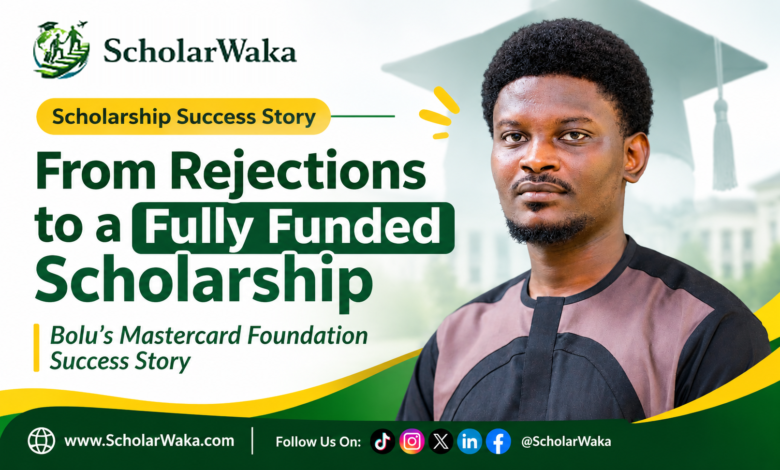
Boluwatife Olaleye, who goes by Bolu, finished his Bachelor’s degree with first-class honours and as the best graduating student in his department. It still took him almost three years of applications to win a fully funded place on the Mastercard Foundation Scholarship Program at Arizona State University (ASU). He is now studying for a master’s in Sustainable Engineering, and he serves as the Scholar Representative for the programme’s ASU cohort.
He is from Ekiti State, Nigeria, studied Agricultural and Environmental Engineering at Rivers State University in Port Harcourt, Nigeria and describes his background as low-income. His story matters because his strong grades did not win it on their own. What changed his results was a record that connected, a willingness to keep going, and feedback from people who had won before him.
Read about the Arizona State University (ASU) Scholarship Boluwatife won: Mastercard Foundation Scholarship Innovation and Technology at Arizona State University (ASU) (Online Graduate Certificate)
Where the Story Started
Bolu did not grow up knowing how scholarships worked. “I just hear that people get scholarships. I did not know what it entails, how people do it, what you need to put together,” he says.
That changed in 2023, right after his final-year project. A coursemate from the Student Union Government told him he was applying for scholarships. Bolu started working alongside him. His first year of applying, 2023 to 2024, was meant to teach him the process. “I knew that it was not going to be easy, because I see the profiles of people that have won scholarships.” They spent much of their time on YouTube, learning from each other.
The Leadership Behind the Application
By then, Bolu already had years of leadership on record. He was his class representative from first year to final year. In his final year, 2022 to 2023, he won an election to the Student Union Government as Leader of the House. During his National Youth Service Corps (NYSC) year in Cross River State, he served in the electrical and solar energy department at the Cross River Basin Development Authority. In addition to his technical responsibilities, he also served as the Corps Members’ Liaison Officer at his place of primary assignment, a position he held throughout his service year. Through this role, he represented fellow corps members and contributed to fostering effective communication between them and the organisation.
He credits these roles directly. “Scholarship these days is not just about being excellent academically. It’s not enough, because a lot of people are applying.”
A Year of Applications and No Offers
In that first cycle, he and his friend sent almost 20 applications between them. “Nothing came.” The second year brought a different kind of lesson. His friend won a place on the Mastercard Foundation Scholars Program at the University of British Columbia in Canada. Bolu was happy for him, and it showed him something concrete: “It is very, very possible.”
In 2024, Bolu received some scholarships, but they were not fully funded. He kept going for a full one, and he explains why plainly. “Coming from a low-income background, my school fees are currently almost $50,000 a year. Where do you expect to get that kind of money from? Even if you are paying 90%, where do you want to get the remaining 10% from?”
He also applied for this scholarship in 2024 but was unsuccessful. However, rather than giving up, he used the experience as an opportunity to learn and improve his application. As part of his preparation, he attended webinars almost daily, studied essays written by previous scholarship winners, and actively followed scholarship communities on LinkedIn. Through these efforts, he gained valuable insights into the application process and what scholarship committees look for in successful candidates.
If you don’t have anyone around you to support, join the ScholarWaka Connect Community (SCC): A Community for Scholarships, Opportunities and Career Growth, where you can connect with past scholars and get guidance on your preparation
The Application That Finally Worked
Bolu reapplied in the 2025 cycle. His timeline for this round:
- October 2025: He submitted his scholarship application.
- Late December 2025 or early January 2026: He was told he had passed the first stage and that his ASU application fee had been waived.
- January 2026: He applied to ASU.
- Late January or early February 2026: He heard that he had been admitted.
- Early March 2026: He had a short interview of about 15 to 20 minutes. He says the panel wanted to meet the person behind the essays.
- March 2026: He received the selection email.
He recalls being told at orientation that over 30,000 people applied and about 45 were selected. He was applying at the same time to other programmes, including Erasmus and the Commonwealth Scholarship.
What he believes made the difference was consistency. “Everything was connecting. My leadership experiences were connecting. You can see the progression in my essays, in my CV, and on my LinkedIn.” His field never wandered. He worked on solar energy in his final-year project, took a course on it, did his NYSC placement in a solar and electrical setting, and applied for a master’s in sustainable engineering. He also believes that reapplying helped. He thinks the selectors can see your name from the year before, but only if your new application shows what you added in between.
Read This: University College London (UCL) African Graduate Scholarship
His Advice to Scholarship Applicants
Bolu’s advice comes from three years of applying. He has also reviewed essays for other applicants during the current cycle.
1. Treat it as a whole-profile process.
Grades are one part. Leadership, community impact and your story count too. He knows scholars in his cohort who finished with a 2:1 or a 2:2.
2. Open with a hook.
The first sentence and paragraph have to make a reviewer want to keep reading. Start with a statistic or a personal story. He advises against opening with “growing up” because it is too common, and he says reviewers read it as a template.
3. Show proof with numbers.
His final-year project on solar dryers for fish and meat reduced post-harvest losses by 50% under test conditions. He wrote the figure into his essay.
4. Ask a question in your essay.
He framed a question about what sustainable principles young African engineers need, and presented his master’s as the way to find the answer.
5. Be specific about the future.
Name the company or researcher you want to work with after your degree. He says the plan may change, but it shows you know where you’re going.
6. Use your resilience story.
He wrote the JAMB entrance exam four times, from 2015 to 2018, before gaining admission. He used that in his second essay, and one line read: “Still, I refuse to give up.”
7. Count the small leadership.
Leading two or three people still counts, if you show what changed because of you. Bolu also founded a tutoring initiative, Pathway Tutors, for coursemates and junior students.
8. Keep your documents consistent.
Keep your CV to two pages, in black and white. Make sure your essay, CV and LinkedIn tell the same story, because he says reviewers do check. Keep your public profile professional.
9. Get feedback and avoid the last day.
Send your essays to people who have won the scholarship. Submit two to four days before the deadline, since portals can crash on the final day.
10. Keep applying and keep building.
Do not resubmit last year’s application unchanged. Add what you have done since. Watch other winners’ stories, find mentors and share your work online.
He adds one note on using examples: his essay is his own, and he advises applicants to write theirs from their own experience, not copy his.
His closing message was simple. “It’s a long journey. It might not come in your first cycle, but then the second one, the third one. How much do you want it? How hard are you willing to go?”
See This: GLOCAL Erasmus Mundus Scholarship | Fully Funded
Frequently Asked Questions (FAQ)
Who is Boluwatife Olaleye, and what scholarship did he win?
Boluwatife Olaleye, known as Bolu, is a Nigerian engineering graduate who won a fully funded place on the Mastercard Foundation Scholars Program at Arizona State University. He is studying a master’s in Sustainable Engineering.
How long did it take him to win?
His scholarship journey began in 2023, and he received the offer in March 2026, so it took almost three years. He first applied to this scholarship in 2024, was not selected, and reapplied in 2025.
How many applications did he make before winning?
In his first year, he and a friend sent almost 20 applications between them and received no offers. In 2024, he received some scholarships that were not fully funded. He kept applying until he won a fully funded one.
Is Bolu studying in the United States?
No. Because of current US travel restrictions affecting Nigerians, he is completing the ASU programme online from Rwanda. He says the Mastercard Foundation also funds a summer immersion programme for scholars next year.
Does an applicant need a first-class degree?
Bolu says no. He finished with a first-class degree, and he knows scholars in his cohort with a 2:1 or a 2:2. He says the process is holistic, with leadership, community impact and your story all counting.
What was the application timeline for his round?
He submitted in October 2025, heard about the first stage around late December or early January, applied to ASU in January, was admitted around late January or early February, had a short interview in early March, and received the final result in March 2026.
What was the biggest piece of advice he gave?
Consistency and persistence. He says your essays, CV and LinkedIn must tell the same story, and that you should keep reapplying with new achievements added each time.
Disclaimer: This article is based on a personal workshop session and reflects one scholar’s own experience and opinions. It does not represent official guidance from the Mastercard Foundation or Arizona State University. Application stages, timelines and arrangements for scholars can change between cycles, and Bolu’s account reflects his own cohort. Always confirm current requirements directly with the Mastercard Foundation Scholars Program and the partner institution before applying.
Join ScholarWaka Community
Get the latest scholarship updates and study abroad opportunities before anyone else.