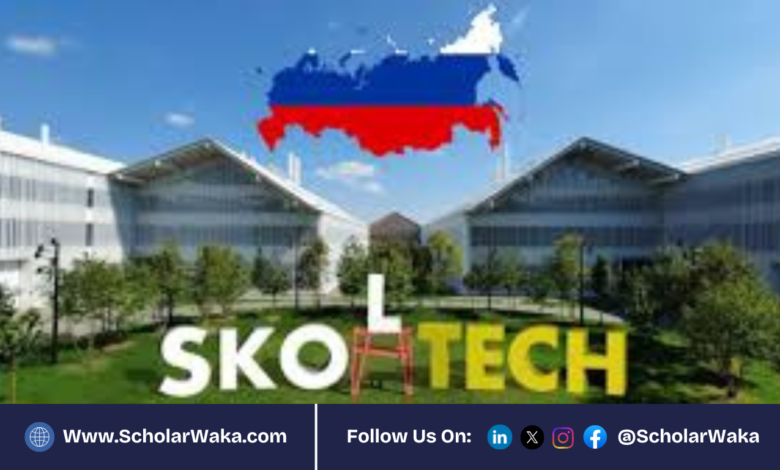
Skoltech Graduate Scholarships 2026 in Russia

There’s a specific structural detail about this scholarship that most secondary listings miss entirely: it isn’t a single-deadline programme at all. Skoltech runs its Master’s and PhD admissions across multiple waves throughout the year, which means a missed early deadline doesn’t necessarily mean a missed year — for this cycle, MSc applications continued through a third wave closing 7 July 2026, and PhD applications remained open right through 29 June 2026, both just recently closed.
Don’t Miss: Top Fully Funded Scholarships for International Students
Founded in 2011 in partnership with MIT, Skoltech charges no tuition fee at all to any admitted student, funds the strongest applicants through a competitive selection process built around portfolio review and an actual Entrepreneurship and Innovation Challenge, and offers a monthly stipend substantial enough to genuinely live on in Moscow. This guide covers the full multi-wave structure, what the selection process actually evaluates beyond your grades, the real stipend figures by degree level, and what to prepare for the next admissions cycle.
Also Read: How to Write a Personal Statement for Scholarship | Tips and Free Template
About the Skoltech Graduate Scholarship
The Skolkovo Institute of Science and Technology, based within the Skolkovo Innovation Center outside Moscow, combines rigorous STEM research with entrepreneurship and innovation training as part of its mission to establish a new model of science education in Russia. Its founding partnership with MIT directly shaped this academic structure and continues to influence its interdisciplinary approach.
Also, Check Out: Top Fully Funded Master’s Scholarships in Europe
Every programme is taught entirely in English, and Skoltech does not charge tuition fees to either domestic or international students. The institute fully covers the cost of your education regardless of whether you receive a separate stipend award. In a recent cycle, Skoltech awarded scholarships to roughly 280 MSc students and 120 PhD students, giving a real sense of the programme’s scale.
Skoltech Graduate Scholarships Summary
| Scholarship Name ⇒ | Skoltech Graduate |
| Host Country ⇒ | Russia |
| Study Level ⇒ | Master’s and PhD |
| Benefits ⇒ | No tuition fee for any student; competitive stipend for scholarship recipients (40,000 RUB/month MSc, 75,000 RUB/month PhD), plus medical insurance |
| Funded by ⇒ | Skolkovo Institute of Science and Technology (Skoltech) |
| Eligible Countries ⇒ | All Countries |
| Application Deadline ⇒ | Master’s Degree: 16th March 2026— now closed; PhD. Degree: 27th April 2026— now closed |
Eligibility Requirements
- You need a relevant Bachelor’s degree (for MSc applicants), or a relevant Master’s or Specialist degree (for PhD applicants)
- You need to have graduated from an accredited university
- You can apply as a senior undergraduate student, in your fourth year or beyond, or as a graduate who’s already completed your degree
- You need to demonstrate English proficiency at a minimum B2 level — accepted evidence includes TOEFL iBT (72+), TOEFL ITP (543+), the Lingvotest Academic English exam (66+), or Duolingo English Test at B2 level
- If your previous degree was taught entirely in English, formal English proof isn’t required
- If you’re applying from the humanities, business, or social sciences, you must demonstrate strong prior training in a related technical field because Skoltech designs its programmes around STEM disciplines.
- GRE scores aren’t required, but submitting one can strengthen your application
What Fields Are Available
Skoltech offers 14 MSc programmes and 8 PhD programmes across STEM disciplines, spanning computer science and engineering, mathematics and applied mathematics, physics and applied physics, chemistry and chemical engineering, biology, bioengineering, and biochemistry, materials science and engineering, aerospace science and engineering, mechanical engineering, and petroleum and gas engineering, geology, and geophysics.

How Funding Decisions Actually Work
This is worth understanding clearly, since it differs from how most scholarships in this series operate: there’s no separate scholarship application to submit. The admissions committee automatically considers every admitted student for financial support through the same competitive selection process used for admission.
The evaluation weighs several factors together — the results of your online testing, your performance in the Entrepreneurship and Innovation Challenge (a genuine assessment of entrepreneurial skills conducted during the final selection round), and your overall portfolio. The best candidates are guaranteed a scholarship as part of this process, rather than needing to clear a separate funding hurdle after admission.
What This Scholarship Pays
- No tuition fee is charged to any admitted student, regardless of scholarship status
- A monthly stipend of approximately 40,000 rubles for MSc scholarship recipients
- A monthly stipend of approximately 75,000 rubles for PhD scholarship recipients — a substantially higher figure, reflecting the different funding structure for doctoral researchers
- Medical insurance, provided to international students in accordance with Skoltech’s local coverage policies
- Access to academic mobility programmes, supporting participation in collaborative research and exchange opportunities
- Additional financial support, potentially awarded based on strong academic performance during your studies
Required Documents
To ensure your application documents meet rigorous academic and administrative evaluation standards, candidates must prepare a complete set of supporting documentation. Below is an expanded, step-by-step breakdown detailing the specific formatting expectations, content focus, and guidelines for both Master’s (MSc) and Doctoral (PhD) applicants.
A. Core Application Portfolio (For MSc Applicants)
1. Higher Education Diploma & Official Academic Transcripts
- Core Purpose: Provides official verification of your academic history, degree completion, coursework rigor, and cumulative grade point average (GPA).
- Key Requirements:
- Completed Degrees: Official diploma/degree certificate alongside certified complete academic transcripts detailing all completed modules and final marks.
- Ongoing Studies: If you are currently completing your undergraduate degree, submit an official interim transcript/academic record showing coursework and grades completed to date, accompanied by an official letter of enrollment.
- Translations: Any documents issued in a language other than the university’s official medium of instruction must be accompanied by certified, literal English translations.
2. Curriculum Vitae (CV) or Professional Résumé
- Core Purpose: Offers a clean, chronological snapshot of your academic accomplishments, practical experience, and technical competencies.
- Formatting & Structure:
- Typically capped at 1 to 2 pages with a clean, scannable layout.
- Key Sections: Contact details, academic background, research experience, professional/work history, key technical or methodological skills, academic honors/awards, and relevant extracurricular leadership.
3. Statement of Purpose (SOP) or Motivation Letter
- Core Purpose: Serves as your primary qualitative narrative, articulating your academic trajectory, intellectual motivations, and readiness for postgraduate study.
- Content Pillars to Cover:
- Academic Background: Overview of your relevant undergraduate coursework, projects, or thesis research.
- Program Fit: Specific reasons for choosing this institution and program (e.g., specialized curriculum, faculty expertise, research facilities).
- Future Vision: Concrete explanation of your short-term and long-term career aspirations and how this degree directly facilitates them.
4. Two (2) Professional / Academic Letters of Recommendation
- Core Purpose: Delivers external validation of your academic capability, intellectual maturity, analytical skills, and suitability for graduate-level work.
- Key Requirements:
- Referee Selection: Prioritize university professors, lecturers, or research supervisors who have directly evaluated your coursework or academic research.
- Document Authenticity: Letters must be drafted on official university or organizational letterhead, signed, dated, and submitted directly by the referees or accompanied by institutional contact details.
5. English Language Proficiency Certificate
- Core Purpose: Demonstrates your capability to participate fully in graduate-level lectures, research discussions, and academic writing conducted in English.
- Key Requirements:
- Official score report from an accepted examination body (e.g., IELTS Academic, TOEFL iBT, Duolingo English Test, or Cambridge C1/C2).
- Exemption Status: If you completed your previous degree entirely in English at an accredited institution in a recognized majority English-speaking country, you may qualify for an exemption and submit an official English Medium of Instruction (MOI) certificate instead.
6. Supplementary Academic Materials (Optional / Where Relevant)
- Core Purpose: Provides concrete evidence of advanced research capability, specialized technical skills, or practical output.
- Examples: Published journal papers, conference proceeding abstracts, software development repositories/portfolios, capstone design projects, or technical certificates.
B. Additional Portfolio Requirements (For PhD Applicants)
Doctoral applicants must submit all six components listed above, along with the following primary doctoral research document:
7. Comprehensive PhD Research Proposal
- Core Purpose: Demonstrates your ability to define an original research problem, formulate rigorous research questions, and design a viable, methodologically sound project that contributes new knowledge to your academic field.
- Key Structural Sections:
- Title & Abstract: A concise, descriptive project title accompanied by a summary (200–300 words) outlining the core problem, objectives, and proposed approach.
- Background & Literature Review: A thorough review of existing scholarly work identifying current gaps in knowledge and justifying the necessity of your proposed study.
- Research Questions & Objectives: Clear, focused research questions and hypotheses that articulate what your study aims to investigate or solve.
- Methodology & Research Design: A detailed plan outlining data collection methods, qualitative or quantitative analytical frameworks, experimental tools, data sources, and ethical considerations.
- Significance & Contribution: An explanation of the theoretical, practical, or policy implications of your expected findings within the discipline.
- Timeline & Work Plan: A realistic project timeline (e.g., Gantt chart) mapping out research phases across the typical 3-to-4-year doctoral period.
- References / Bibliography: Complete, standardized academic citations (e.g., APA, IEEE, or Harvard style) for all literature referenced within the proposal.
What the Application Process Requires
- Choose your specific MSc or PhD programme, confirming your academic background genuinely matches that track’s technical requirements — Skoltech evaluates technical fit closely, so a generic application without clear alignment underperforms
- Prepare every required document, including your research proposal if applying for a PhD
- Submit your online application through Skoltech’s official SIA application system, uploading all portfolio materials and completing the required questionnaire
- Pay the application fee — this is waived entirely if you submit before 15 February for the relevant cycle
- Complete online testing and, if invited, an internal Skoltech English test during the interview stage
- Participate in the final selection stage, including the Entrepreneurship and Innovation Challenge and, for shortlisted candidates, an on-campus or offline assessment stage
- Await your combined admission and scholarship decision, since both are determined through the same competitive process
What the Deadline and Wave Structure Looks Like
- MSc applications: Ran across multiple waves — Wave 1 closed 16 March 2026, with a Wave 3 closing 7 July 2026. All waves for this cycle are now closed
- PhD applications: Accepted continuously from 2 February through 29 June 2026, across two waves, with Wave 1 closing 27 April 2026. This window is also now closed
- Selection and enrolment: Results and enrolment typically follow in stages after each wave closes, with the academic year beginning in September
- Next expected cycle: Based on Skoltech’s consistent annual pattern, expect the following year’s MSc and PhD application windows to open again around February, running through multiple waves into the summer — check Skoltech’s official admissions pages directly as the next cycle approaches, since exact wave dates shift year to year
What to Do Before the Next Cycle Opens
- Confirm your specific target programme and track early, since Skoltech evaluates technical fit closely — a strong general STEM background isn’t enough without clear alignment to your chosen programme
- Start preparing your portfolio materials well ahead of the February opening, particularly your statement of purpose and, for PhD applicants, your research proposal
- Apply as early as possible within the wave structure if you can, since earlier waves may offer a stronger competitive position before later waves narrow remaining places
- Submit before 15 February if you want your application fee waived, since this is a firm cutoff rather than a soft suggestion
- Secure your English proficiency evidence early if your previous degree was not taught in English, as Skoltech requires applicants to demonstrate English proficiency. Some secondary sources incorrectly suggest that you do not need to provide any proof of English proficiency.
Frequently Asked Questions
Is the Skoltech Graduate Scholarship still accepting applications?
No. Both the MSc (through Wave 3, closing 7 July 2026) and PhD (closing 29 June 2026) application windows for this cycle have now closed.
Do I need to submit a separate scholarship application?
No. All admitted students are automatically considered for financial support through the same competitive admissions process — there’s no standalone scholarship form.
Is Skoltech really tuition-free for every student?
Yes. Skoltech charges no tuition fee to any admitted student, regardless of whether they separately receive a stipend through the competitive scholarship process.
Do I need IELTS, TOEFL, GRE, or SAT to apply?
You must provide proof of English proficiency through an accepted language test or an official university certificate confirming that English was the language of instruction for your previous degree. Although some secondary sources claim that no English proficiency evidence is required, Skoltech requires all applicants to satisfy this requirement through one of the accepted pathways. GRE and SAT are not mandatory.
What’s the difference in stipend between MSc and PhD scholars?
MSc scholarship recipients receive around 40,000 rubles monthly, while PhD scholarship recipients receive around 75,000 rubles monthly, reflecting the different funding structures for each degree level.
Disclaimer: All scholarship details and figures in this post are verified from official Skoltech sources as of July 2026. Information is subject to change without notice. Always confirm the latest details directly on the official Skoltech admissions pages. ScholarWaka is not affiliated with the Skolkovo Institute of Science and Technology or MIT.
Official Application Portal
Join ScholarWaka Community
Get the latest scholarship updates and study abroad opportunities before anyone else.