IAEA Marie Sklodowska-Curie Masters Scholarship 2026 | Fully Funded

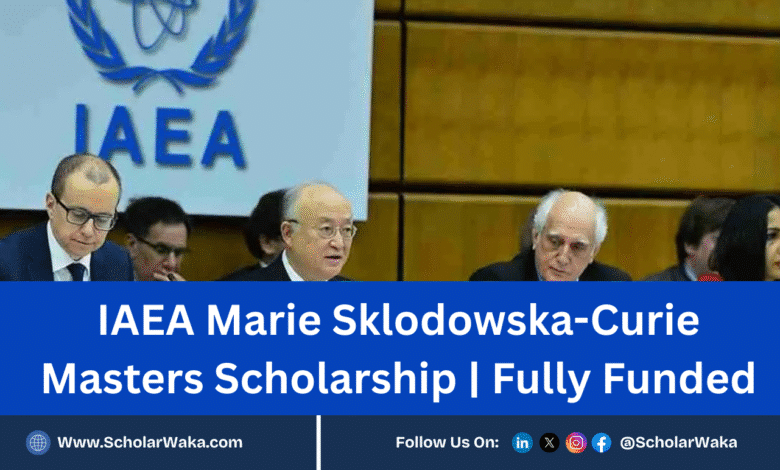
The International Atomic Energy Agency’s Marie Sklodowska-Curie Fellowship Programme funds women pursuing Master’s degrees in nuclear-related fields, offering up to €20,000 toward tuition and €20,000 toward living costs, alongside an IAEA-facilitated internship opportunity.
Also, Check Out: Top Fully Funded Master’s Scholarships in Europe
The most recent application round, which closed October 31, 2025, covered enrolment for both the 2026/2027 and 2027/2028 academic years — so if you missed this window, you’ve missed access through both of those intake years. The programme runs on an annual application cycle, historically opening in September, so the next round is likely to open within the coming weeks. This guide covers who genuinely qualifies, what the funding actually covers, and what to prepare while you wait for the next window.
Don’t Miss: Top Fully Funded Scholarships for International Students
About the IAEA Marie Sklodowska-Curie Masters Scholarship
Named after Marie Sklodowska-Curie, the pioneering physicist and two-time Nobel laureate, this fellowship exists to address a specific gap: women remain significantly underrepresented in nuclear science and technology, despite the field’s importance to areas like climate change response, energy security, and medical applications.
Also Read: How to Write a Personal Statement for Scholarship | Tips and Free Template
Since launching in 2020, the programme has grown substantially — an early cycle in 2022 awarded 150 scholarships, a subsequent cycle in 2023 reached 200, the highest number in a single cycle at that point — and has supported more than 200 women from over 90 countries by the programme’s own count as of a few years ago, with graduates going on to internships facilitated by the IAEA, PhD study, or direct entry into nuclear-sector careers.
The programme is funded through contributions from IAEA member countries, alongside intergovernmental, governmental, and private sector partners, giving it genuinely broad institutional backing rather than depending on a single funding source. Selection deliberately considers geographic, linguistic, and field-of-study diversity alongside individual merit, meaning the programme actively works to avoid concentrating awards among a narrow set of countries or subfields.
IAEA Marie Sklodowska-Curie Masters Scholarship Summary
| Scholarship Name ⇒ | Reach Oxford |
| Host Country ⇒ | Global |
| Study Level ⇒ | Masters |
| Benefits ⇒ | Up to €40,000 total (€20,000 tuition + €20,000 living costs), plus IAEA-facilitated internship |
| Funded by ⇒ | International Atomic Energy Agency, with member state and partner contributions |
| Eligible Countries ⇒ | All IAEA Member States — female applicants only |
| Application Deadline ⇒ | Most recent cycle (covering 2026/2027 and 2027/2028 academic years) closed October 31, 2025. The programme runs annually, historically opening around September, so the next round is expected soon |
What the Fellowship Provides
- Up to €20,000 toward tuition costs for your Master’s programme.
- Up to €20,000 toward living costs during your studies.
- An internship opportunity facilitated by the IAEA, lasting up to 12 months — this is a genuine professional pathway built into the fellowship, not an optional add-on, and has historically been a route many recipients have used to move directly into IAEA-connected or nuclear-sector careers.
- International exposure and networking within the nuclear science and technology field specifically, connecting recipients to a genuinely global professional community.
One important detail on funding stacking: if you already hold another scholarship, IAEA support may be adjusted to avoid duplication — for example, only covering tuition if your other scholarship already covers living costs. Be upfront about any existing funding in your application rather than letting this surface later in the process.
Who Can Apply
- You must be female — this is a gender-specific programme, created deliberately to address underrepresentation of women in the nuclear field.
- You need to be a national of an IAEA Member State — check the current member list, since this determines your baseline eligibility before anything else.
- You must already be accepted by, or enrolled in, an accredited university’s Master’s programme in a nuclear-related field — this scholarship doesn’t fund university applications themselves, only enrolment once secured.
- You need strong academic performance, with preference given to applicants achieving 75% or higher, or a GPA above 3.0 out of 4.0 — this is stated as a preference rather than an absolute cutoff, but it’s the benchmark the selection committee works from.
- Your field of study needs to fall within the programme’s supported areas, which include but aren’t limited to nuclear engineering, nuclear physics and chemistry, nuclear medicine, isotopic techniques, radiation biology, nuclear safety and security, nuclear non-proliferation, and nuclear law.

Documents to Prepare
The IAEA Marie Skłodowska-Curie Fellowship Programme (MSCFP) supports young women pursuing Master’s degrees in nuclear-related fields (such as nuclear engineering, nuclear medicine, radiation biology, nuclear safety, non-proliferation, and nuclear law). The award provides up to €20,000 per year for tuition and up to €20,000 per year for living costs (for up to two years).
All supporting materials must be submitted digitally via the official IAEA MSCFP Online Application Portal. Strict Translation Rule: Every document not originally in English must be uploaded alongside an official certified English translation. Uncertified or untranslated submissions result in immediate administrative disqualification.
1. Copy of Valid International Passport or National ID:
Specification: High-resolution digital scan of the biographical data page of your valid international passport. Alternatively, an official national ID card showing your full legal name, date of birth, photo, and nationality.
Eligibility Purpose: Verifies that you are a female applicant and a citizen of an IAEA Member State.
2. Official University Admission / Enrollment Letter:
Content: Official letter issued on university letterhead by an accredited institution confirming your acceptance or active enrollment in a Master’s program.
Mandatory Data: Must explicitly state the exact name of the degree, confirm that the field of study is nuclear-related, and state the total duration of the Master’s program (1 or 2 years).
3. Official Statement of Tuition Fees & Institutional Costs:
Requirement: An official fee breakdown invoice or invoice summary issued by your university’s bursar/financial department.
Detail: Must outline exact annual tuition charges, mandatory student administration fees, and any university-mandated lab charges in the local currency or Euros.
4. Documentation of Existing / Concurrent Scholarships (If Applicable):
Mandatory Transparency: If you hold other financial awards, government grants, or partial university tuition discounts for the same Master’s program, you must upload the official award letters.
Impact on Funding: The IAEA adjusts its award based on existing grants. Failure to declare third-party financial support constitutes grounds for fellowship cancellation and repayment demands.
5. Standardized IAEA Reference Forms (Sent Directly by Referees):
Submission Protocol: Candidates must download the official IAEA MSCFP Applicant Reference Form and send it to their chosen referees. Referees must email the completed form directly to [email protected] before the application deadline.
Quantity & Source: One academic reference is mandatory (from a university professor or thesis supervisor), while a second reference is strongly preferred (academic or professional supervisor in a nuclear/scientific setting).
- Direct Rule: References uploaded by the applicant directly onto the application portal are deemed invalid.
All documents must be submitted in English, with official translations where the originals aren’t in English. Incomplete or untranslated applications are explicitly not considered.
How to Apply — For the Next Round
- Confirm your university admission or enrolment status in a nuclear-related Master’s programme is secured before the application window opens — this scholarship funds enrolment already achieved, not a pending or speculative application.
- Check your academic performance against the programme’s preference threshold — 75% or higher, or a GPA above 3.0/4.0 — and be ready to present your transcripts clearly if you’re below this but have other strong qualifying factors.
- Begin arranging your reference letters early. Since referees submit reference templates directly to MSCFP rather than through you, give them ample notice — this step depends on someone else’s timeline, not just your own.
- Prepare official translations now for any documents not already in English, so this doesn’t become a last-minute bottleneck once the application opens.
- Watch the IAEA’s official MSCFP page for the next round to open — based on the historical pattern, this has typically happened around September.
- Complete the online MSCFP application form once it’s live, uploading all required documents.
- Confirm your referees have submitted their reference templates directly to MSCFP before the deadline — this isn’t something you can verify is complete just because you’ve submitted your own portion.
- Wait for notification by email. If selected, you’ll typically be asked to confirm acceptance of the fellowship within one week of receiving the offer, so be prepared to respond promptly.
Frequently Asked Questions
Is the IAEA Marie Sklodowska-Curie Fellowship currently accepting applications?
Not right now. The most recent cycle, covering the 2026/2027 and 2027/2028 academic years, closed October 31, 2025. The programme runs annually and has historically opened around September, so the next round is expected soon.
Can Nigerian or other African women apply?
Yes, provided your country is an IAEA Member State — this covers the vast majority of African nations. Check the current IAEA member list to confirm your specific country.
Do I need to already be admitted to a Master’s programme before applying?
Yes. This scholarship funds enrolment already secured — you need an acceptance or admission letter from your university in hand as part of your application, not a pending application.
What happens if I already have another scholarship covering part of my costs?
IAEA funding may be adjusted to avoid duplication — for example, covering only tuition if your other scholarship already covers living expenses. Disclose any existing funding directly in your application.
Does the fellowship guarantee an IAEA internship afterwards?
It provides the opportunity to pursue an internship facilitated by the IAEA, for up to 12 months — this is a genuine, built-in pathway rather than a vague promise, though it’s an opportunity to pursue rather than an automatic placement.
Disclaimer: All scholarship details, deadlines, and eligibility criteria in this post were verified from official IAEA sources as of August 2026. Information is subject to change without notice. Always confirm the latest details directly on the IAEA’s official MSCFP page before submitting your application. ScholarWaka is not affiliated with the International Atomic Energy Agency.
Official Application Portal
Join ScholarWaka Community
Get the latest scholarship updates and study abroad opportunities before anyone else.